
I'd like to start by apologizing for the long gap between the previous entry and the current, it was a busy year for me. I wouldn’t like to give the impression that these longer-form explorations – which represent a massive improvement from say the earlier threads – take an entire year to produce, or that such massive delays are necessary. Hopefully, I will be more productive with regards to these threads in 2023. I haven’t finished writing this one, but I think it is time to get started anyway. I am not going to shorten any aspect of it, so please bear with me.
Here we will review some of the events of the Iraq war. I chose the word ‘review’ because I don’t want to paint such a basic examination of the facts of the war, which were exposed even throughout the mainstream coverage of the war, as anything particularly revelatory.
But I do think there is much of value in examining even the basics of this subject. I cannot speak for others, but for me this is something I've never felt like I properly understood and hopefully by the end here we will be further along on the path of understanding.
There are a handful of prerequisite subjects that must be addressed before the war itself, first of all being a basic mechanical framework for analyzing the relationship between the coalition forces and ‘Al Qaeda’.
The central fact that this framework will be built around is still in my opinion one of the most underexplored premises of the entire 21st century – in terms of writing available in the English language – which is that Al Qaeda is a tool fabricated and controlled wholesale by the West, operating in complete coordination with Western interests.
The proof for this is extremely simple, that in 9/11 the towers were brought down by controlled demolition yet the attack was announced several weeks earlier by Osama Bin Laden -
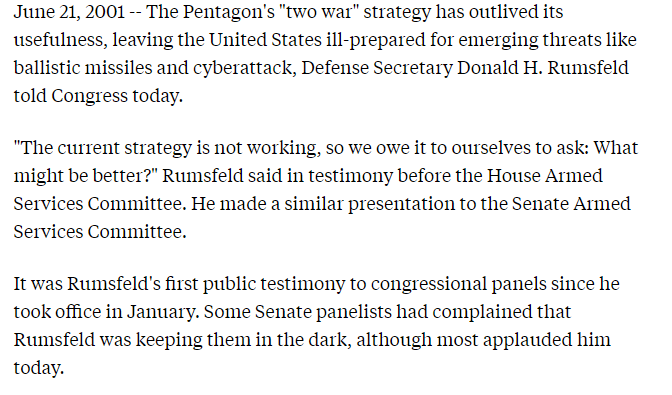
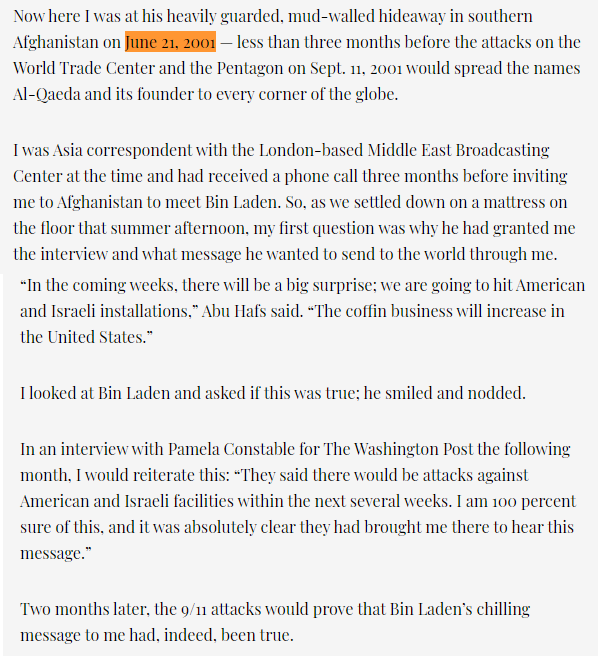
The anthrax attacks and their “connection” to Al Qaeda and the hijackers further solidify this, and there is at least a basic book outlining this called ‘The Anthrax Deception’, and of course this is an absolute minimum of the available evidence, but I think it is perhaps the simplest and least deniable proof of the nature of the relationship.
An immediate conclusion then, is that any combat operation purported to be conducted against Al Qaeda was in fact conducted for another purpose.
Likewise, the reverse is true - any operation supposedly conducted against American or Western interests was also in fact conducted for another purpose.
This also necessarily establishes communication between AQ ‘leadership’ and the United States – otherwise it would be impossible for Osama Bin Laden to warn of 9/11 in late August and for the US operators to conduct the plane show and controlled demolition in early September. To be behind on this is to be behind on everything.
But even though the premise itself is obvious to many, I have not come across even a surface-level cohesive reanalysis of the Iraq war with this in mind. So, let's review:
Using these premises as a starting point, we can begin to formulate a framework for the events of the Iraq war with regards to the role played by Al Qaeda and the coalition forces and the interactions between them. For the relationship between Al Qaeda and the coalition forces to function, there are three significant categories of actor within either of the twin ‘antagonistic’ organizations:
1: People who are aware of the relationship between the two organizations and are in direct communication with members of the other organization
2: People who are aware of the relationship but are not in direct communication
3: People who are unaware of the relationship between the two organizations
This refers to actors on the ground, physically present in Iraq and active during the war.
Presumably actors who are in categories 1 and 2 would be unwilling to engage in any genuine combat situations against each other where there might be the possibility of injury or death. But if category 3 actors do exist, it is possible these actors may have been set up to engage against each other in some kind of combat for the sake of show or for some other purpose. Category 3 could contain both lower level direct members, but also could consist of independent actors who are for various reasons temporarily allying with one or the other organization. It is possible that category 3 could engage with other category 3 actors, or category 2 actors who have a significant enough advantage that they do not feel significant risk of injury or death by engaging. But it is unlikely that a category 1 actor would engage vs a category 3 because category 1 would be the most insulated and most valuable group of actors.
Generally speaking I think there is a tendency to overstate the number of category 3 actors across the board, to remove the intention from the action, and we will demonstrate that this tendency is incorrect and even absurd. It is not enough to say that the actions of Al Qaeda in Iraq were merely convenient for the coalition forces – they were part of one single two-pronged war fought against the nation of Iraq. We will get into the specific actions, tactics, strategy, goals, and narratives to this end but first let's continue to develop a basic framework of the relationship itself so that when we get there we have something concrete to evaluate these things against.
As for these three categories of actors from both groups, let’s consider what their composition might be and how we might try to classify actors as being part of one or the other based on information available to us.
(Also, a note before continuing: none of this is to say that there were not attacks attributed to Al Qaeda but that were in fact conducted by coalition forces proper – I think this is probably the default mode of operation.
But I think another erroneous tendency is possible: to swing the pendulum the other way and underestimate the existence or size of Al Qaeda as an organization, ‘it was all the coalition’, and I find this unrealistic because it seems unlikely that coalition troops could blend in sufficiently to be fully operational at a local level.
Similarly it must be said up front that many ‘suicide’ bombings are classified as such on dubious authority and rather I believe these were simply bombings with materials planted ahead of time either by coalition forces or Al Qaeda members or collaborators of another category.)
Let’s begin by estimating the composition of category 1, the category of direct communication between the two groups.
Obviously we can put ranking military officers from the coalition, particularly from the United States, into this category without hesitation.
The entire war on Iraq was fought on this pincer principle of ‘false’ antagonistic entities, it is unrealistic that any significant commander was out of this loop because the war effort depended and even hinged on tight coordination between the groups.
Whether or not the planning was done under one roof, the coalition planners and the Al Qaeda planners must have been frequently in contact and with a short feedback loop between the two entities. While both entities may have maintained separate headquarters, maybe or maybe not, the bulk of contact likely occurred on coalition military bases or property – this is because it is hard for coalition commanders to travel freely or blend in or meet secretly or safely, and because the inconvenience of communicating only by messenger or even signal seems to outweigh any security concerns of meeting directly on base or other property. Secure signal communication was certainly possible, but imagine planning a complex war over the equivalent of Zoom in 2004.
Rather I think it is more likely these actors were shuttled to and from properties in “contractor” vehicles or (if necessary) uniforms, or Iraqi police or military vehicles and uniforms, etc.
As for where this planning occurred, other than bases I think that so-called “prisons” probably formed the majority of coalition-maintained central headquarters for Al Qaeda.
The same logic that belies the authenticity of combat operations belies the authenticity of prisons with regards to these specific prisoners. These prisons were secure facilities owned and operated by the coalition, with many people and vehicles coming in and out, strategically located near centers of operation, and particularly in the early years of the invasion there was limited access by the Iraqi government forces.
Avoiding the pendulum swing: no doubt just as there was a legitimate resistance that the doppelganger resistance sought to supplant, there were genuine prisoners captured and detained by the coalition that were probably held in the same facilities. But my speculation would be that these prisons were segregated and that there were regions within them that actually were used as a proper HQ for Al Qaeda.
These prisons and possible headquarter locations include Camp Bucca in the southeast, Abu Ghraib (until ~2006) Camp Cropper and Camp Taji near Baghdad in the center, and Camp Suse in the North. Very roughly speaking these are the most operative regions of the war -
And keep in mind this is all just a reflection of what I've gleaned from a very short period of research combined with my personal insight. I don’t have the ability to understand the nuances of the various political forces of Iraq, and I'm not painting myself as a geopolitical explainer.
But I think that this subject is worth studying even by people like me who do not have a genuine connection to the region, so I hope that my analysis is respectful and useful and that I don’t overstep any boundaries. If I make mistakes, please forgive me.
Now that we have broached the subject of these facilities, a cursory examination of geography and population distribution of Iraq is probably necessary before going further:
The two famous rivers cut from the Northwest to the Southeast of the country. Generally speaking the largest cities follow along the course of the rivers, and the areas between and North/East of the rivers are more populated whereas South and West of the rivers are much sparser. Here is a map with many of the major cities labeled:
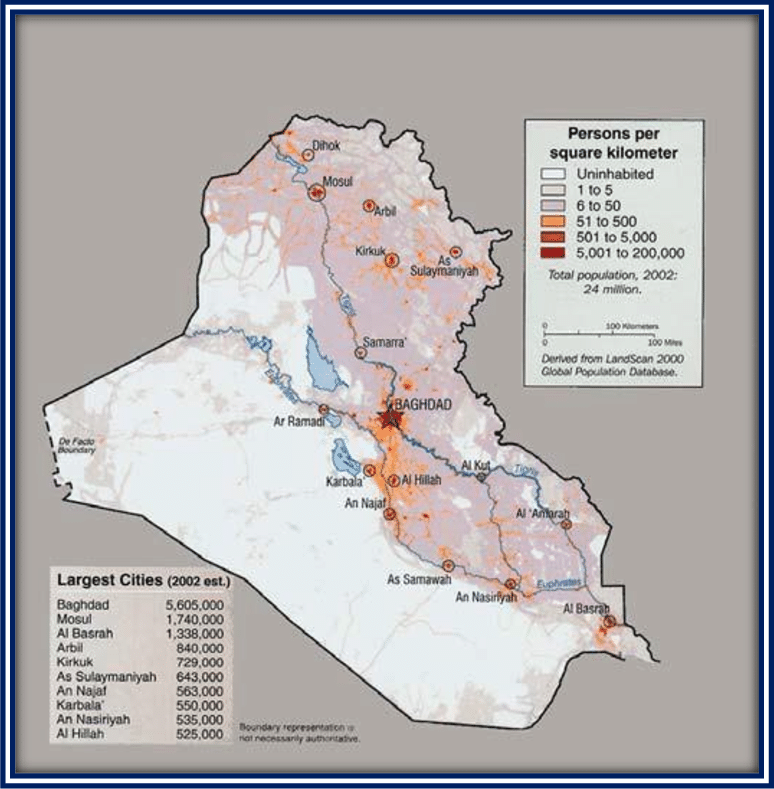
Following the rivers South and East of Baghdad are the cities of Karbala, Hillah, Najaf, Nasiriyah, Amarah, and Basrah for example. And near the very bottom of this region was Camp Bucca.
Again very roughly speaking this was an area with less open "Al Qaeda activity” – Al Qaeda by and large was constructed as a doppelganger for resistance in the predominately Sunni areas of Iraq, and for various reasons I think there were limits on how open the activity could be in this region. For one, this region is considerably denser in terms of population than the regions where Al Qaeda had an open and persistent presence. For another, this is an area with more Shia and so the narrative construction doesn’t really work.
Whatever the reasons may be, and I hesitate to speculate too much due to my lack of social familiarity, I don’t think the invaders were able to achieve the same degree of societal destruction as they did elsewhere in the country.
Then there is Baghdad roughly in the center, if we follow the rivers back up North. Baghdad is a distinct theater of the war in terms of the operations of the invader – it does not fold per se into a broader regional strategy, but rather it seems that it was treated as a standalone center of interest due to the size and complexity of the city. Near Baghdad again were Abu Ghraib (until its abandonment in 2006), Camp Cropper, and Camp Taji. Now, a note on the abandonment of Abu Ghraib -
https://twitter.com/2youngBadazz/status/1420387348597018629
“Abandoned” infrastructure is a subject that has come up before, and so this is a can of worms that I'd prefer not to focus on at the moment but needless to say the Abu Ghraib “scandal” was a typical intentional “leak” and so the closure of the prison and the shifting of the inmate population were obviously planned as well. I am not sure why they would need to re-purpose this facility or what use a “dark” facility would offer that existing or “light” facilities wouldn't, but I also do not think the building truly sat idle until 2009. A loose end for another time.
To the West of Baghdad is the province of Anbar, the supposed ‘stronghold’ of Al Qaeda – the province’s two largest cities are Fallujah, and then Ramadi, both somewhat near to Baghdad. And then additional smaller cities, with the Euphrates as a focal point. For perspective, both of these cities are below the top ten in terms of population.
It may also be correct to include certain cities slightly North of Baghdad – Samarra and Tikrit for example – as part of this general operational region of the occupation.
The region farther North along the Tigris includes major cities like Mosul, Kirkuk, and Irbil. This region is where Camp Suse was located, for reference, and contains the Kurdish region of Iraq. generally speaking, I think this also constitutes a distinct operational theater for the occupation with its own “tempo” etc.
All of this will be given context and explored further later, when we examine the timeline and the news coverage of the occupation.
But returning to the basic framework of operation -
We had discussed using the term “category 1” to refer to knowing actors who have direct communication with the counterpart “antagonistic” organization, “category 2” for knowing actors who do not have direct communication with the counterpart, and “category 3” for unknowing actors.
And we were discussing who category 1 actors might be and how they might operate. As for the composition of this category on the Al Qaeda side, a probable floor for this category would be spokesfigures. At minimum a spokesfigure would be in category 2, in other words the idea that unknowing dupes could possibly exist in public-facing positions is stupid and I won’t indulge it here.
That kind of ‘it just happened to work’, or ‘manipulation of unknowing actors’ talk is senseless nonsense or deliberate poison and hopefully this thread will be able to bury some of this thinking and leave anyone clinging to it for ulterior motives exposed.
However, rather than spokesfigures or media-facing operatives I think that the bulk of this first category, those who are in direct coordination with coalition forces, consisted of operatives trained by (groups like) United States special forces or that are part of regional special forces type outfits from countries allied with the coalition.
The leadership of this category, and thus the leadership of the organization in general, presumably were cut out from one or more groups that had many years if not decades of experience either officially in a regional special forces outfit or working directly with US or other imperialist countries’ special forces groups. For a comparison from another region, think GAFE or the Zetas. It need not be that these groups trained with United States Special Forces proper, it could be Marines, Navy, a dark group, etc or equivalent from other allied countries. Almost certainly this would be a necessary filter for the leadership of this organization. This is in my opinion inherently logical but it is also established with the precedent of the Zeta cartel and the GAFE, as well as testimony from former Zetas.
As for category 2, for the upper and some of the middle ranking members I think there would be a similar background as category 1 with regards to proven experience in ‘special force’ type groups. I think that this category would be much wider than people might think, forming the bulk of AQ operatives as well as possibly the bulk of forward-facing coalition forces and we will validate this later with practical examination.
On the coalition side this could include almost anyone from any unit that played a significant role in the war – such as the 101st airborne, etc etc. On the Al Qaeda side I would think a similar principle would apply, that any significant unit of the armed forces of regional allies could be a recruiting pool – meaning that while Al Qaeda is posed as an ‘unconventional’ group, I think it may actually consist of army regulars who are direct detachments from allies in the region.
I think this re-framing could be useful, that for example the Iraq war was not fought with ‘random volunteer’ dupes from non-military channels but rather that so-called Al Qaeda detachments were simply – for example – cut out from various gulf countries’ armed forces.
As for the lower ranking members of this category (2, knowing but no direct contact), I think it would likely open up to include members of various private security organizations (either regional or from the coalition nations) even if they did not have the same level of ‘official’ experience as the middle and higher ranking members of this category.
As for category 3, on either side they can probably best be identified by having been killed in the ‘combat’ between the two organizations or perhaps more rarely by conducting actions that are noticeably in alignment with the alleged ideology or goals, as opposed to the genuine ideology or goals, of the organization they are part of. The pool could be really anyone in the coalition forces or Al Qaeda, but the question then is what purpose does this category serve and what role does it play in broader actions by either organization.
This is useful to examine not because it would absolve any blame from category 3 coalition actors but rather it helps us to try to suss out the organizational and command structure of the broader operation – it helps us to know if this or that unit or actor is is one or the other category.
Whereas with Al Qaeda, being that the recruit pool for this category is probably largely locals it is a question that is somewhat more sympathetic depending on the specific operation in question – any forceful action taken against the invaders is noble and brave. That being said, for operations that genuinely are in line with Iraqi interests it is probably more often the case that they were conducted by the genuine resistance and then falsely attributed to Al Qaeda by the media, and this is one of the major functions of the entire fiction of Al Qaeda.
Leaving out analysis of the actual physical role it plays on behalf of the invaders, from a narrative perspective this fiction performs a “cross up” function – it commits atrocities which are attributed to the genuine resistance and it absorbs the heroic actions of genuine resistance in the media to try to minify perception of this resistance and its success and strength to outsiders.
As for judging actions from individuals in either organization, for Al Qaeda they may be judged on the spectrum of whether they are social or antisocial from the perspective of the society of Iraq:
How useful they are for the invaders and against Iraqi society, vs how useful they are against the invaders and for Iraqi society.
For example, to attack a masjid or a marketplace is an action always useful to the invaders, belying the ostensible ideology of being against the invaders and for Iraqi society. Whereas to attack coalition members or their resources directly is an action that – if we wave aside deeper motivations, just for a moment – is on its face an action against the interests of the invaders. Though some of these actions may be committed by genuine resistance, some attacks on coalition resources may be done by “the coalition” itself.
Understanding this nuance is key to understanding the Iraq war, and failing to be capable of understanding nuance like this means that modern warfare as a whole will be totally incomprehensible.
So, in certain cases, these may sometimes represent actions taken by a category 3 actor. We will revisit deeper motivations later in an assessment of broader goals, strategies, and tactics. For the coalition forces, it is a given that their actions are antisocial and rather the spectrum to evaluate their actions actions against is whether or not these actions are meaningfully against Al Qaeda the organization or not, whether they are compatible with an anti-Al Qaeda orientation.
In actuality, many actions that are represented as being ‘anti Al Qaeda’ were actions taken against Iraqi society – so we should scrutinize very closely any action represented as such, whereas any action resulting in say the death of an invader or destruction of invader property can be seen at least superficially as a net good and it is hard to ‘misrepresent’ this action in isolation as being antisocial. This is a fundamental dis-symmetry to keep in mind between the two organizations, though they are working as ‘twins’ this doesn’t mean that they are symmetrical in nature. At any rate, these criteria can be used to identify and differentiate actors as being part of the category 2 or category 3 of actors.
Secondly -
To understand the war in Iraq as a component of the “global war on terror”, we must understand the historical material being alluded to by the war on terror, what is being referenced by the war on terror and what that says about the war on terror itself. This will be explored in the next chapter.