V. Late 2003 into Early 2004.
Let’s examine the changing character of the war over the course of 2003 into early 2004. This is where coverage of the war at large will really begin.
We can use April as a rough starting point –
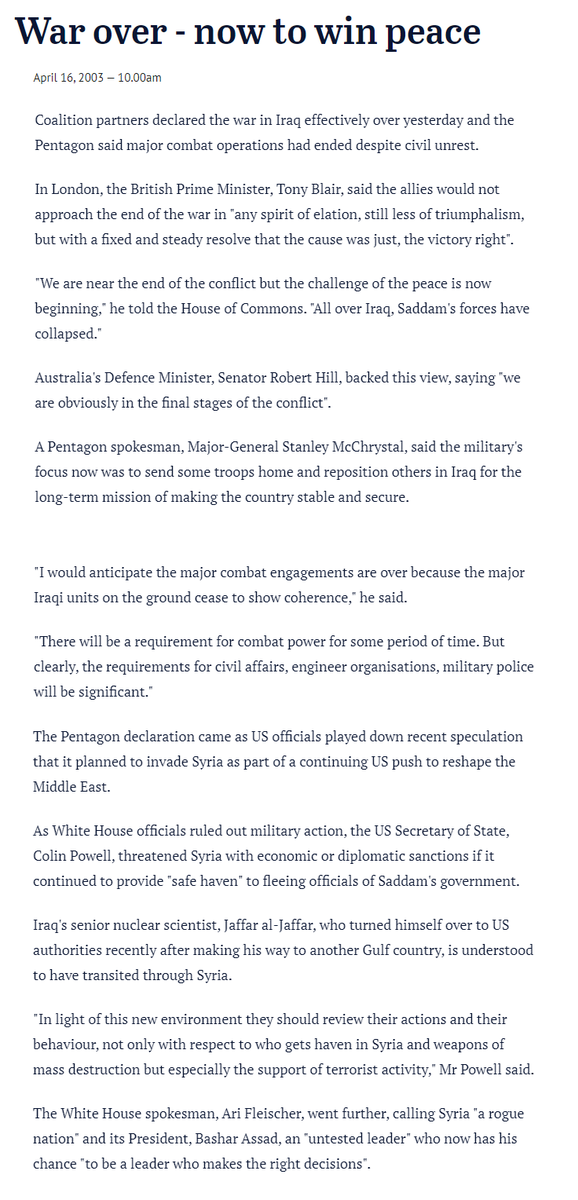
April of 2003 marks the declaration that the invaders have ‘triumphed’ over the previous government of Iraq. We are not forced to swallow this claim wholesale, but the nuance is out of scope here.
What is significant is that this marker represents a point in time, roughly speaking, where the previous societal defense mechanism against outsiders – at any rate its backbone, the military – had been eliminated.
This meant that the coalition could entrench and begin its longer-term war against Iraqi society.
Immediately after neutralizing the military, or at least significantly disrupting its ability to defend against the coalition, the coalition began destroying policing capability. This will be a theme throughout the war and one we will examine continuously, but in the early second phase of the war this consisted of looting and dismantling police stations –
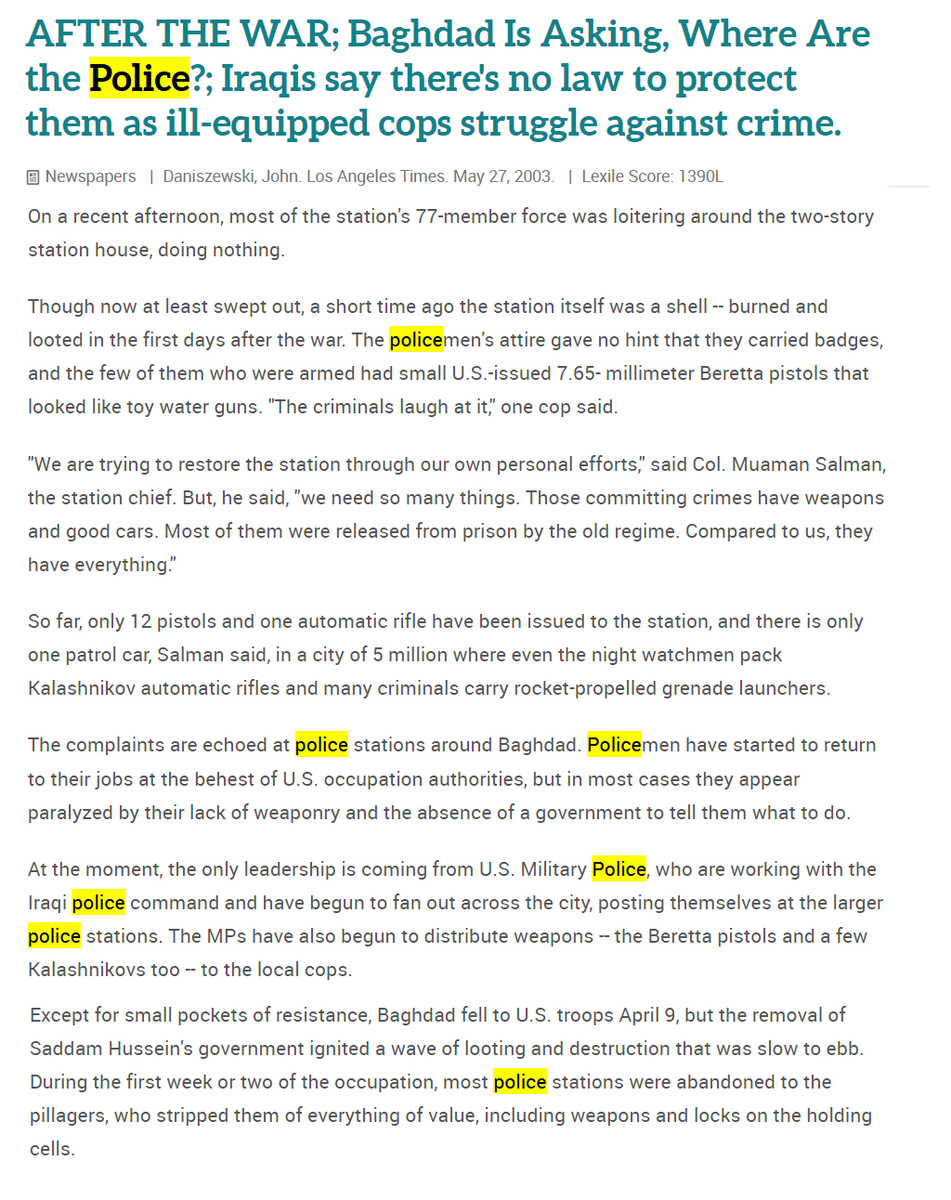
From the last paragraph – most police stations were ‘abandoned’ to the ‘pillagers’, who stripped them of weapons and locks etc.
The ‘looting’ discussed here and in many other stories focusing on Baghdad in the early aftermath of April, May, June and so on in 2003 is a cover for the broader actions of this second phase. The coalition and their agents – the force that makes up ‘AQ’, discussed earlier, likely foreign troops trained by Western special operatives – looted the entire city, broadly speaking, to maximize the damage and exacerbate the situation of its people and also to provide a pretext for coalition presence.
This looting included a disarmament effort of the ‘second line’ of societal defense, police stations and the police apparatus.
The second paragraph describes that the police station was not only looted but also ‘burned’, which is not really an understandable action for Iraqis to take unless you believe wholesale the ‘organized criminal elements with RPGs’ narrative. Over time this premise will be completely unraveled just as were the premises of the previously mentioned assassinations of Hakim and Khoei. After years and years of exhausting attacks against the police, it is undeniable that this is a coalition initiative.
The cover given here – following the same pattern as in those two cases – is that these actions are ‘exceptional’, being that they are a part of ‘looting’, an action temporally scoped to the early aftermath of the invasion and dismantling of the previous government. But these exact same actions continue to take place as time goes on, so this narrative falls apart.
With Hakim and Khoei, these actions were presented first as ‘former regime elements’, also as ‘Sadr’, but over time this narrative is dropped and blends seamlessly into a general narrative of ‘Al Qaeda’.
These initial attacks against police infrastructure were also presented as temporally exceptional, ‘looting’, etc, but the attacks against police infrastructure will continue for years and blend seamlessly into the general narrative of ‘Al Qaeda’-attacks against police infrastructure.
This theme of disarmament, mentioned in the earlier paragraphs of the image, in the face of a simultaneous ‘attack’ by AQ/criminal elements/whatever specter conjured by the invaders will also continue to be established to such a degree that you have to deny the entire pattern outright to deny that these actions are a coalition initiative. This is the ‘two pronged strategy’ of coalition ‘vs’ false insurgency that is a pillar of the entire war.
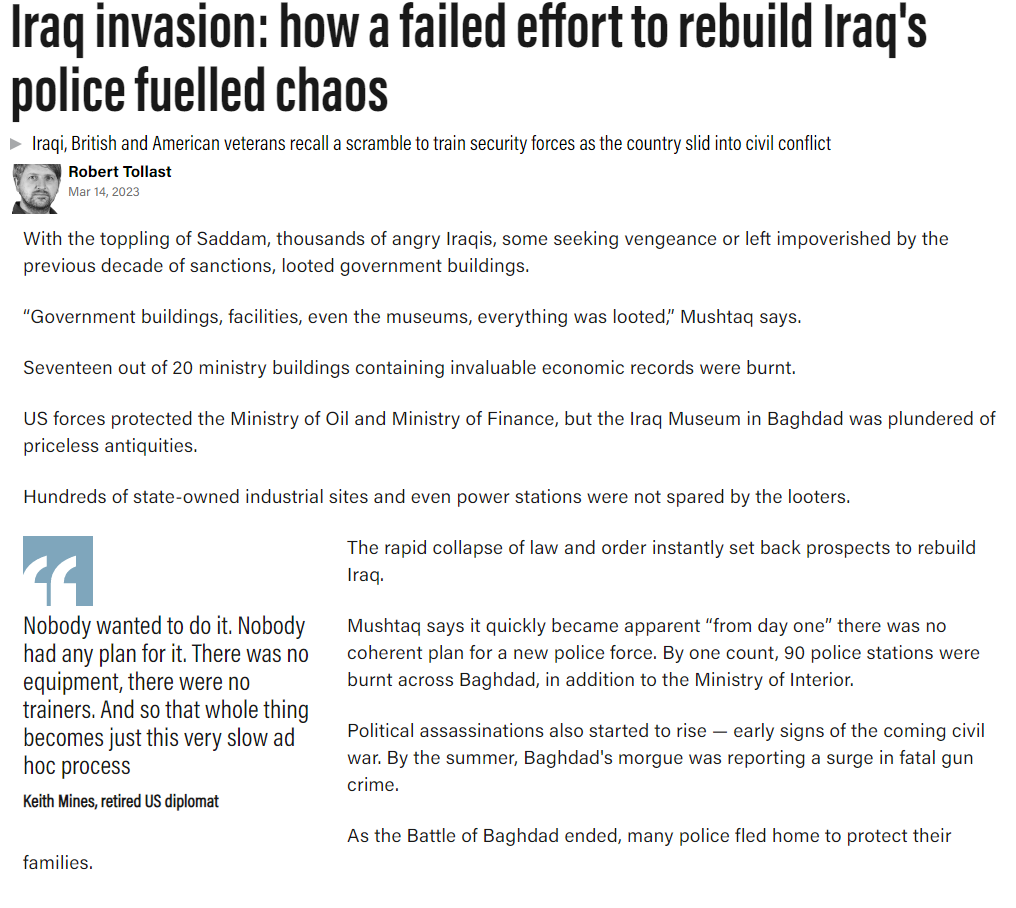
This is a much later article – in fact written in March of 2023 – but it describes the scale of police station burning with a level of precision that I did not find in the contemporary coverage of the immediate aftermath of the initial ‘invasion’.
The figure given here is that 90 police stations were burnt across Baghdad as well as the ministry of interior and an additional ‘17 out of 20 ministry buildings’. Also hundreds of state owned industrial sites, also power stations, also museums and libraries.
This is the immediate second phase of the war on Iraq. By summer the morgue was reporting a ‘surge in fatal gun crime’. None of this is simply ‘organic violence’ in a ‘power vacuum’ – these words are just invader talk.
Now – this article embraces the false narrative of a ‘civil conflict’, ‘civil war’. This is also invader talk, there was no civil war, and we will expose this premise over time.
This is a later and upcoming phase of the war, and although some of the attacks and general violence against society in this early phase resemble it, it is not really the same in character.
I think the best way to characterize this phase is that it is the dismantlement of the secondary lines of defense of society – the police, the non-military governmental apparatuses, etc – as well as an initial blow against the stored-up resources of society: infrastructure and industrial plants, historical heritage in the form of objects, attacks against small and medium businesses, random violence against families, etc.
This article also mentions ‘political assassinations’ – we have covered two so far. The assassinations of Khoei and Hakim were part of this ‘immediate aftermath’, the second phase being described here.
I covered them first because I thought that would be a better way to structure things, but remember that they occurred in April and August of this year, 2003, and so they belong in the phase that we are covering now.
As mentioned, the Baghdad library was also ‘looted’, burned –
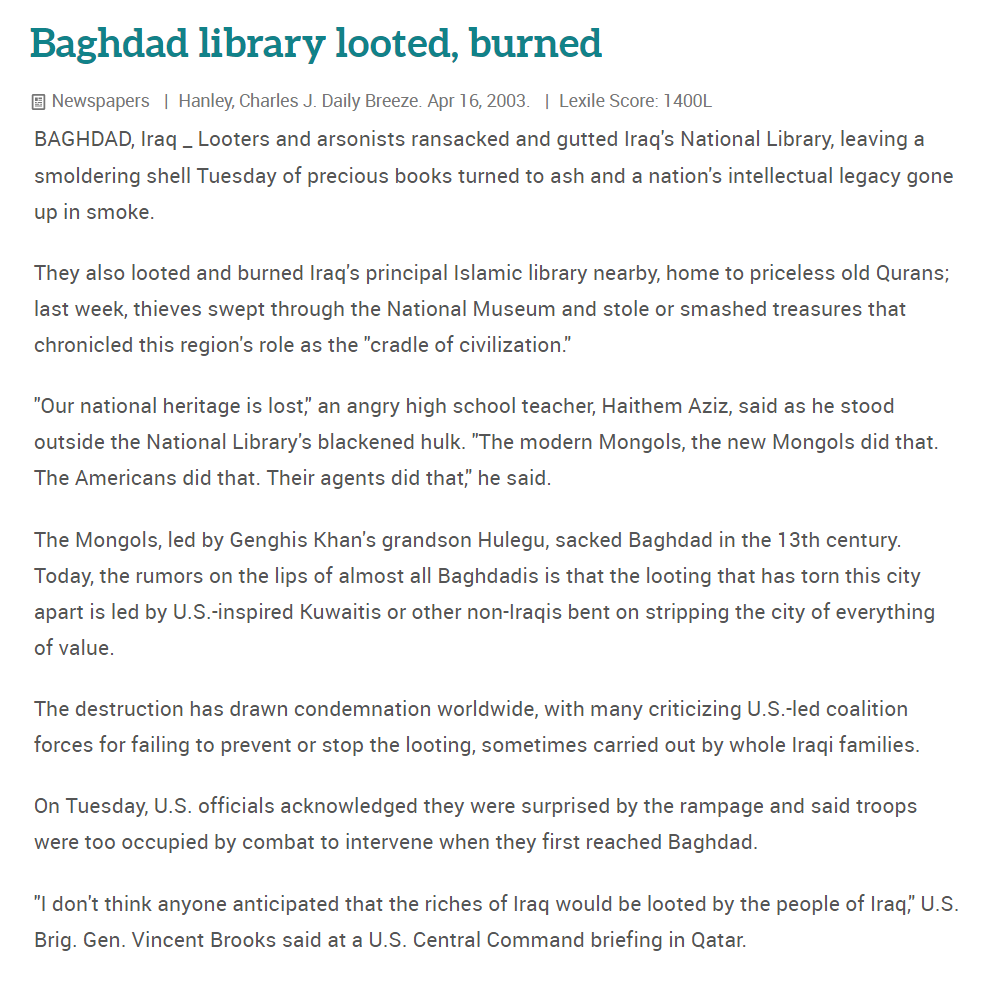
This article asserts that thieves ‘stole or *smashed*’ treasures, why would thieves smash treasures? Even this article does not attempt to deny that Baghdadis correctly accuse US-inspired non-Iraqis as being the ‘looters’, stripping the city of ‘everything of value’. If you believe the coalition narrative you disbelieve the narrative of Iraqis even insofar as their views are covered by English-language press.
I don’t want to dignify the smug smirking and winking ending quote with any time other than to illustrate that they periodically insert these things into their coverage, just as they did in the coverage of Khoei and Hakim.
Here the reason behind the ‘looting’ is laid bare –
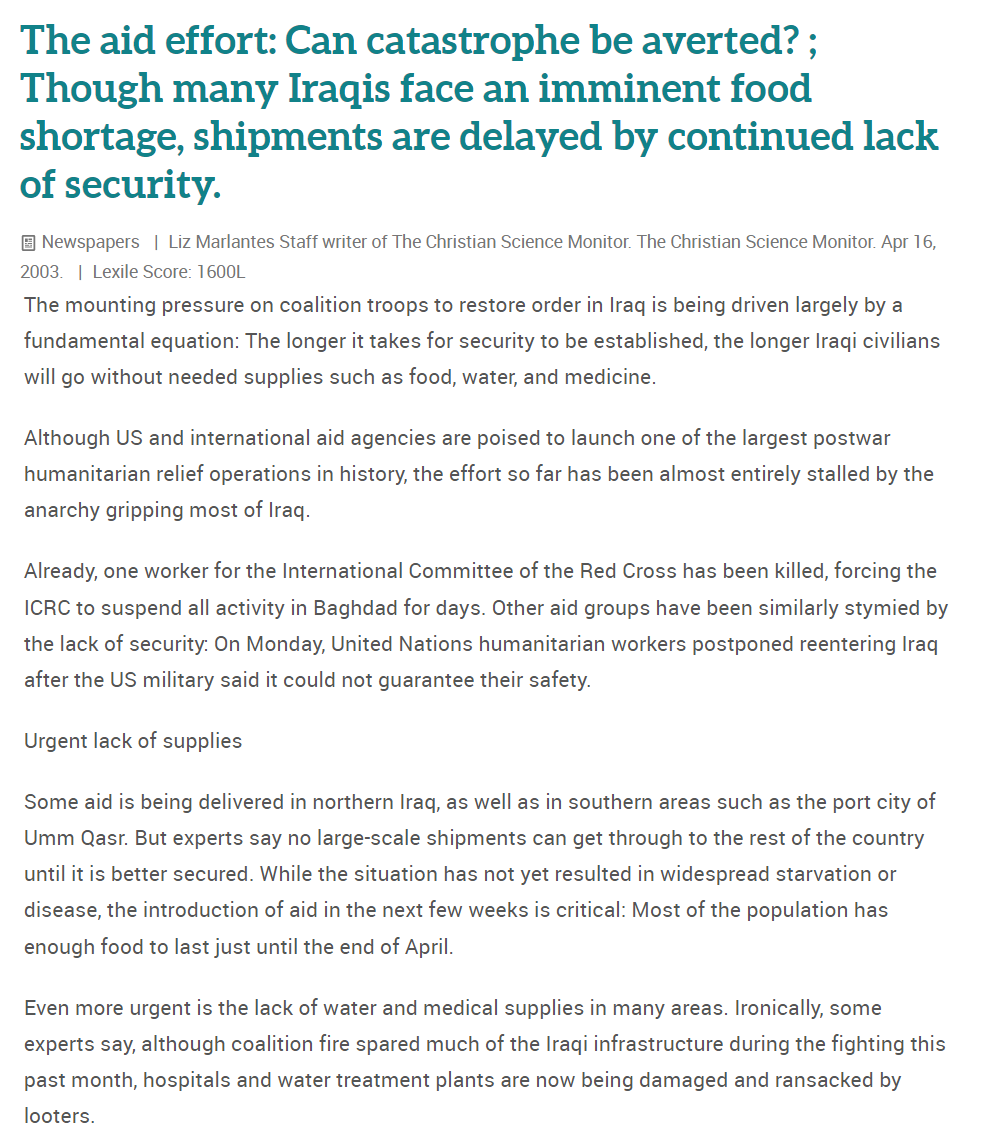
The ‘looting’ is simply an attack on the population, done in the absence of the primary defense mechanism and secondary defense mechanism.
Aid agencies were ‘poised’ to launch ‘one of the largest humanitarian relief operations in history’ – and what does this mean? This means that funds were earmarked, taken for this effort. But when you know that the effort is impossible, you don’t actually need to buy the goods. You simply transfer the amount earmarked for the effort, knowing that you have an excuse not to deliver.
This is a common con, hardly ‘advanced’ enough to note, but worth understanding. This is the same sort of thing as ‘hackers stealing Covid unemployment relief money’, or ‘spoiled Covid tests’ –
In such cases it can be presumed that there were never Covid tests to begin with, it was known they would be revealed to be ‘spoiled’ and therefore there was no need to actually manufacture or even pretend to manufacture such tests.
Also mentioned is that ‘already one worker for the ICRC has been killed’ – this is on April 16th 2003, just after the initial ‘triumph’.
A note also, this is something we will return to later –
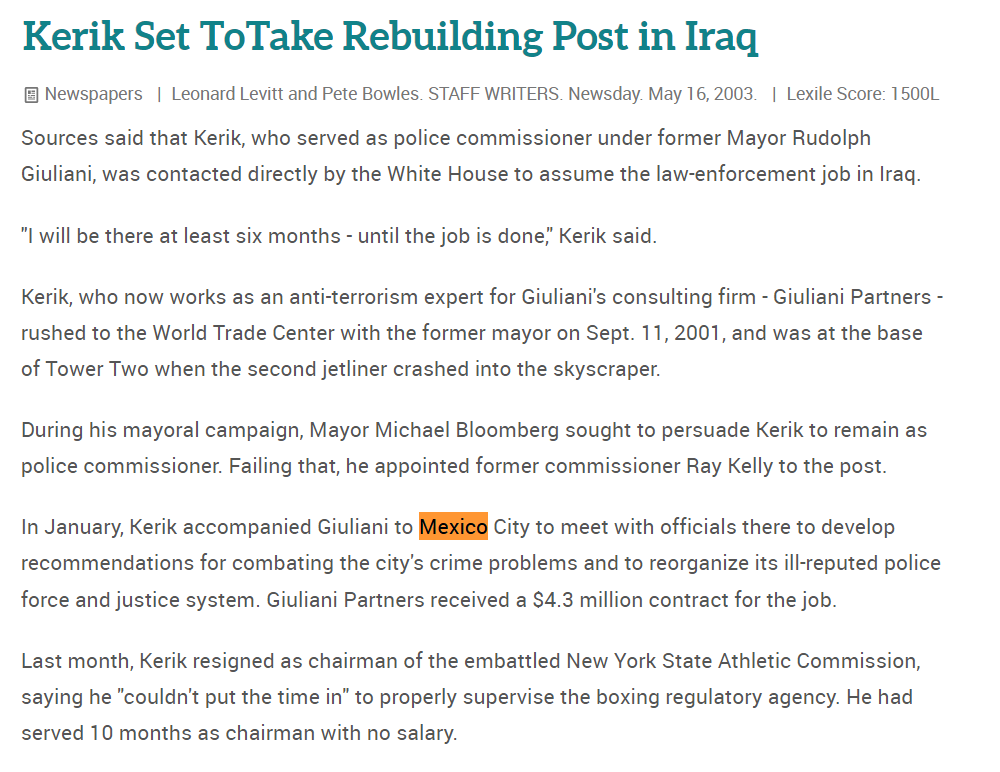
Note that the NYPD police commissioner hired to be the top ‘law-enforcement’ figure in Iraq had a history of working on ‘policing efforts’ in Mexico City. There is a connection between the war on Iraq and simultaneous happenings in Mexico that will be illustrated as the war progresses. For now just make the note.
Here, by the way, I don’t mean to imply these public figureheads actually do meaningful work, I don’t think they do, I think these names are probably fictional and the figures fictional. But the connection is being drawn. The actions undertaken both in Iraq and Mexico are what illustrate the connection, the pattern that we will observe, not such announcements, but this is a symbolic nod by the invaders.
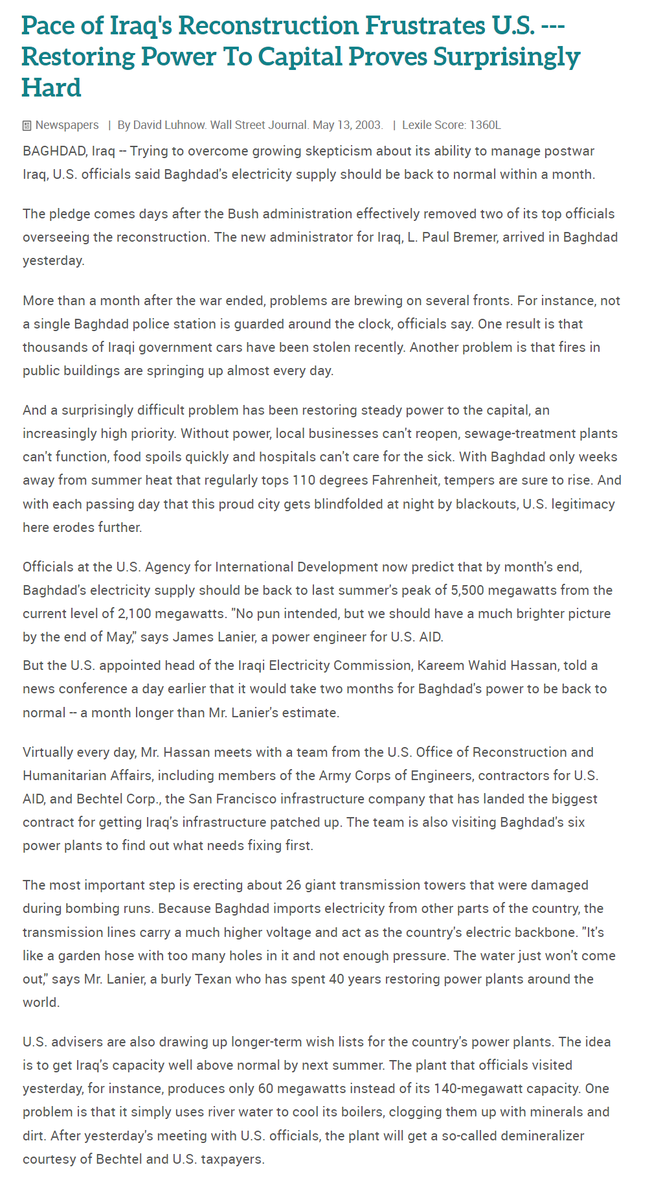
This is just more details about this phase of the war, and due to time limitations all of what I am presenting so far is focused on Baghdad. I just don’t have time to go further. But this is the same basic con as before, and it is a timeless one, that plants were destroyed in the war to provide a pretext for contracts and orders for things like “demineralizers” and infrastructural work by firms like Bechtel.
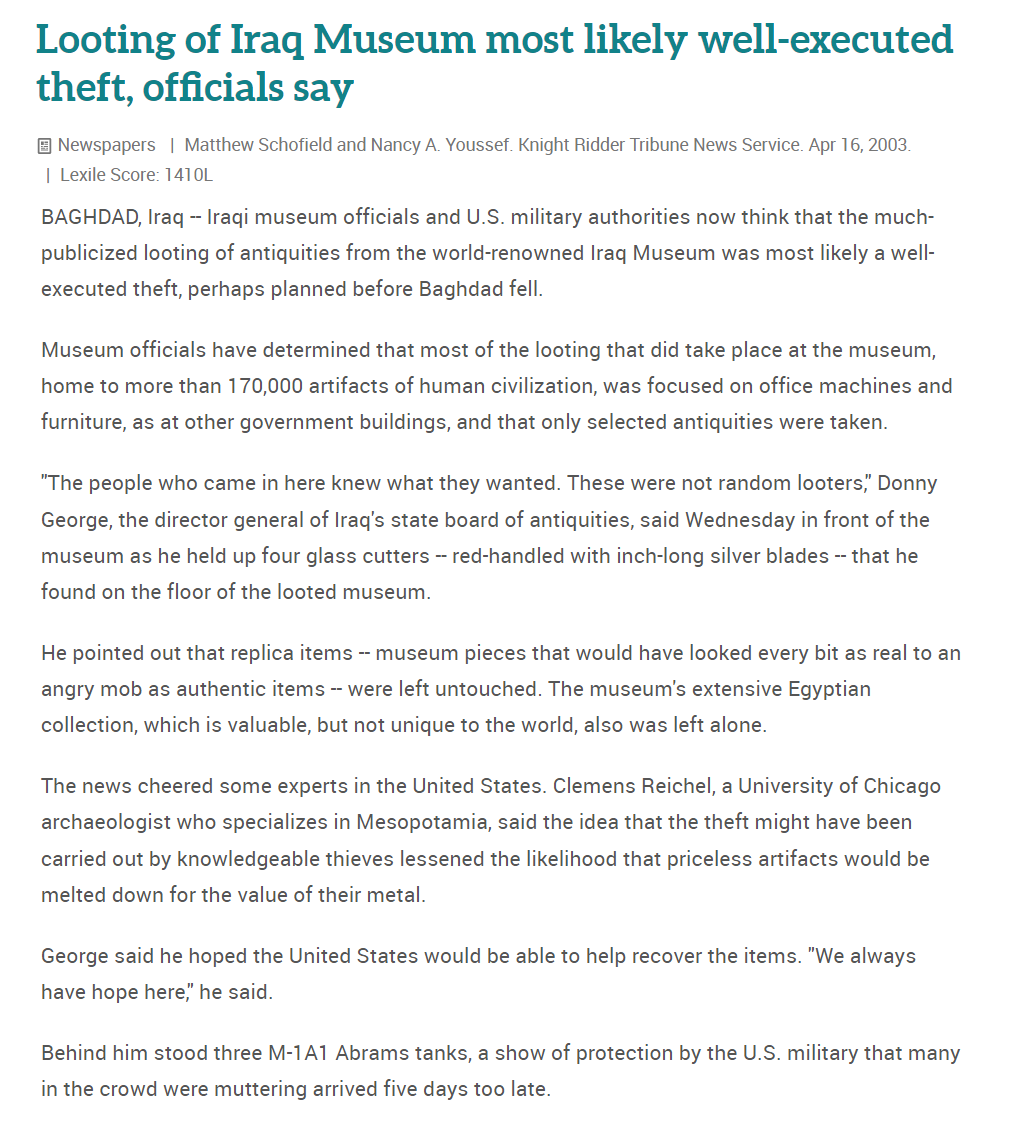
This really deserves greater development but this isn't the kind of work. The dimension of the war that is a war against the societal heritage of Iraq specifically is one that will continue to be observed and developed throughout the course of this thread.
Regarding ‘political assassinations’ –
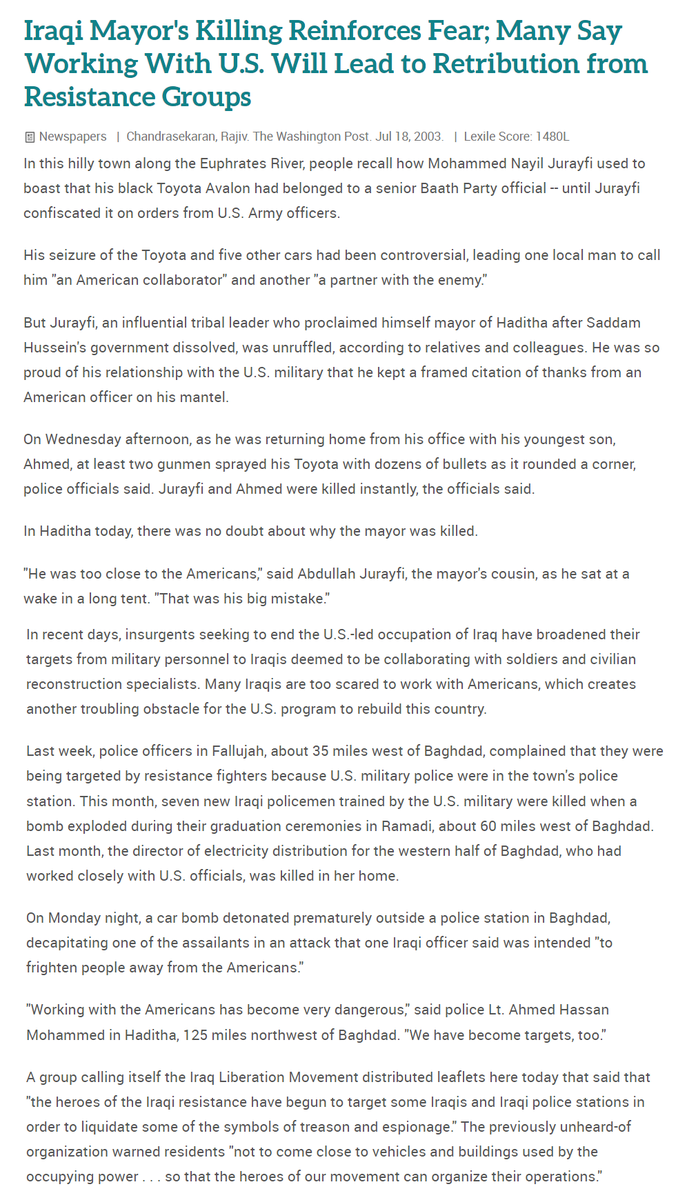
Here we have another instance of the ‘attacking allies’ theme. The mayor of Haditha is being claimed here to be a ‘proud’ US ally, a collaborator, someone working directly with the invasion.
Now, the very first paragraph is itself an instance of the ‘intentional contradiction or error’ meta-theme of coverage – Jurayfi used to brag that his Toyota Avalon belonged to senior Baath party officials – until he confiscated it on orders from the Americans.
What is the intended reading here? If he seized it on orders from the Americans, this would occur temporally before the bragging. Its framed as first: bragging, second: seizure. This is mind-eroding text. Its impossible to make it make sense.
There will be more of this actually as the article progresses, but at any rate, this is a supposed ‘ally’. And I don’t take their word for it but it is possible he was a genuine ally.
Side-bar, this is I think a good point to address explicitly the question of:
What about the possibility that the elimination of genuine coalition allies could be done by a genuine *resistance*?
As I phrased it earlier, one of the ‘big tricks’ of the Iraq war is to use a ‘false resistance’ to “commit atrocities which are attributed to the genuine resistance and absorb the heroic actions of genuine resistance in the media. To try to minify perception of this resistance and its success and strength to outsiders.” But this is a somewhat limited framing for obvious reasons, it views this gambit through the lens of ‘the perception of Western news audience’. And as I said earlier, how important is this audience really? Not that important.
So, what about the atrocities – what is their primary purpose? At a most significant estimation, smearing the resistance would be a secondary or tertiary outcome of any AQ/etc action.
This will all be explored, this is just a disclaimer so that I do not give the wrong impression to readers that Western perception is driving decisions but rather the reason we explore and examine it is because it is one of the things we are best equipped to do.
But it is not the driver of strategy or the shape of the actions taken by the invaders.
Back to the question at hand: what about the possibility that the elimination of genuine coalition allies could be done by a genuine *resistance*?
Is it not possible that a genuine resistance would eliminate certain collaborators working with the invaders? Yes, of course this is possible. Lets explore possible motivations and disincentives for a resistance to do this.
By going through this logic here and early, we will not have to do this every single time I ascribe an action to the invaders.
I think the most obvious motivation to eliminate a collaborator would be that the collaborator poses an active threat to such a resistance.
Either that they are a spy embedded in the resistance, or a genuine organizer of anti-resistance activity, or providing crucial assistance to the invaders that would be affected by their elimination.
I tend to think that this does not apply much if at all to these ‘political’ targets like the mayor of a town etc and particularly at this early stage.
Keep in mind also we’ve already seen those touted as allies by the Western press be admitted to be much less than clear-cut allies if not outright adversaries, but certainly not appearing to be any sort of active threat level to a resistance organization.
Things we cannot know include actions such as passing lists of names to the coalition – not ‘embedded spy’ work as such, but an active intelligence threat. This is certainly possible and in the scope of actions that could produce motivation for elimination by a genuine resistance.
But with all of this being said, I don’t really think especially in this early stage of things that there was per se even an organized and formalized resistance that could be threatened by this mayor. What would he do – give the names of every anti-American Iraqi in Haditha? I mean, lol.
So what could even be the motivation in this case, what threat could the mayor of Haditha present, and to who? I personally do not believe this motivation to be applicable here.
For one, and remember we are exploring true resistance motivations, there could be ‘creating a power vacuum’.
Let’s preface very strongly that I am not historically literate in this subject. But I don’t like or agree with the idea that this means we cannot engage with something logically.
I imagine that it would make more sense to try to eliminate a native collaborator in a more firmly established colonial situation where order prevailed and the colonial apparatus was clear-cut, well-organized, and reliant on such local collaborators.
But that situation does not seem to apply here. There isn't AFAICT a firmly established ‘colonial apparatus’, and so to dislodge a collaborator doesn’t really seem to have much immediate impact other than ‘sending a message’, or maybe slightly disrupting what is still a very early and formative part of the process of establishing the ‘occupation’.
As for ‘sending a message’, there is some value here. I can see it. But I don’t think any genuine resistance would take the matter lightly and eliminate a person unless it was truly popular to do so.
I’m not trying to defang the resistance by saying that ‘they would never kill anybody, this would be immoral’ or something crazy like this. But I don’t think its something taken lightly by mass-supported organizations, I think that’s an “invader narrative” that people would be so inclined to commit murders in their communities, and this is an extremely ‘chaotic’ period of time and these political assassinations seem to be of low return value to me personally.
Also – allegedly this person was an ‘influential tribal leader’. This is a town of probably under 50 thousand people. Maybe this man and his son were hated, but the idea that they would be worth outright eliminating I think seems a little extreme. There is a lot we cannot know. But we do know that the West engages in bad-jacketing of figures like Hakim – claiming them to be allies when they were not.
This is a little bit of my rationale for why I don’t really see a strong motivating factor for a genuine resistance to have conducted this attack.
Lets repeat the image after so much time away from it:
And now let’s think from the invader perspective.
Why would the invaders eliminate such a figure?
I will be a little cryptic and say that there is a reason that is perhaps even more primary than destroying organization cohesion, creating a ‘power vacuum’ so to speak, but I will wait to discuss this later as the pattern around this reason emerges more clearly. InshaAllah.
And when I establish this reason, I will give examples from this same time period but in theaters well-removed from Iraq so that it becomes unchallengingly clear that this is a pattern used specifically by the West, I will be able to “West-jacket” this practice, and thus leave no doubt that this phenomenon of ‘political assassination’ is owned by the invaders. But the ‘power vacuum’ aspect, destroying societal cohesion, is more relevant at this particular phase.
For one, ‘power vacuum’ obviously and inherently benefits the invaders. The elimination of stability points such as mayors or tribal leaders, allows the invaders to move without organized opposition.
The invader goal here is not to simply enact an organization that assists with the extraction of wealth from the lands of Iraq but to destroy its wealth outright when necessary.
As for ‘sending a message’ from the invader perspective, the message is that nobody and nothing is safe. Violence is everywhere. Ally or not, collaborator or not, nobody is safe from death. That is the message sent.
While this may not be crystal clear yet, we will see the exact same pattern as before where initially these actions are chalked up to a vague ‘resistance’ or other figures but eventually these patterns become explicitly claimed by AQ and the related forces.
And – continuing with the theme of multiple conflicting realities, of the splitting mechanism – there is the two-sided “choice” one needs to make. Either these actions are conducted by a genuine resistance and falsely claimed by AQ or they are in fact invader actions that are done under the AQ banner to provide an alternative line of reasoning into their motivation.
Examining the image again –
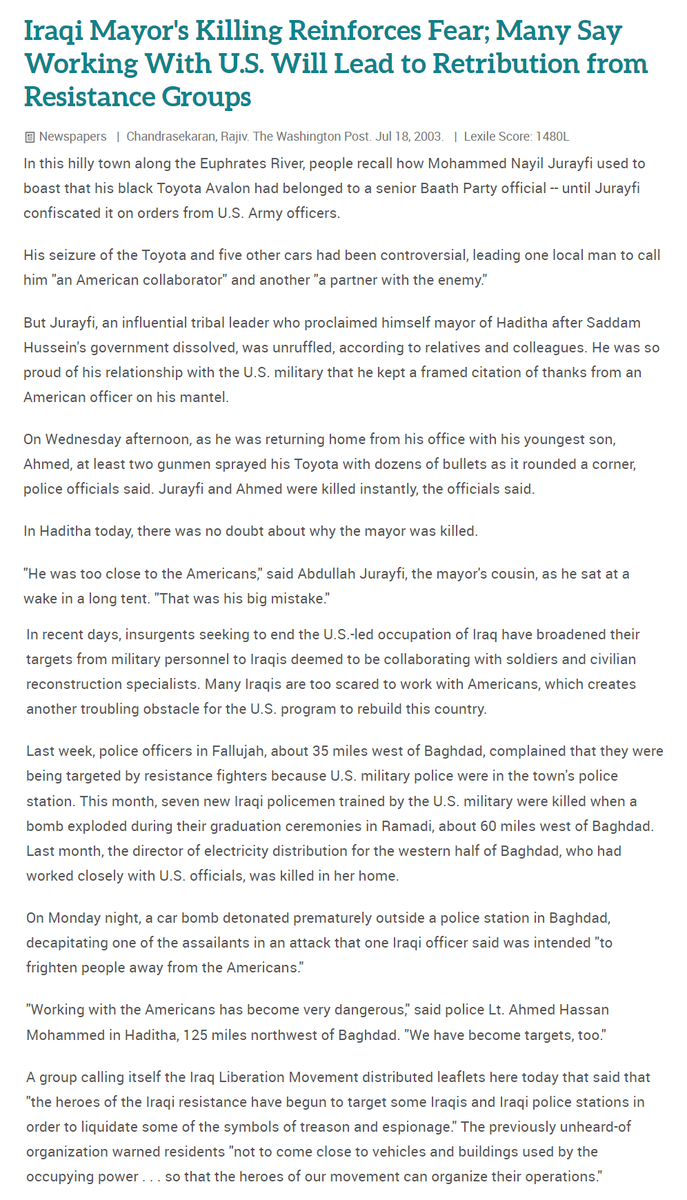
Other deaths here are also presented as occurring in this time-frame, including: civilian reconstruction specialists, police officers and new police graduates, the director of electricity distribution for Western Baghdad, etc.
Do these assassinations serve a resistance, or the invader? Presumably access to electricity and water would serve the base of any popular resistance, restoring this access benefits this base, and attacking it serves the invaders against this base of the general population.
So the question, discussed earlier, emerges – are some of these deaths genuine resistance attacks against collaborators, or are all of them or most of them simply invader actions to create the chaos and instability that serves them?
I lean towards the latter for the reasons described above.
As for the second ‘explicit contradiction’ – why would a car bomb prematurely detonated decapitate an assailant? This is a very very strange piece of text. Is the bomb in a car? Where in the car?
Was it... Being carried by an ‘assailant’ to be placed in a car when the detonation occurred? This makes no sense. Why would a bomb cause decapitation? This is one of those ‘symbolic contradictory elements’ that we have seen with past coverage.
As for the leaflet group – we have seen what can be assumed to be false leaflets in the case of Hakim/Khoei with regards to Sadr. So this is presumably an active invader program, the creation of false leaflets.
As for the group described, I find zero other references to this group afterward.
Here in July of 2003 we see the police force of Fallujah protesting the involvement of American forces –
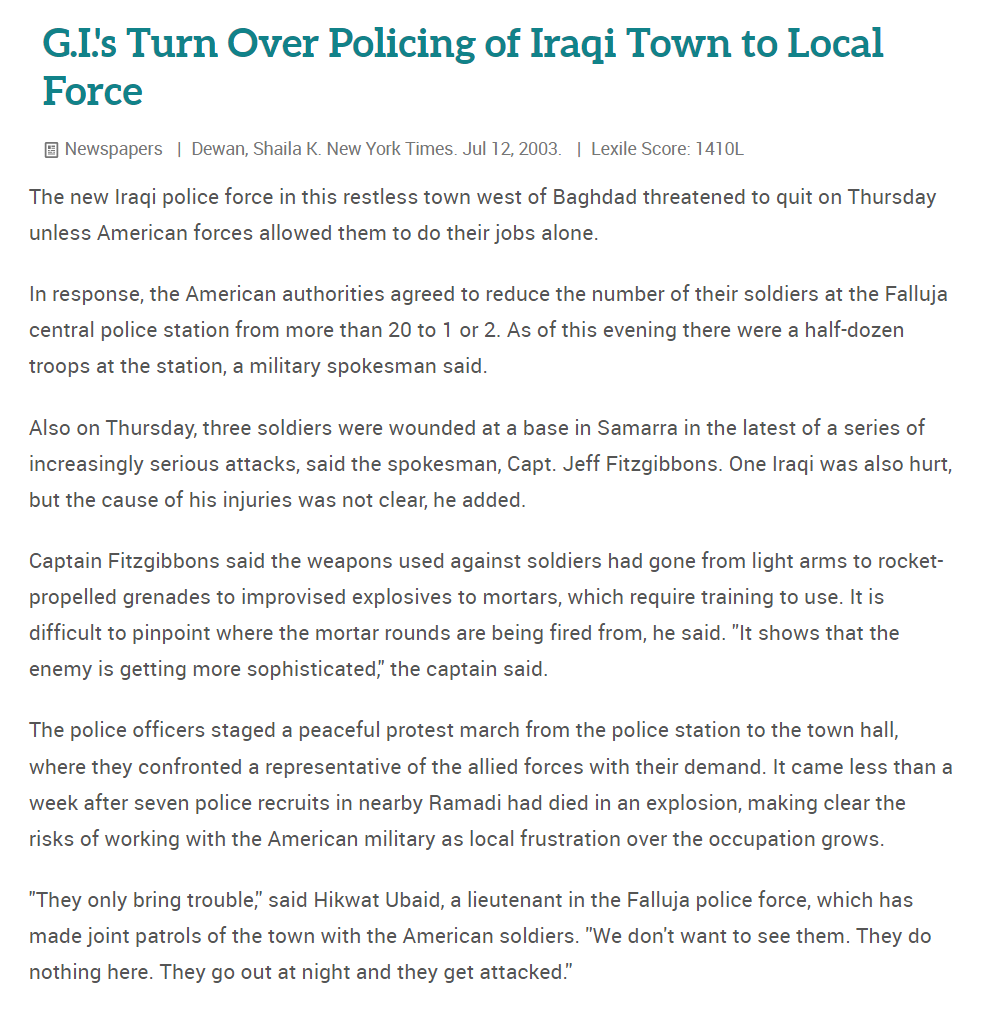
Note that Americans always seem to be the common element – when they show up, the attacks begin. Is this because there is a genuine ‘resistance’ targeting collaborators or because the Americans themselves are the organizing element and delivery mechanism of the attacks?
I believe it is quite obviously the latter.
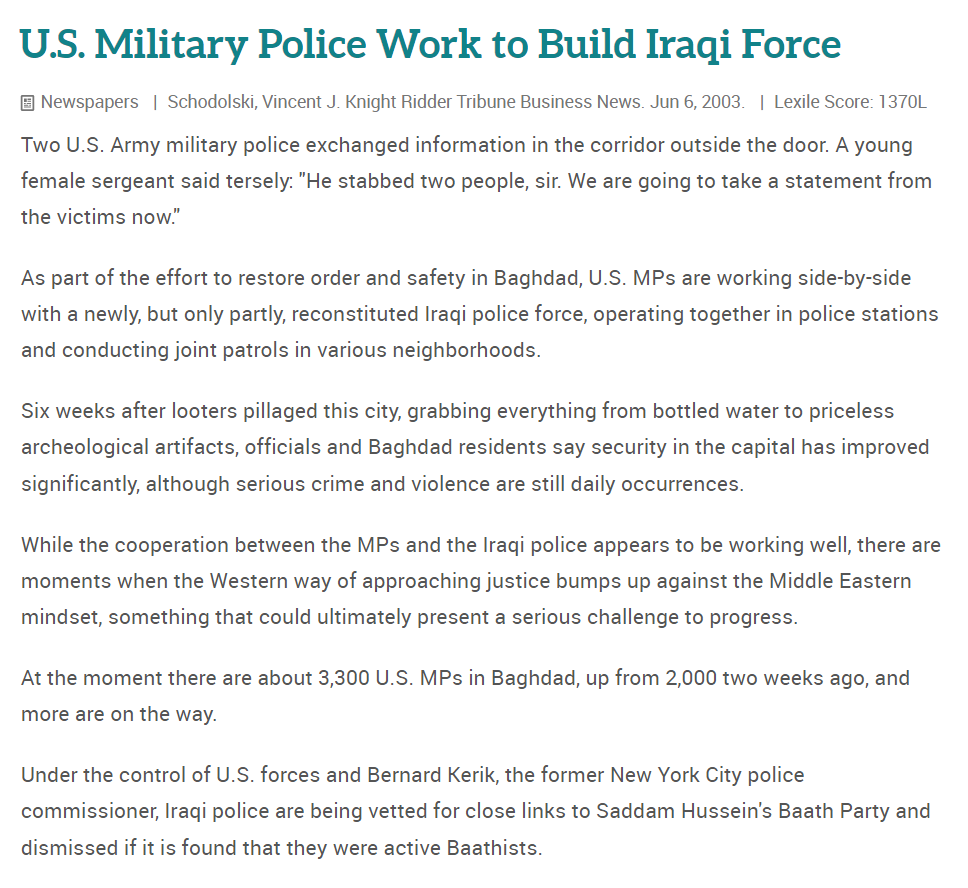
No new information here, but more ‘looting’ talk – if people do not have water to drink, ‘grabbing bottled water’ is not looting. But I show this image to suggest that basic goods like bottled water were likely among the items targeted by the coalition and their allies, strategic removal in order to amplify the effect of ongoing denial of infrastructure here narrated as ‘looting’.
Keep in mind that throughout the Iraq war there is almost no event that doesn’t exist, as covered, as a set of multiple conflicting possibilities – either residents took water legitimately to survive, or the coalition seized/destroyed the water to deny it.
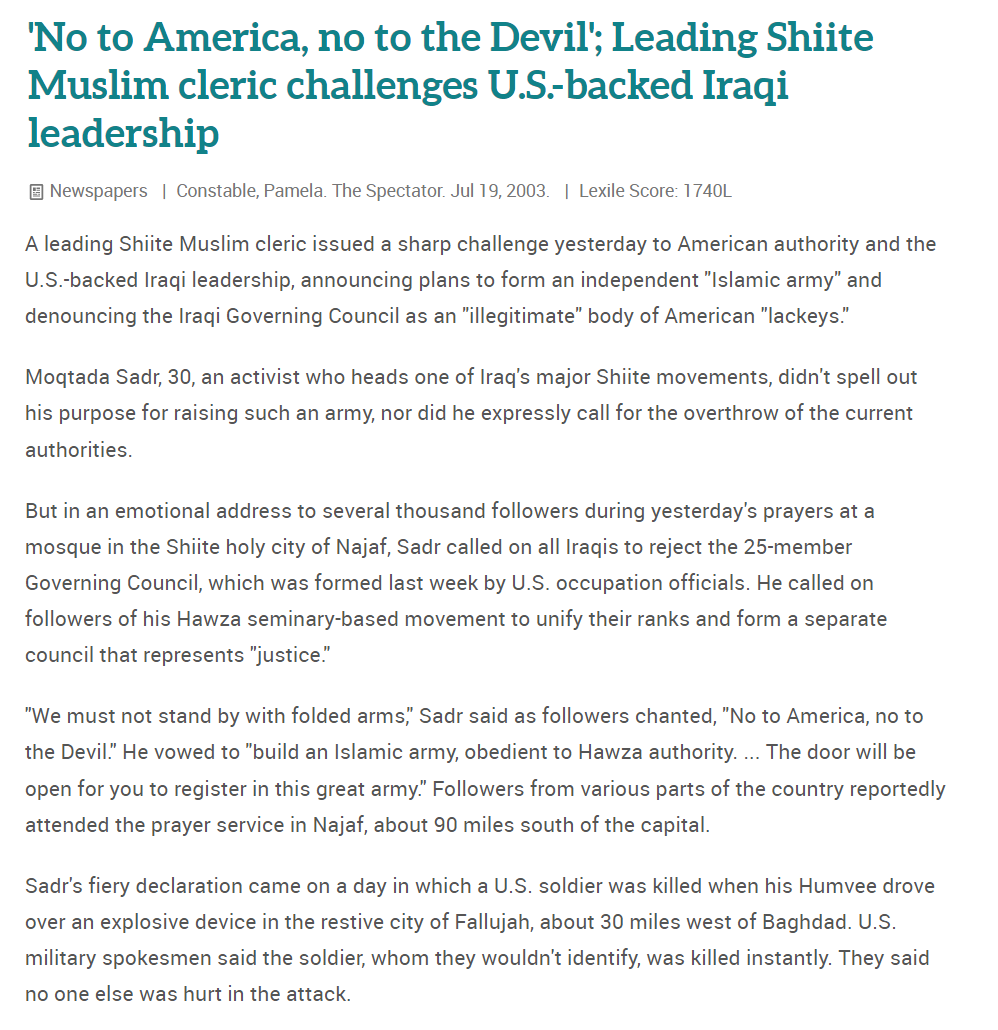
In July, the aforementioned Moqtada Sadr here calls for an independent Islamic army to counterbalance the occupation forces and their sham political structure.
As I said, I will not be weighing in on the social figures of Iraq other than to say that this of course is a logical and correct objective against the coalition.
I add this statement here as context because the coalition response to Sadr and the groups of people associated with him will be one of the longer-running arcs lasting through until more or less the end of this thread, the dynamic between these two groups is very important to at least understand as best as outside observers can.
Moving onto the month of augusA, so roughly four months into this second phase of the war –
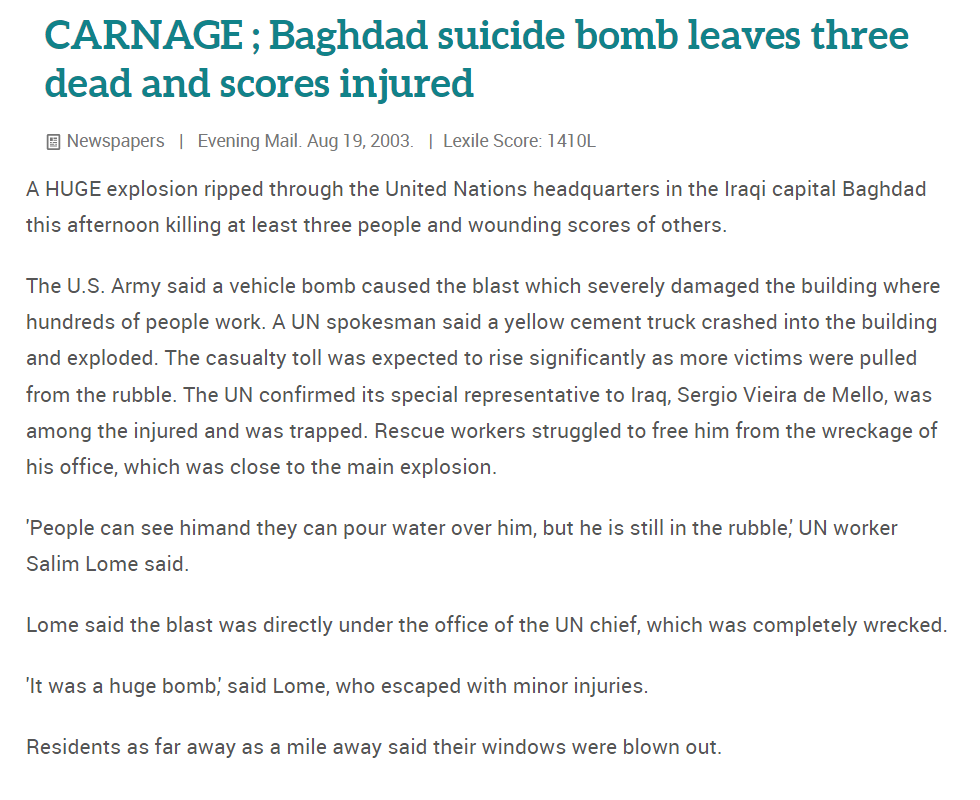
The UN headquarters in Baghdad was attacked allegedly by a ‘vehicle bomb’, allegedly by a ‘yellow cement mixer that crashed into the building and exploded’. Implied obviously is that this was a ‘suicide’ attack.
Let it be also obvious that I have no sympathy for the UN or their offices or staff in Iraq. This is one of those interesting ‘ambiguous’ actions where – if it was done by a legitimate resistance, this wouldn't be the strangest target selection. It is not perhaps the most directly useful, and not perhaps the most optimized in terms of reducing collateral damage. But I personally lean towards that this is a very-nominally “self-targeting action”, with quotes to imply that no damage would be done to anyone deemed important to the coalition.
“Insiders”, category 1 and 2 and useful category 3 actors would likely have been extracted before the action. And I think certain ambiguous actions like this may have been undertaken for the following reasons –
For one, there is a narrative to build about “shifting targets by the resistance” that serves as cover for the changing nature of invader actions. These “self-targeting” actions help to cement the narrative that “innocent or gray-area civilians and civil organizations are attacked by the Iraqi resistance”, when in fact the real shift to track is that the coalition itself is beginning the phase of outright war against the civilians of Iraq.
This target has sentiment value in that regard. Another reason is that they may have been done to try to garner sympathy from Iraqis for fake resistance groups before these groups showed their true faces.
It can be imagined that from the Iraqi perspective, there may have been many clandestine resistance groups and until certain false resistance groups fully lifted the mask it may have been valuable to generate sympathy, to find low-level assistance from Iraqis, to gather intelligence on resistance-inclined Iraqis through these fake resistance groups. What is meant by ‘lifting the mask’ will become very clear over time as the war progresses, but in this fairly early phase many people may have been operating without the knowledge that there were fake resistance groups conducting what could be perceived as authentic actions against the coalition.
Keep in mind that throughout the Iraq war there is almost no event that doesn’t exist, as covered by the West, as a set of multiple conflicting possibilities – either a legitimate resistance attacked the UN, or it was a false attack by the ‘false’ resistance.
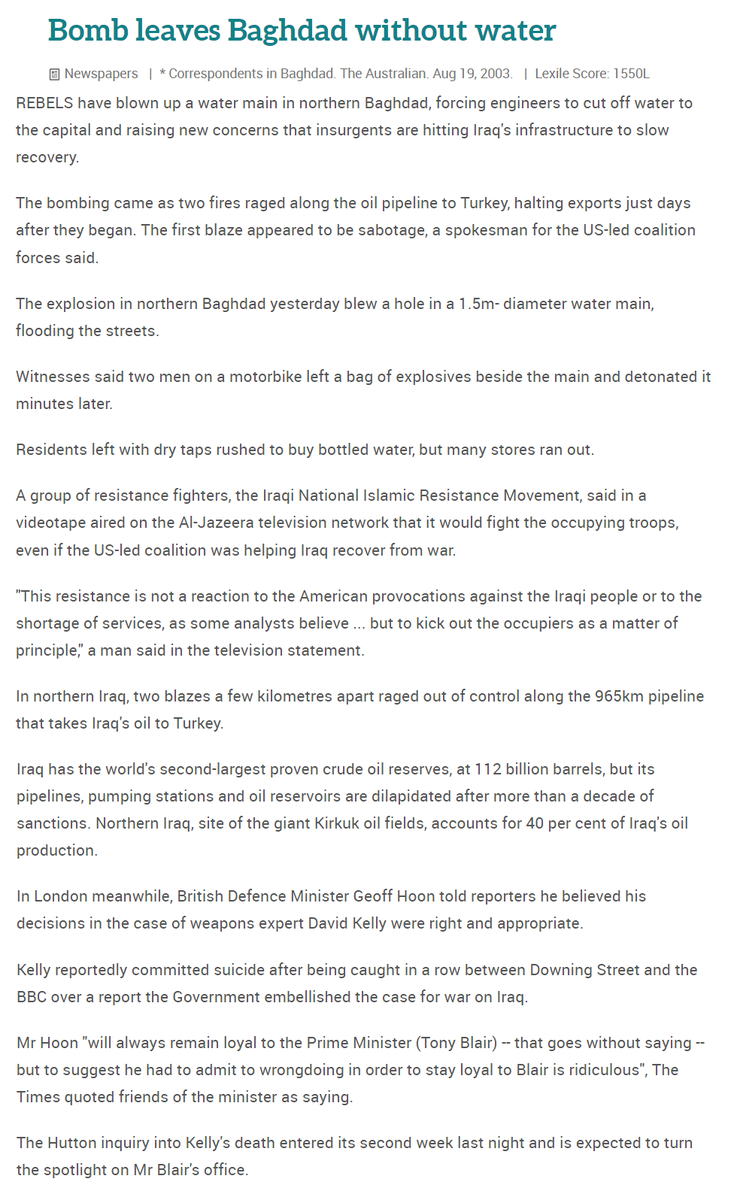
Also in August – keep in mind this is after the alleged “looting” of water bottles – “rebels” blew up a water main in northern Baghdad, cutting off water to the city. “Insurgents”, aiming to “slow recovery”.
Also included, though I don’t have time or interest in exploring these things, is the “suicide” of David Kelly – just an example of how brazen things were at this time with regards to “eliminating loose ends” or more likely in my opinion staging the elimination of loose ends.
I say this because in the case of these ‘high profile’ political ‘assassinations’ I don’t think there are genuine loose ends or genuine opposition or genuine leaks. The staging of dissidence is just fake conflict in the line of what was examined in the SDI thread –
here he is at maybe his lowest, removed from his position and having people send their condolences about his 'midlife crisis' - invented by his enemies the dastardly teller and wood pic.twitter.com/c8tuztx0tu
— 2young badazz (@2youngBadazz) January 4, 2021
Whereas in the case of lower-profile targets such as coalition soldiers, I think these have a higher chance of being genuine eliminations for a variety of reasons. Such as legitimate antipathy towards occupation tactics, possible intelligence leaks to genuine Iraqi resistance etc
As for the oil pipelines being attacked, we will address this later – but the principle point here is that this is economic warfare against the state of Iraq, a deliberate shut-down of oil flow to restrict income into the country.
It is not and never has been as simple as it is often presented – an “occupation” to “exploit” the resources of Iraq including oil resources.
Rather sometimes the goal is to extract wealth from these resources, sometimes the goal is to deliberately shut down production for the sake of limiting or destroying productivity as its own end. This same pattern applies to political machinery, industrial productivity, etc.
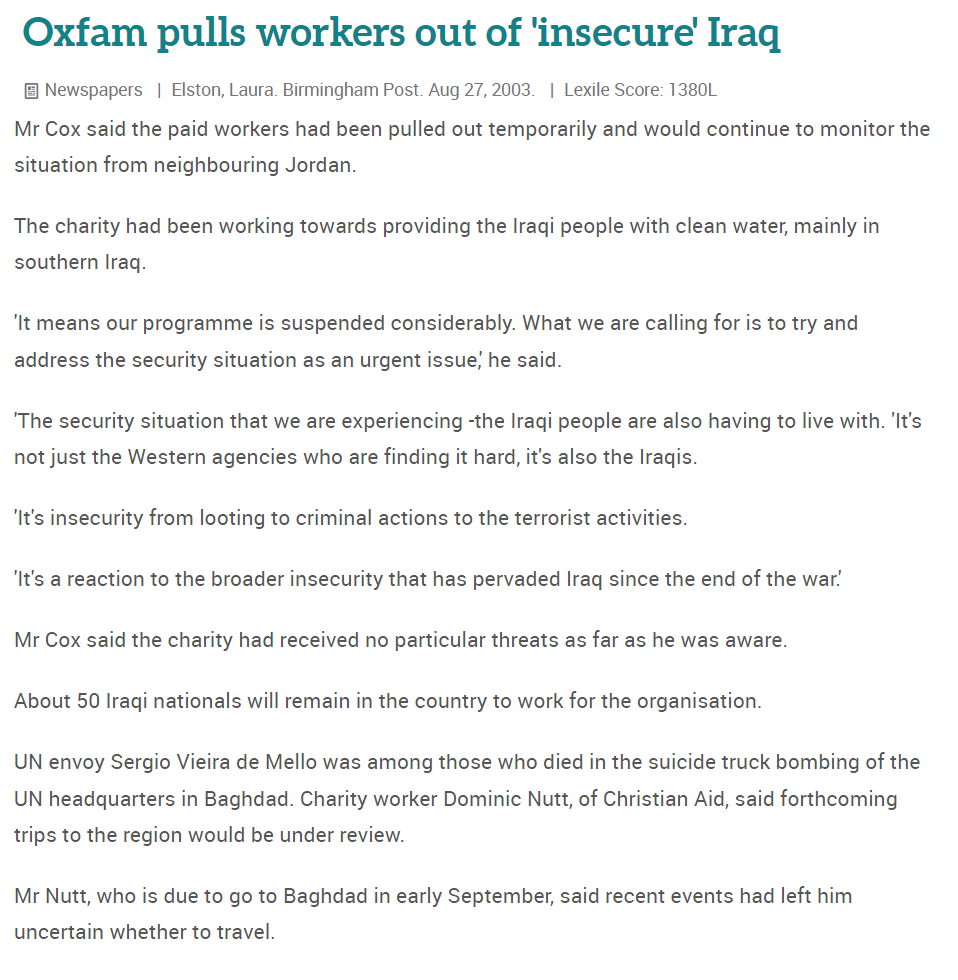
Here the Oxfam charity pulls out workers in late August, an indication of the completion of the sequence of: fake aid budget, no actual aid materials purchased just money changing hands, and then the ‘pull away’ of the resources that were “intended” to deliver the aid.
We see the mention of “terrorist activities” alongside “criminal actions”, again marking a shift in the language used for what is nonetheless a singular thrust of the coalition and their allies. We see confirmation that the UN envoy has “died”, and again we see the “suicide” narrative for this particular bombing which again can be read as either: it was a legitimate resistance action (though this is IMO unlikely) that was not an “SB”, or it was a fake resistance action that can be attributed to groups like AQ by means of the SB labeling.
We see the claimed killings of aid workers including with grenades and the theft of cars.
This sort of behavior I find unlikely to be genuine resistance, although there are times when resistance groups can intelligently identify false aid groups as legitimate targets.
I think rather in this case it is much more about 1) creating such a narrative and feeling among legitimate aid groups so that they feel forced to leave and 2) providing a pretext to not deliver paid-for fake aid that was never actually purchased.
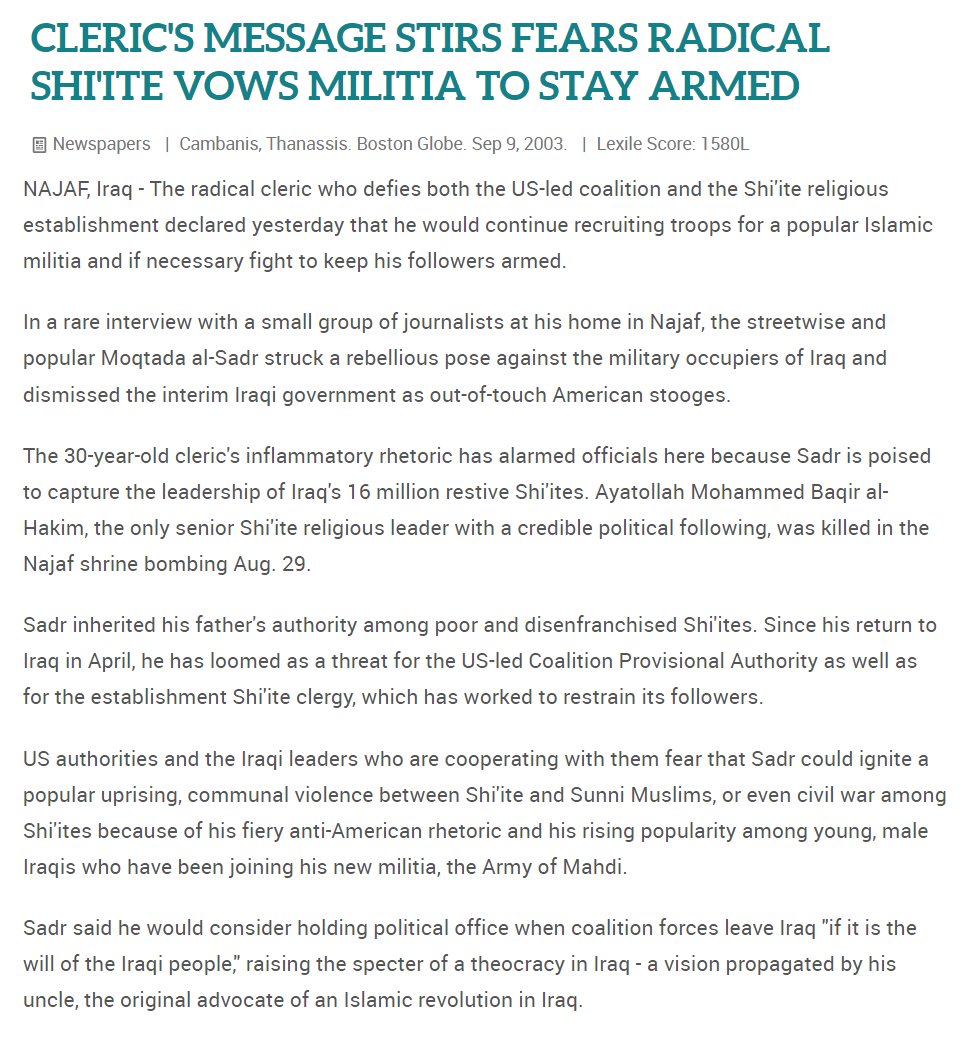
Here we see Sadr again openly dismissing the interim government, and we see the early seeding of the “civil war” narrative – “communal violence”, “civil war”, etc.
This will be developed into a key narrative used to cover coalition violence and is one of the principle lies of the Iraq war.
As we will see, “communal violence”, ‘organic violence’, this whole idea is used all over the world including in the united states to mask military actions such as ‘mass shootings’ – and here as elsewhere including the united states this is a falsehood.
This will be observable beyond doubt when comparing the specific form of actions, and this will provide a framework for designating certain actions as ‘military’ actions rather than ‘organic’.
Moving into October of 2003,
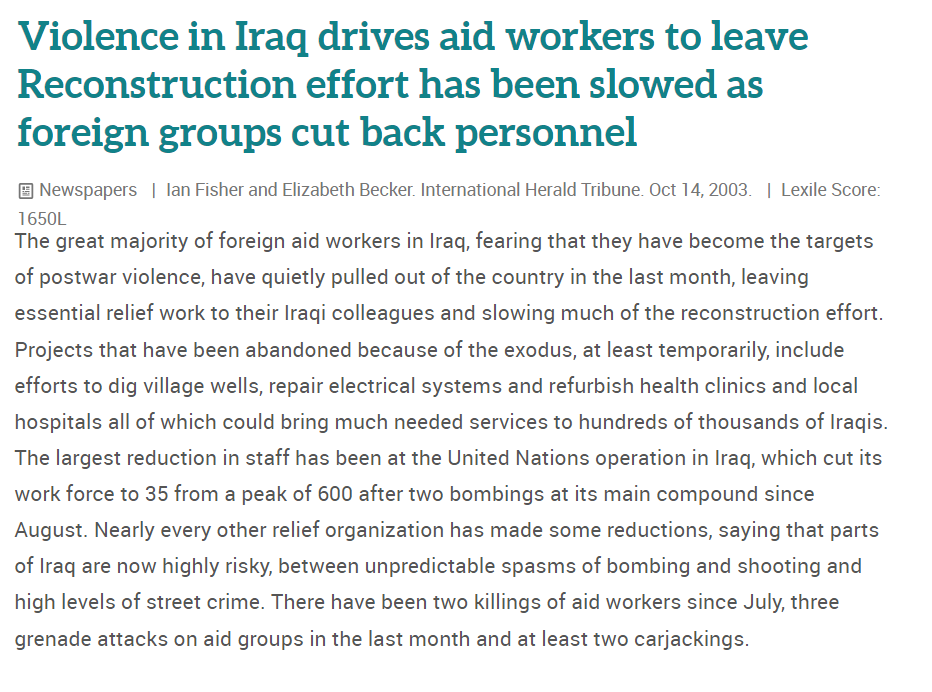
Now, after the summer has waned, did the coalition begin attacking in earnest the “foreign aid” apparatus in Iraq. presumably some foreign aid is simply fictitious, but presumably other foreign aid is genuine. My assertion is not that any and all aid is somehow fictitious, again this is the kind of extremism that I think leads to matrix-brain where one cannot differentiate real and false actions because of want of a framework for evaluating things with more nuance.
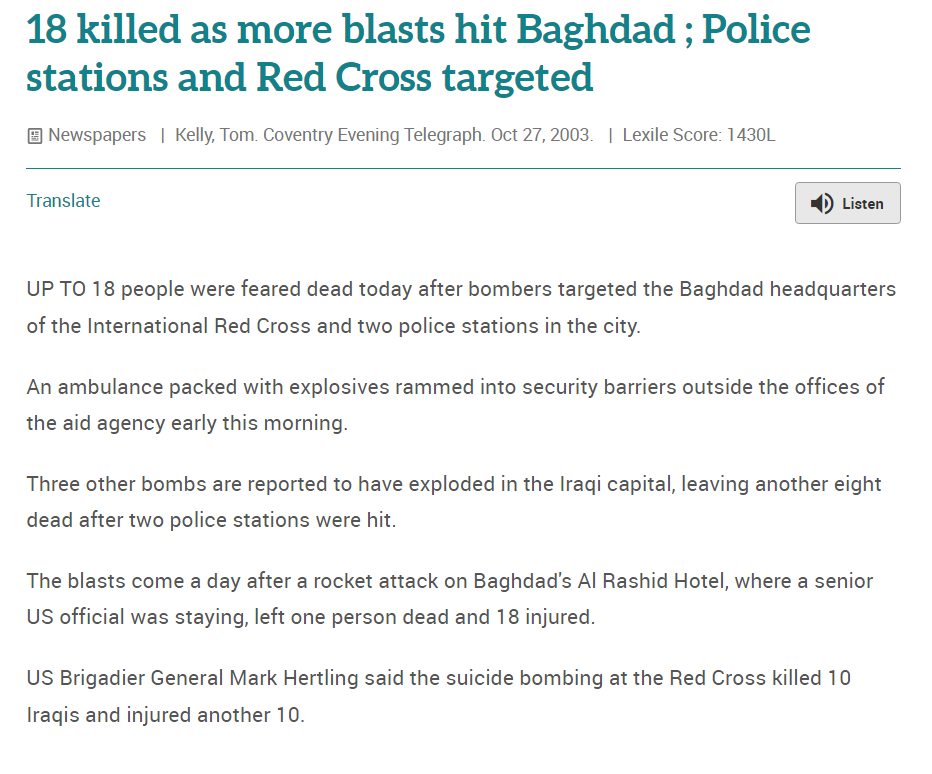
Here these actions were taken further, with allegedly 18 dead in an attack on the International Red Cross in Baghdad as well as – of course – two police stations. The claim is that ‘an ambulance packed with explosives’ rammed the barriers to the office.
IMO the entire concept of car-borne SB attacks is a fiction. More likely – remote-controlled explosive devices planted on the ground (refer to prior discussion, ‘1lb per plane’, etc) or in unwitting cars.
As for the attacks on police stations – expect this to continue. Police represent a core threat to the coalition as a line of defense, populated by Iraqis, against the violence inflicted by the coalition.
This form will be developed into something that readers should be able to have a very firm understanding of by the end of this thread.
Now – compare the Western analysis to the analysis here:
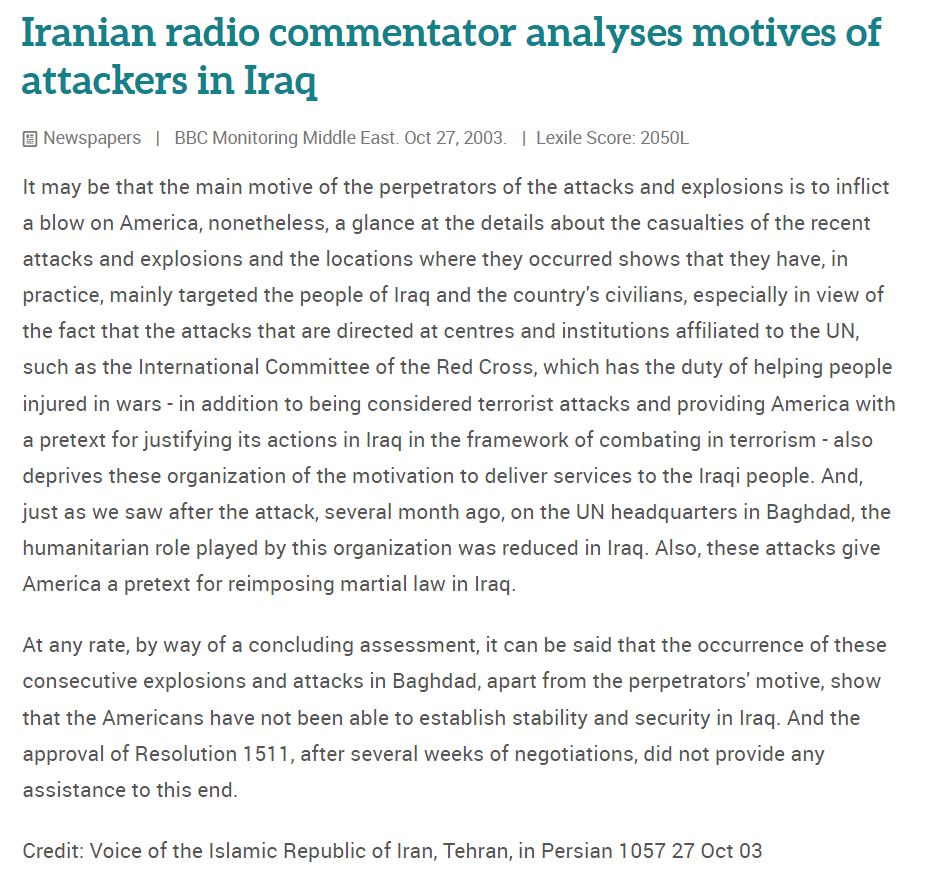
this analysis more or less speaks for itself, and I present it to once again emphasize that regional press (and even the broader Western press via quotations) fully articulated the view that the coalition was responsible for all of this violence and the reasons why.
This is the default analysis by the people of the region.
So you shouldn’t have to work your brain into a frenzy to evaluate if my accusations here are valid or not – if this is what you are doing, you are again expressing that you have a tendency to believe in and embrace the narratives of the invaders over the people of the region.
Now – this is a single paragraph, but what is not included here and this is not a criticism is that these attacks are not just a pretext for occupation or imposing martial law but are in fact the mode of attack from this initial phase onward.
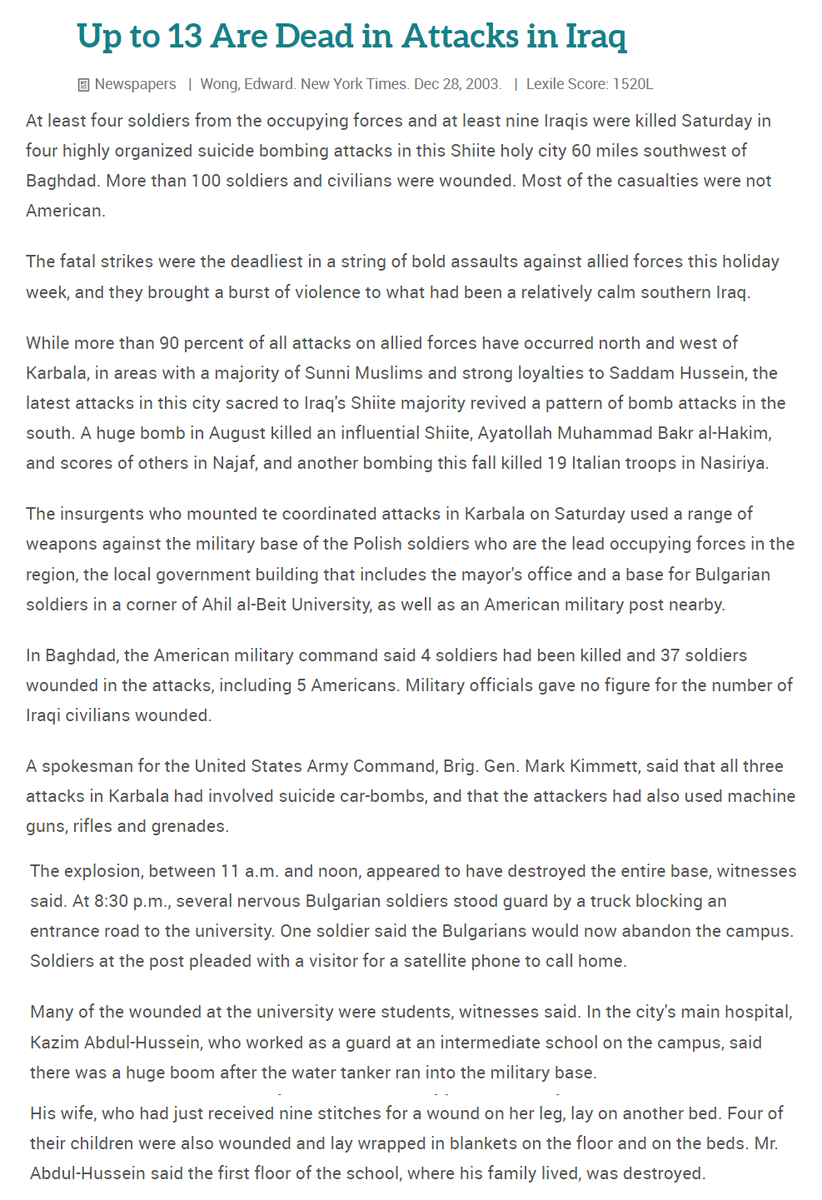
This article from December of 2003, so our coverage of this first year of the war is drawing to a close, we are confronted with an interesting disparity: a casualty count of 13, combined with the assertion that there were ‘four highly organized’ attacks in Karbala.
A geographic point – by and large we have focused on Baghdad, or near Baghdad. This image highlights in the third paragraph that at least according to the news narrative a strong focus on “securing” the insecurity of Baghdad and the nearest-by regions, with the figure given here as 90% of attacks on allied forces.
Returning to the image at hand –
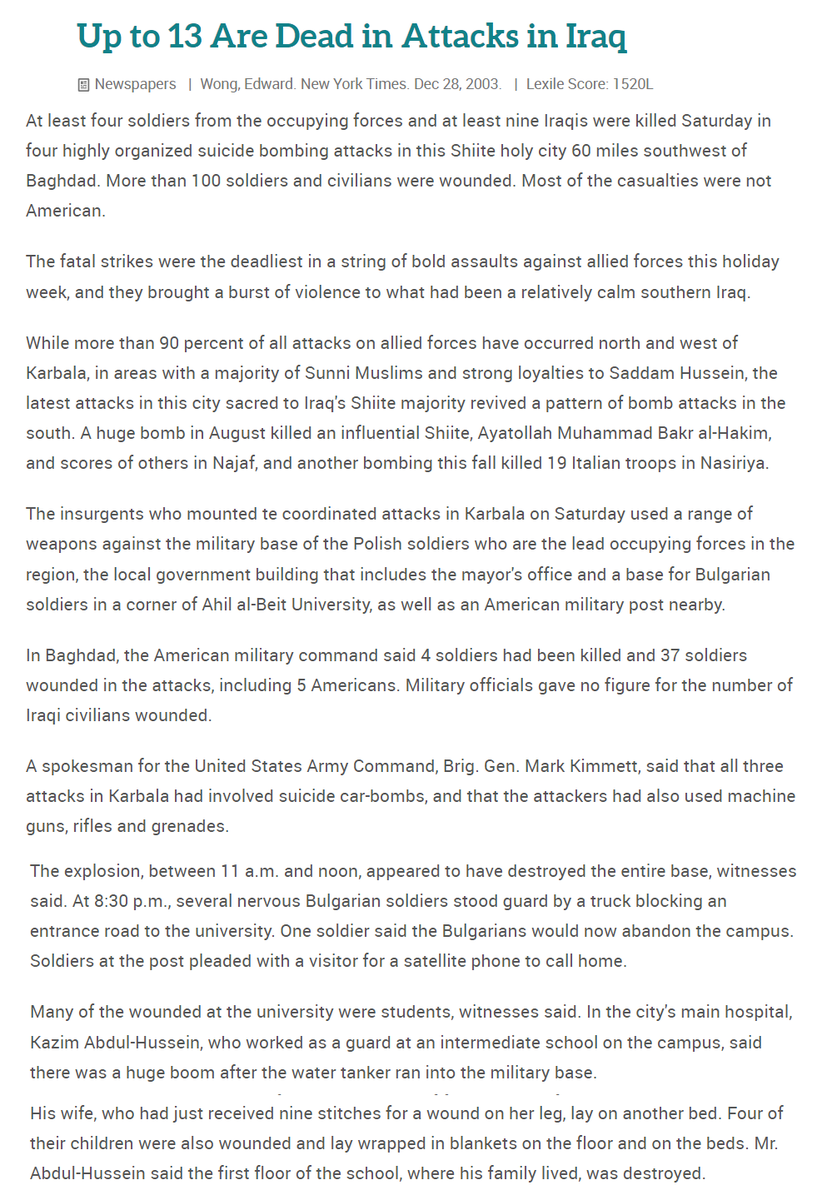
We can reject the joke framing of ‘bold assault against allied forces’ – I find the entire premise of this attack, as given, rejectable. For one it appears very clear that the majority injured and affected were Iraqis –
I am not saying I would never believe in any collateral damage in a genuine resistance attack. But I don’t believe in these cases where the scale of ‘collateral damage’ significantly outweighs the damage done to the coalition.
Furthermore, one of the main targets – IMO this is the ‘actual’ target – was the university and “many of the wounded were students”. This is a school shooting. The school and the students, in my opinion, were the target of this operation.
Curiously, according to “Mark Kimmett” the attacks involved both SB vehicle attacks – a clear fiction – and small arms, which – if the majority of the wounded were Iraqis, that would seem to imply they were fired upon by the attackers.
So this, if fiction, serves “against” the narrative of the invaders to blame organic “resistance” groups for this attack. Perhaps more intentional contradiction, intentional revelation.
At any rate, universities and education are another obvious and permanent target of the coalition.
Moving into January of 2004, we see the shift towards purely civilian targets becoming part of the narrative –
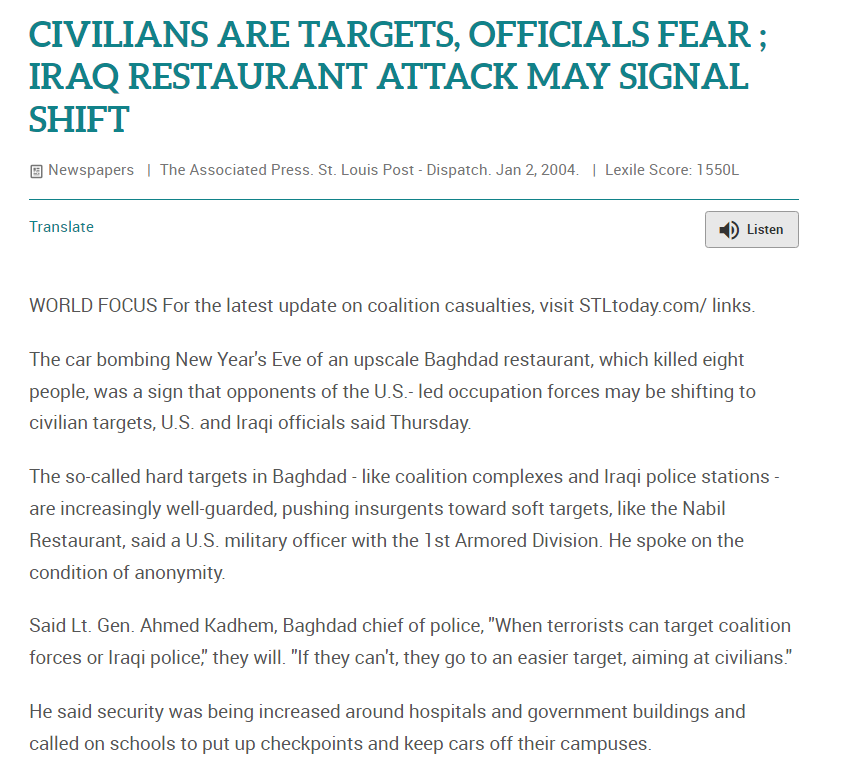
The article here makes an intentional “error”, describing police stations as well-guarded and difficult to attack. We will see this premise belied. But at any rate, the narrative is being established that there will be an increase of civilian targets.
The “cover” is that other targets are “too difficult” – this is such an absurd premise that we should take this supposed quote from the chief of Baghdad police as an indication that either the individual is fully compromised or is being fictionally misrepresented or doesn’t exist.
“If terrorists cannot target coalition forces, they will... Aim at civilians”. Why. Why? This is where the brain must be fully turned off.
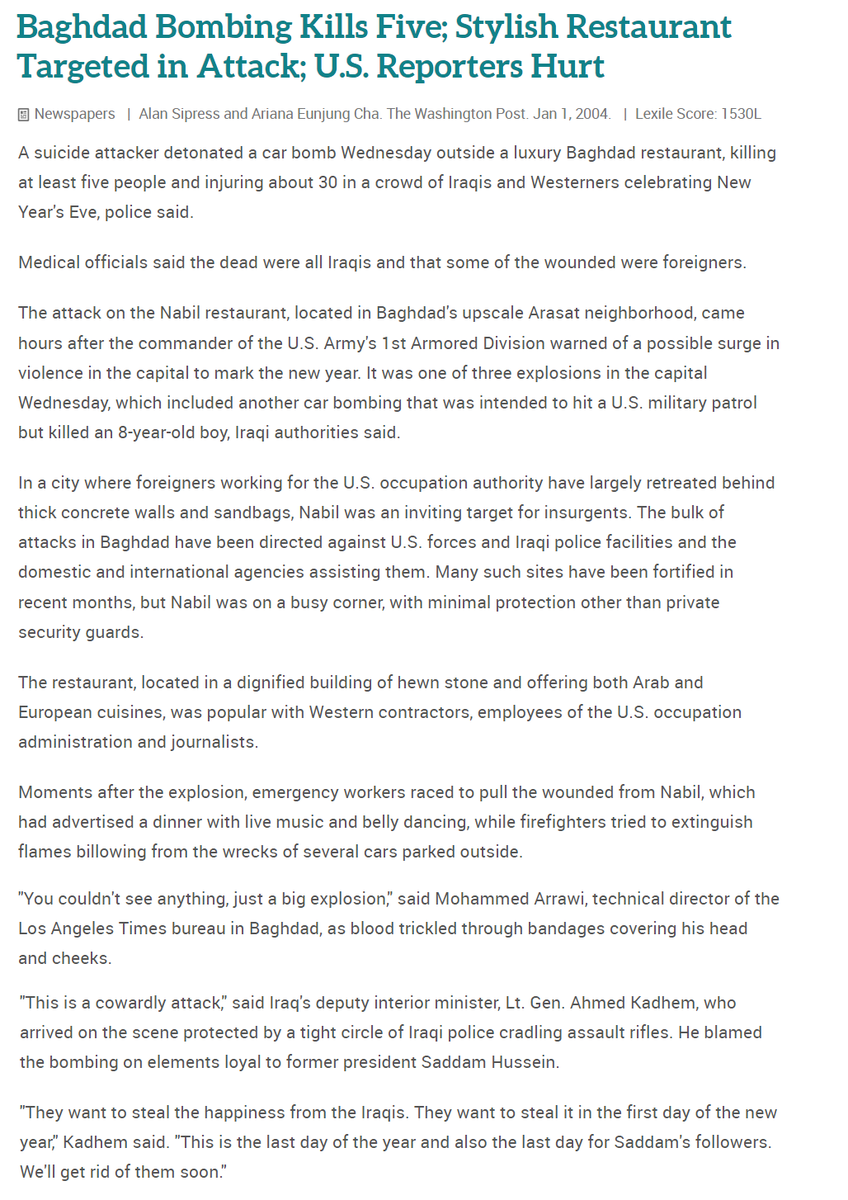
Here are more details about the attack, again a predictable emphasis on ‘Iraqis and Westerners’ in the crowd. The deceased were “all Iraqis”, and only “some” of the wounded were foreigners. More of the same absurdity:
“Now that the occupation authority has retreated behind fortification, this restaurant was an inviting target to insurgents” – Why? Why would they target it? Allegedly it was “popular with Westerners”, yet the victims were almost entirely Iraqis.
Note here that the deputy interior minister blames former regime elements – remember the pattern. Now it is too early to simply “blame AQ”, this narrative is only in a very formative stage.
The attacks need to be attributed to “something”, other than the coalition itself, and FREs serve as the most convenient source of blame in the interim period. But as we saw before, this will eventually be completely erased by the AQ narrative and the form of the attack will remain identical.
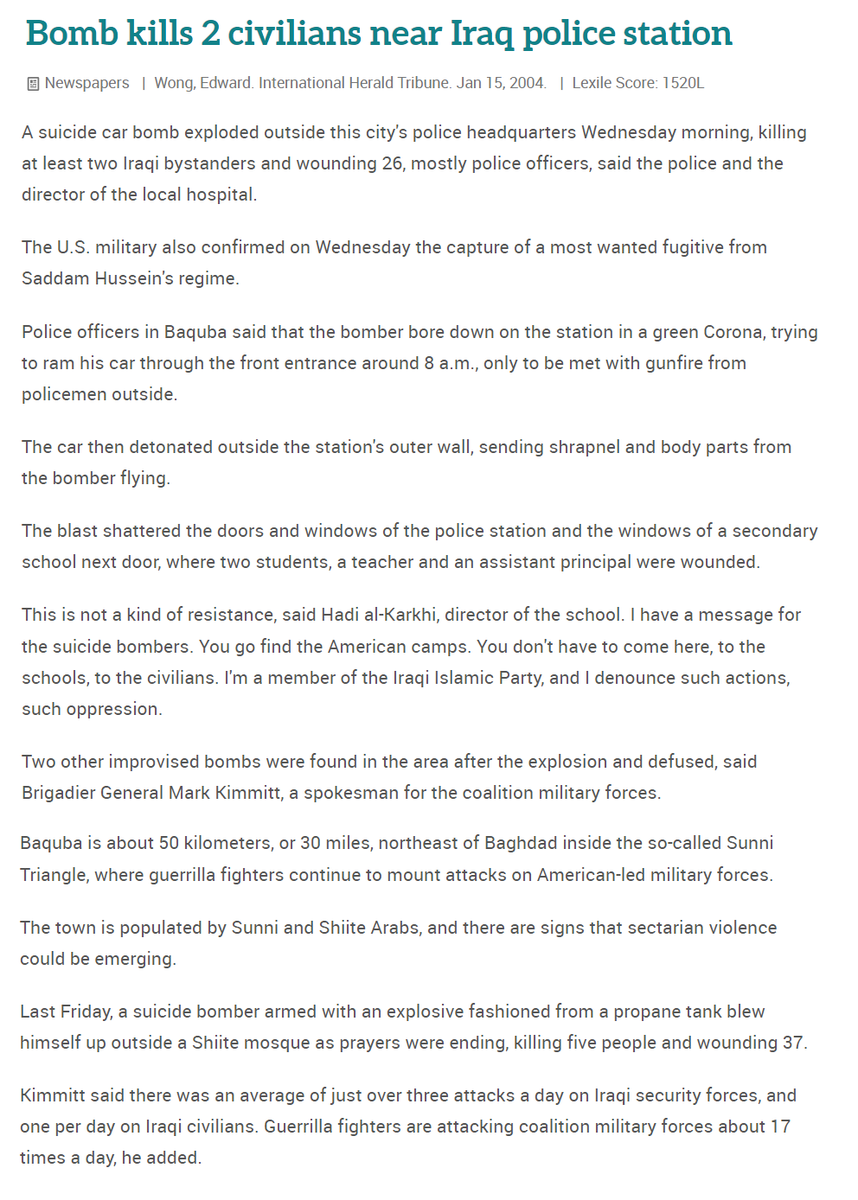
On the 15th of January, it is now 2004, there was an attack on police headquarters that can serve as our first examination of these attacks. Though as per usual I reject the proposed medium of attack. We have read of them indirectly, but we will continue to cover them directly as this thread progresses. Before we were examining Karbala to the South, Baqubah is slightly to the North of Baghdad.
Not only was the police station attacked, but a school as well dealt with the fallout – surprise surprise. Police stations and schools. The quote here from the school’s director strikes me as fabricated –
a way to try to show that people validate the premise of self-destructive attacks. The article eventually gets to its secondary payload which is to assert that “sectarian violence is emerging”.
It mentions a fairly major attack that I did not have time to find coverage of, another “self destructive attack” against a masjid and its members. Once again, I believe in the attack and I disbelieve in the methodology described. Furthermore there is no sectarian violence emerging but rather the coalition is setting its sights directly on the population and their defense mechanisms such as the police.
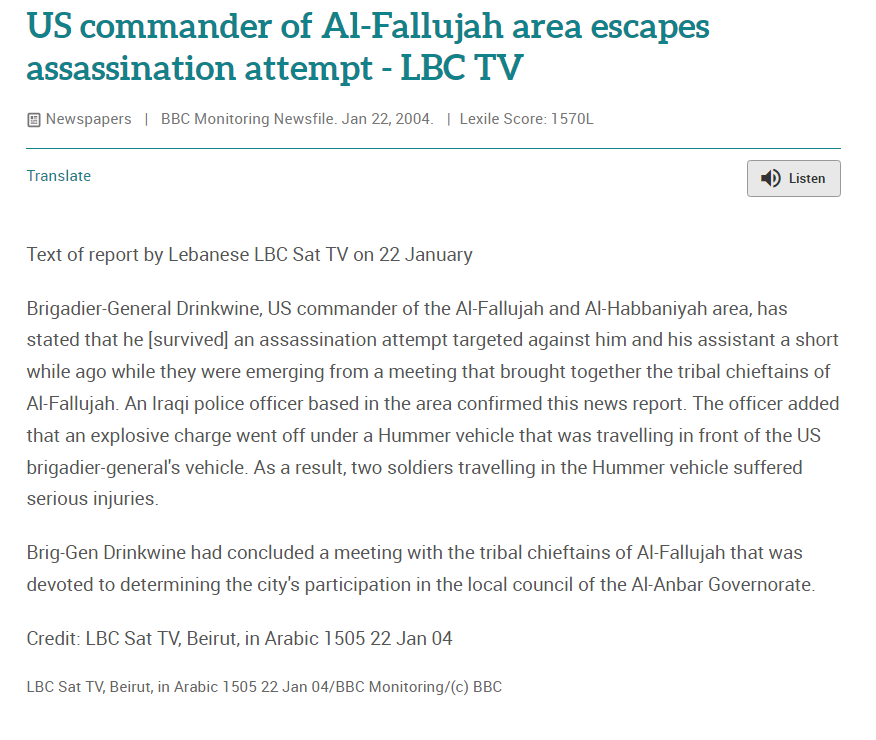
This detail from January 20th of 2004 I throw in to make the claim right now: Brigadier General Drinkwine, alleged commander of Fallujah, is not a real person, that is not a real name.
This is some weird twisted ironic joke from the coalition, an ironic codename, something. May they be cursed. We will cover the area of Fallujah later on.
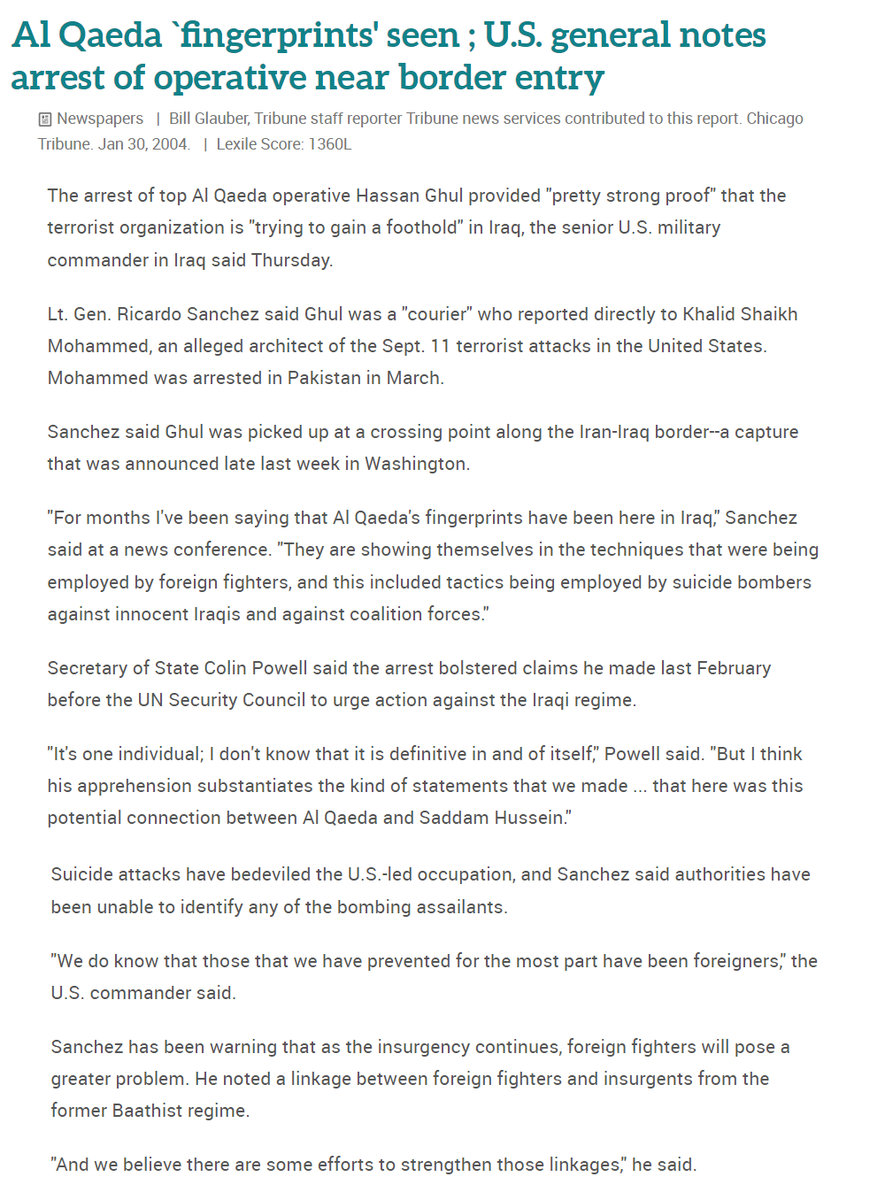
This is our last image from January, there was an alleged arrest of a ‘top AQ operative’ which shows ‘strong proof’ that the organization is ‘trying to gain a foothold’. Now we start to see the shift from FREs to AQ in earnest, this is one of the signals that this shift is coming and we will eventually forget anyone other than AQ was ever accused of these actions.
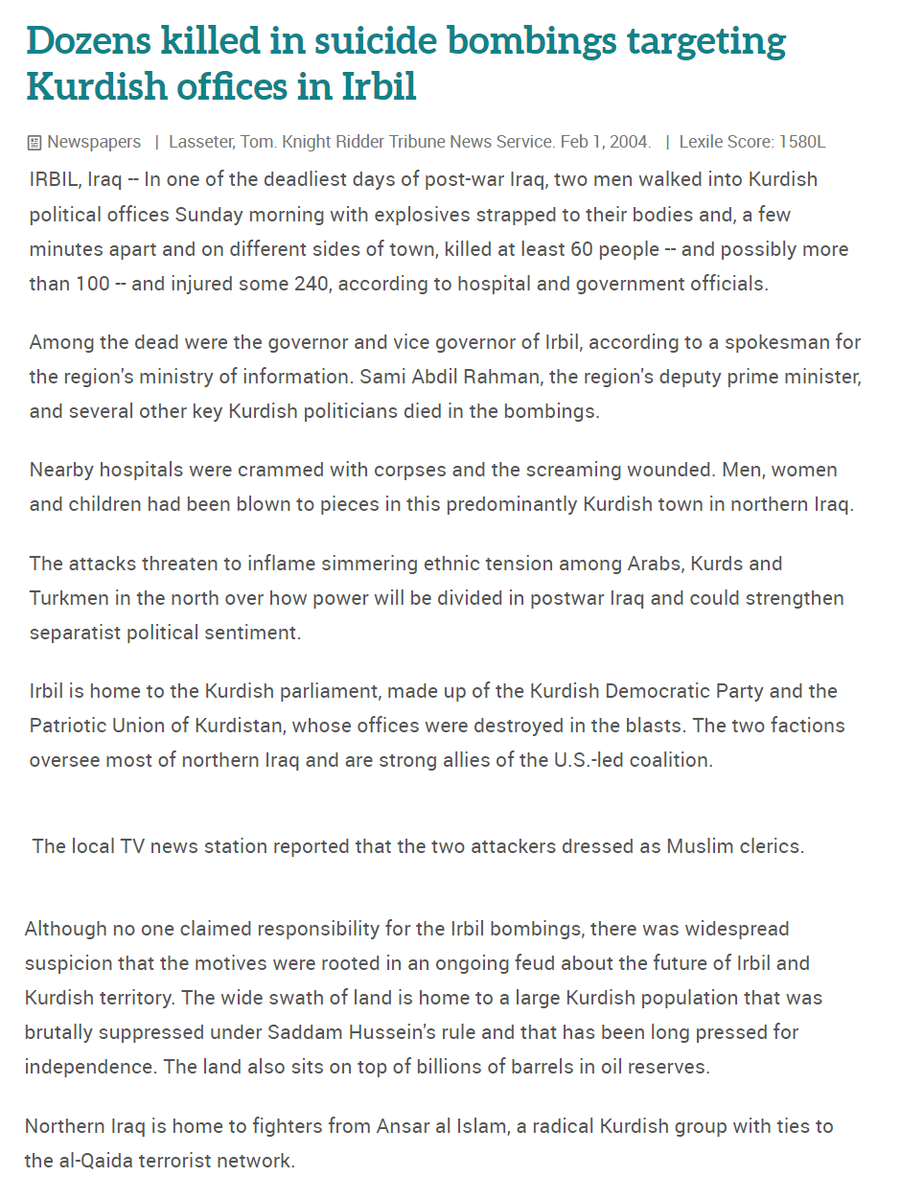
Here, now in February, we see a different type of attack than we have seen covered thus far. This is in Irbil – recall the geography, review if necessary, this is northern Iraq. The attack was a coordinated bombing against – presumably – the political structure of Irbil
The casualty figure here is given as at least 60, in later reporting this figure is given as roughly double this, 117. As the image states, the governor, vice governor, key ministers and politicians, as well as the political offices of the two predominant political parties, were all eliminated in the attack. The narrative, as you can see is per usual at this point, is a self-destructive attack with explosives ‘strapped’ to their bodies.
Let me again ask – who saw this?
These attacks killed anywhere between 60 and 117 people, they destroyed the entire offices. Who saw this? How close were they? Did the attackers not obscure the explosives before entering the building? Why did nobody stop them then?
This makes no logical sense, I apologize for beating the hammer repeatedly on this subject. The bombs were then presumably planted ahead of time. This is at present my ‘go to’ explanation, because in terms of resources required it simply requires that an agent was able to get in and out and leave a small device – how small I still cannot say. But what else could it be than this?
As for the ‘attacking allies’ theme, certainly the Kurdish parties had been working with the coalition leading up to and during the initial invasion. But the narrative in the Western media as a simplistic ‘ally’ relationship is at the very least more questionable than presented.
The initial arrival of the coalition forces, in this case Special Forces Group 10 and CIA paramilitary officers, coincided with a joint operation against “Ansar al-Islam”, allegedly an Al Qaeda adjacent group. As with any such group, presumably –as discussed in the very beginning of this thread – the group was made up of US special forces-trained soldiers probably from the militaries of nearby allied countries. Are we to think that the Kurdish parties were unaware of this?
How then to reconcile this operation, particularly from the perspective of the Kurdish parties? Perhaps they recognized that they were between the pincer but estimated that they did not have a choice.
Nonetheless, this aforementioned February bombing attack seems to be not a mere pruning of certain elements but an all-out offensive strike against the leadership of the parties. If we imagine the Kurdish parties to be of reasonable awareness, they would know that both Ansar al-Islam (if the AQ jacketing is true) and this strike were offenses led by the coalition – even putting aside a broader historical context of the US relationship to the Kurdish parties. This puts the parties in a very difficult place indeed, and this I believe spells out that there is really no such thing by and large as a true ‘US ally’ in this equation. All allies were subject to attack at any time, from the coalition itself.
This is yet still the beginning of this theme of the war. But without question, the ‘men, women, and children’ were the recipients of an attack from the coalition and this is the true nature of the Iraq war.
There is a tendency to minimize the ‘atrocities’ of this war, focus on minor provocative incidents from coalition and contractor, rather than narrate the war as entirely composed of such attacks.
The war indeed was a war against civilians, they were not ‘collateral damage’ or attacked in isolated incidents but in fact the main recipient of coalition violence throughout and this is one of the incorrect revisions that this thread will hopefully erase.
As for the motivation of this mode of attack, attacks against ‘allies’, we have already discussed the element of destroying cohesion and imposing chaos by eliminating stable societal and political structures. There is a deeper motivation is probably becoming clear to some readers, but we will allow the pattern to be established fuller before addressing this head-on.
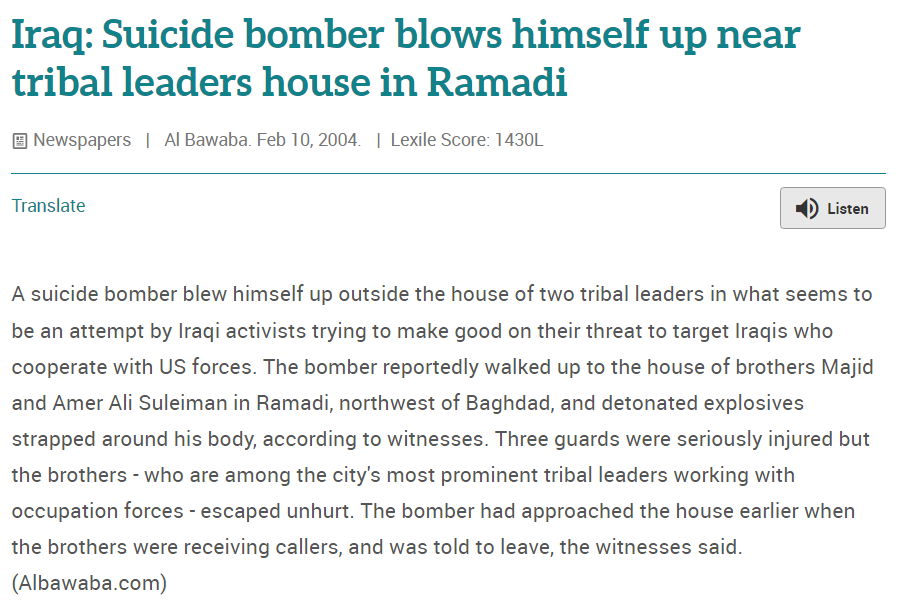
Another pillar of target selection by the coalition forces includes the educated and the educational apparatus of Iraq. The mode of assassination is not made clear, though it is placed in the context of ‘car bombings’. Also listed are police stations, again, and masajid (’mosques’).
As per usual, attacks against masajid in particular very obviously contradict the ‘insurgency’ narrative – as well as, as we will see, marketplaces and other purely civilian targets.
There is no motivation for the insurgency to attack such locations, whereas there is abundant motivation for the invaders to attack such locations. The invaders have been let off the hook by the vast majority of Westerners critical of the Iraq war –
They focus on the handout-atrocities that the Western press gave to them, contractor incidents, “isolated incidents”, etc. This is ceding the much more important ground which is that the coalition itself was behind the organized mass attacks against civilians throughout.
We will, ahead of time, list a compilation of such attacks to illustrate the nature of the invaders before we specifically cover this part of the timeline:
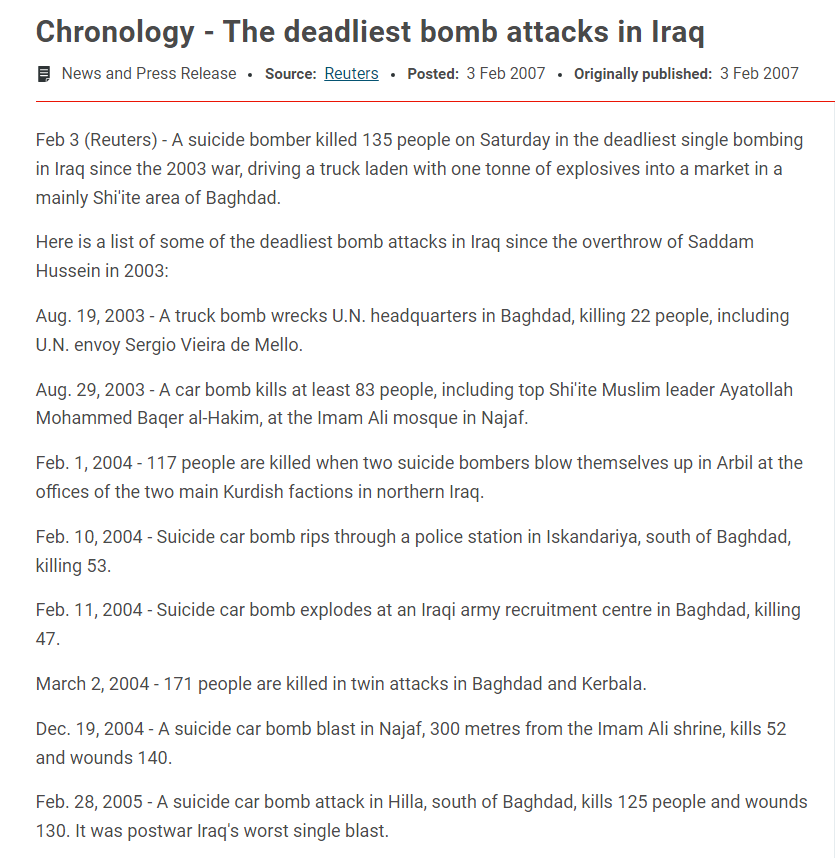
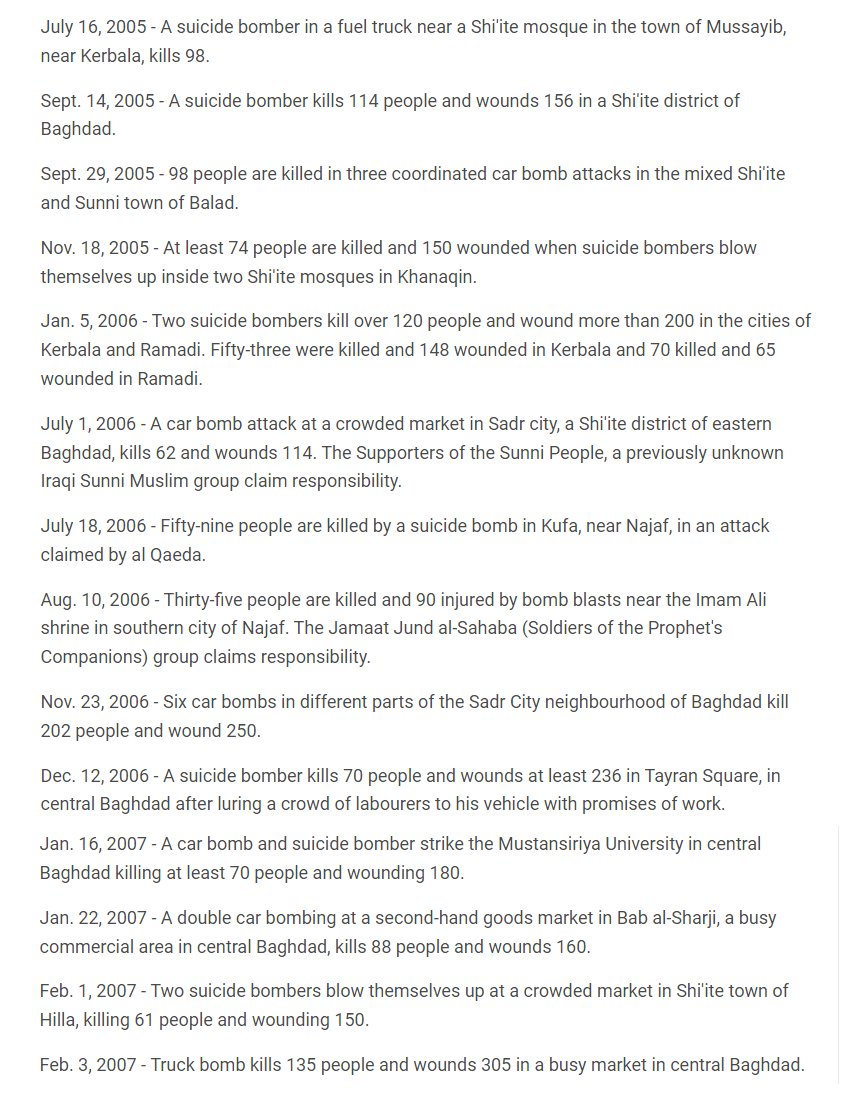
“Car bombings”, “suicide bombings”, marketplaces, masajid, the places of the people in their day to day lives. This is the war in Iraq
In early February, the second phase of the war – the post-invasion phase being discussed – was giving way to the third phase of open and all-out warfare against the people themselves. The narrative apparatus for this is a shift to AQ, and this narrative was the signal that this phase was beginning – I don’t want to say the narrative “allowed” for this transition because this would erroneously imply that it was in any sense necessary to conduct such operations, but it did serve as a covering mechanism to Western audiences even though their brains were so shut that it wouldn't truly matter much how this cover was achieved or whether it was covered at all.
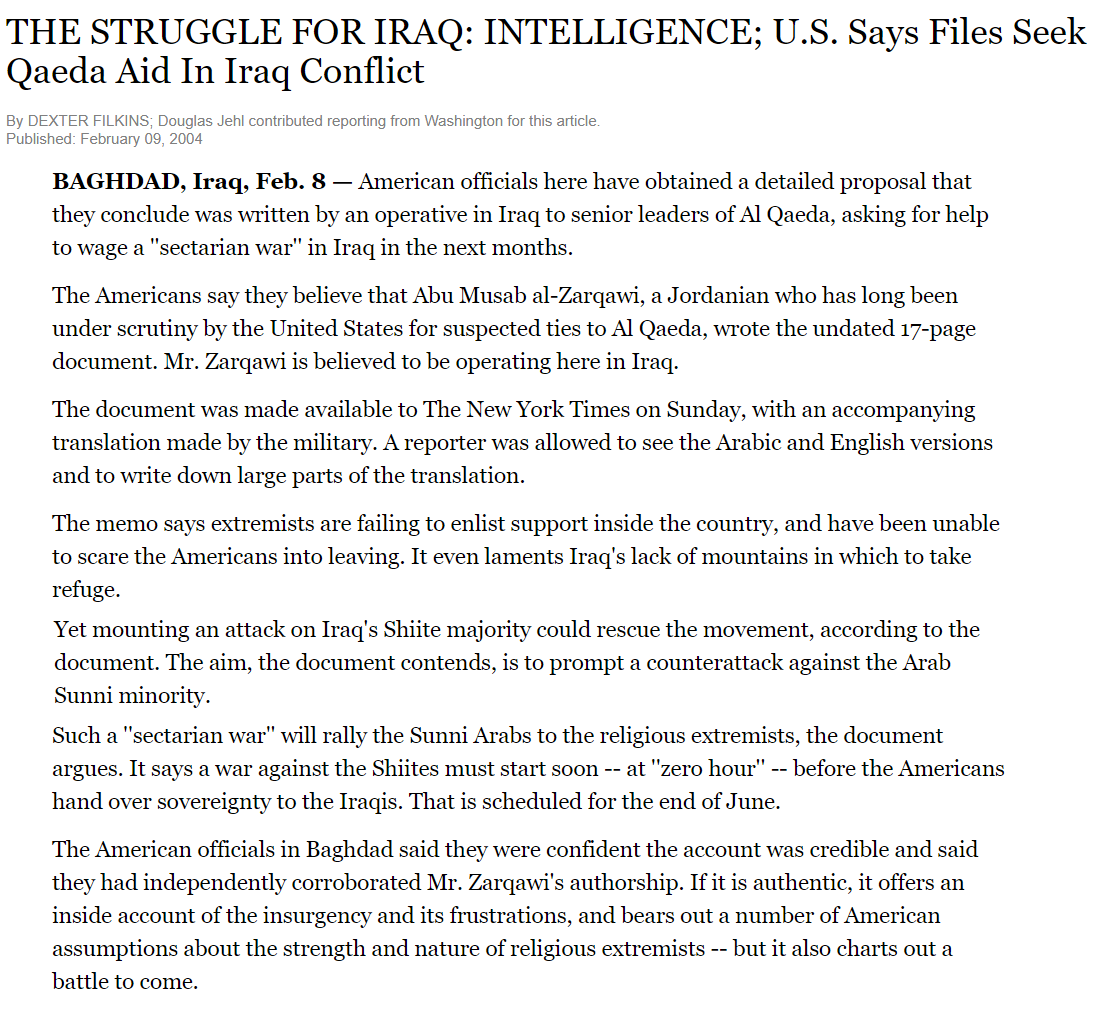
Here the lie of the “sectarian war” is delivered to the minds of the Westerners. The so-called “Zarqawi memo”. “Attacking the Shiite majority could trigger a backlash against the Sunni minority and trigger a sectarian war to rally support for AQ”.
“This must occur before a political handoff”. There was never to be a political handoff – there was never a goal of establishing a stable “puppet authority”. This is demonstrated by the continuous attacks against the puppet political apparatus by the coalition itself.
But we see here, in the coverage, the assertion slipped in that AQ = “the insurgency”. What we have not been able to cover thus far is the nature of the genuine insurgency, because the genuine insurgency was not covered.
It was “drowned out” in the Western press by the doppelganger, by the attacks against social and political targets. Presumably such a genuine insurgency did exist, and we will see accounts of it later.
At this time it is difficult to find “verifiable” information about such attacks. At any rate, the form of such a genuine insurgency does not really need our examination –
It would consist of attacks against the coalition and their legitimate allies, which in my opinion by and large does not include the police forces.
The reason being that I think by and large the police forces represent a body of armed and organized Iraqis who would be able to try to save lives against the attacks of the coalition – this is why police forces were so heavily targeted by the coalition forces.
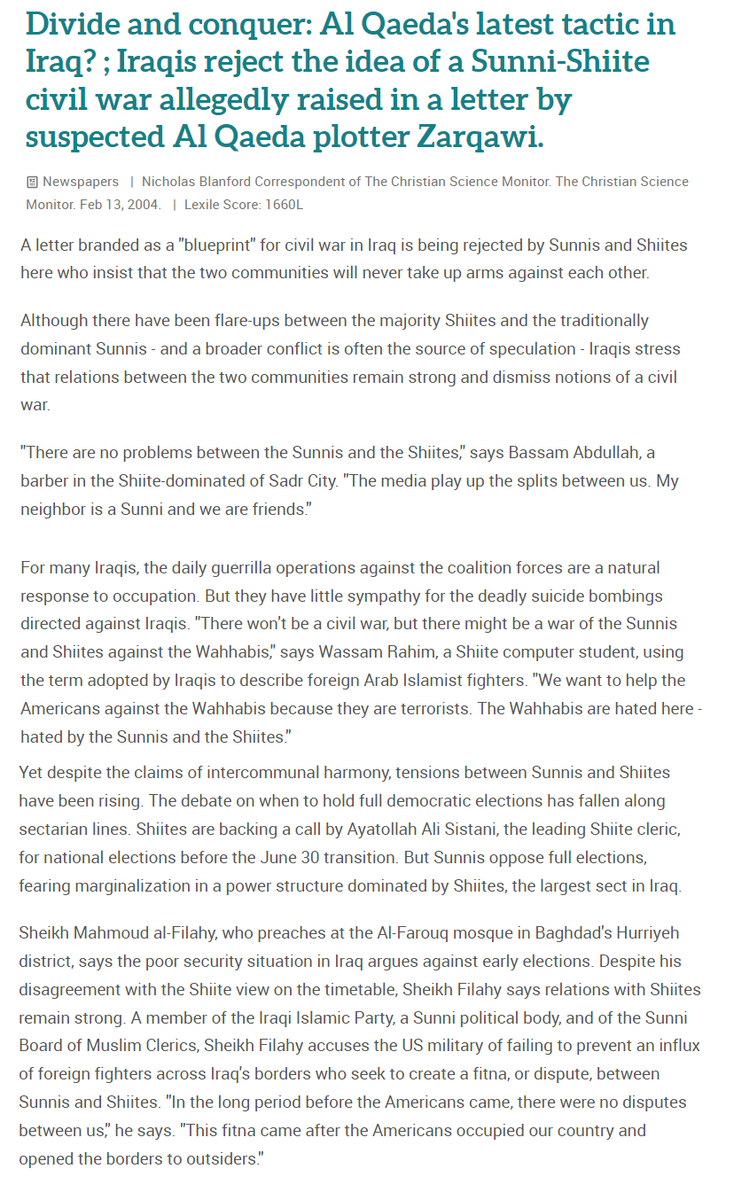
In response to this “blueprint”, Iraqis asserted unilaterally that such a civil war was an impossible figment of the imagination. Indeed. “The media play up the splits between us”. “We are friends”.
“There won’t be a civil war, there might be a war by Sunnis and Shiites against the Wahhabis”. While we can reject the latter part of this quote about assisting Americans, as either misguided or planted, what is suggested here is what should be obvious to all of you reading this thread –
That it makes no sense that the Iraqi people would fight each other. Despite this, the article baselessly asserts that ‘tensions are rising’ – whether or not there was disagreement about the nature of elections etc, we don’t really need to weight into.
There are legitimate positions that could be derived for or against any sort of participation or timetable for these elections, that there was some form of debate on this is absurdly misrepresented as being contrary to the idea of “inter-communal harmony” and it is more or less delivered as a “gotcha” supporting the premise of a civil war. This is walked back in the final paragraph, but you can’t just forgive this kind of backhanded rhetoric because they slightly walk it back –
As phrased, moderate debate and disagreement over electoral timetables is being used as a “well, actually...” to support the civil war premise. But again, its made as clear as it possibly can be here: “before the Americans came, there were no disputes”.
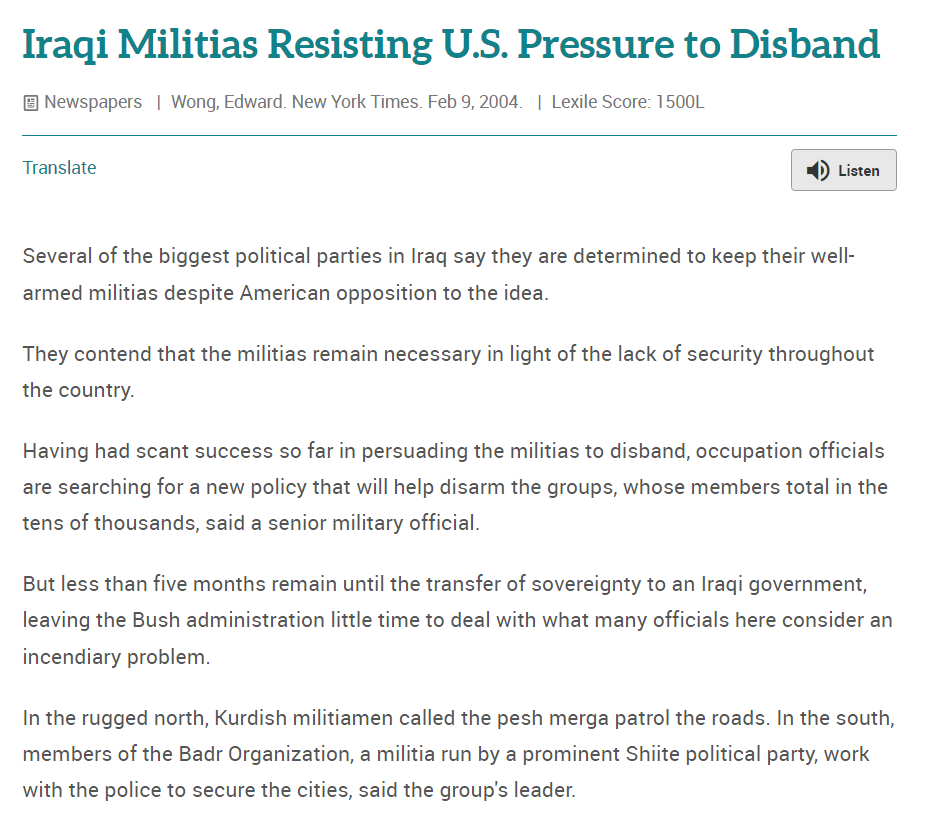
Just a small piece of context here, various militias were another persistent target of the coalition that remained armed to protect Iraqis against attacks from the coalition, and disarming these groups represents a significant thrust of the war.
These groups, which presumably are harder to attack than police organizations due to their structural differences, represent another buffer of defense between the population and the coalition.
Moving on, another very large-scale attack occurred in February – it should be becoming clear that attacks are intensifying and escalating as the war is progressing – this one in Iskandariyah.
Iskandariyah is South of Baghdad, has a population of maybe a hundred thousand, from which we can note that major attacks were not limited to very-large cities or any particular geographic region of the country.
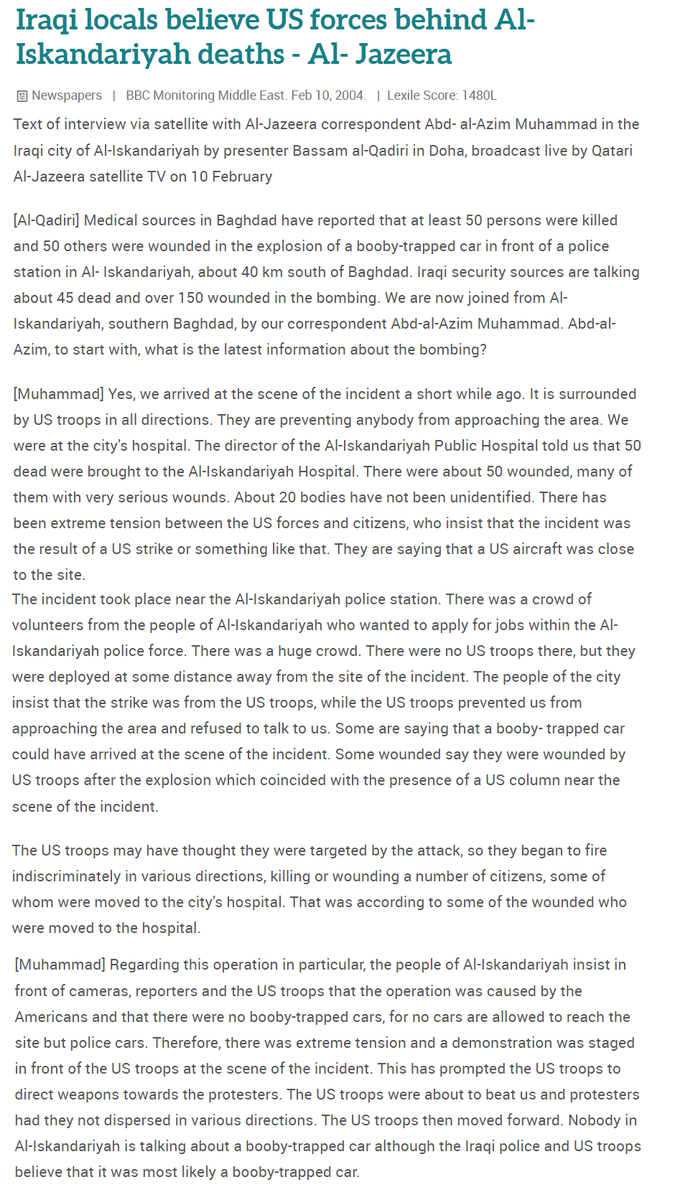
We see a slight departure from the ‘self-destroying vehicle bomb’ narrative, with the phrasing seemingly implying a pre-rigged parked car as the source of explosion.
Predictably although this is not described in the attacks we have examined so far, US forces have surrounded the site and are not allowing access. Citizens are insisting that this was the result of a US strike, allegedly mentioning US aircraft as a possible source.
This – US aircraft – gives us another possibility to pre-planted remote detonated explosive device. At times this makes sense and at times this would present problems –
Attacking the inside of a building (rather than simply hitting the outside of it), the very obvious trail that missiles/etc would display during transit, etc. All of those things need not be insurmountable issues, and we are seeing what may be an example of this here.
At any rate, here is a police station being attacked and the citizens nearby are insisting that it was US forces. This should always be the obvious case but here we have explicit confirmation even in such an outlet as Al Jazeera.
Moving further into the article, the bystanders “insist” there was no booby trapped car – ok, so at least we have to take this seriously, maybe this was an airstrike. Certainly I see airstrike as the number two possibility as a rule after pre-emplaced bomb.
I don’t want to simply cling to the pre-emplaced bomb theory but I also think that there are probably many cases it makes more sense than airstrike. I will keep all options in mind as we continue.
At any rate, according to this coverage, at minimum the narrative given is there was no car bomb.
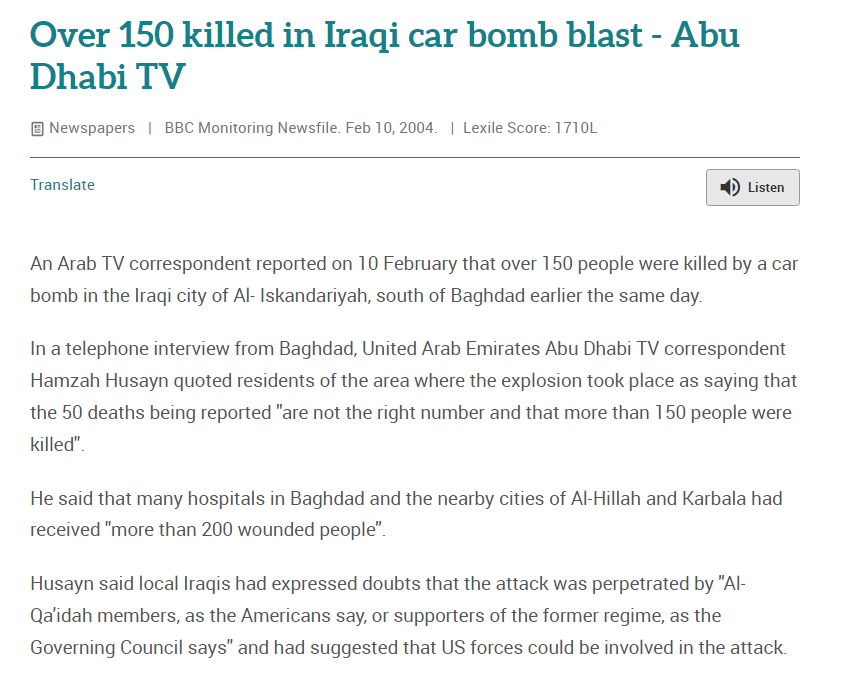
Eventually the casualty figure here was given as over 150, so this is a large-scale attack. Reiterated is that this was an attack by US forces.
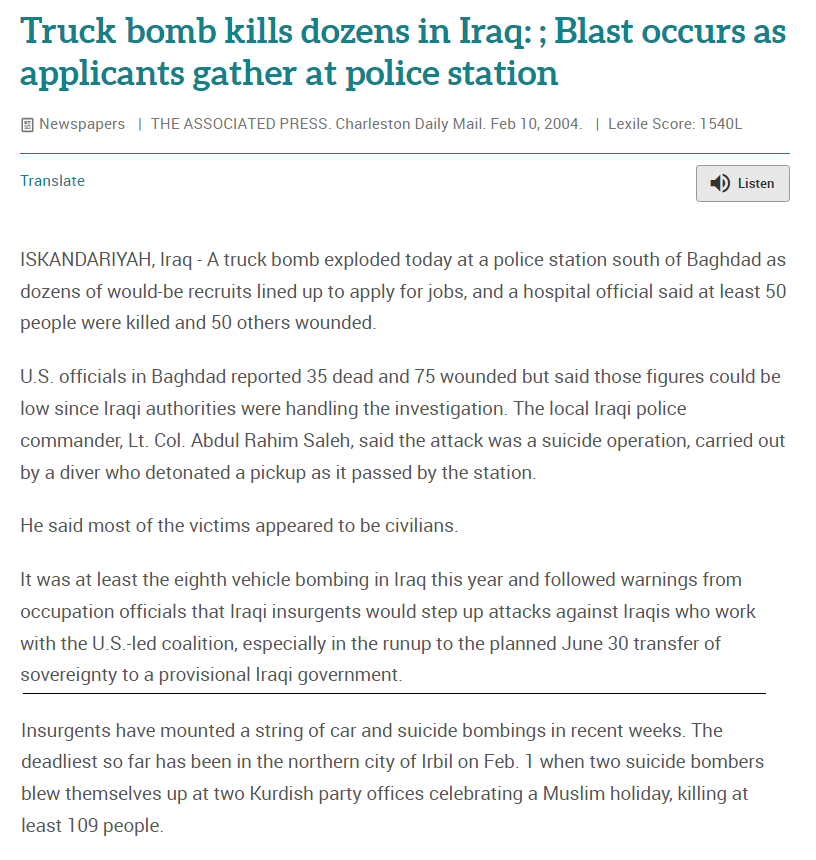
Here, seemingly after a time lag, they do try to get ahead of this narrative and assert that it was not just a ‘rigged car’ but a ‘suicide car’ and it is reiterated that the target was the police station and particularly the line of potential recruits applying for jobs.
The ‘suicide’ narrative we can write off as false, but I do believe this is an accurate assessment of the target and the motivation. This sub-form of attacking recruits is one to remember.
Note that there is a phrase here, ‘at least the eighth vehicle bombing’. We don’t even think this is a vehicle bombing. I highlight this because this is a fake statistic, this is not ‘real’ data. We will also see much of this going forward as things progress.
I am trying to draw attention to forms, patterns, themes, narratives being built or deployed even at this early stage and that will continue to be utilized throughout the war.
So, who was the unit that was present at the attack in Iskandariyah?
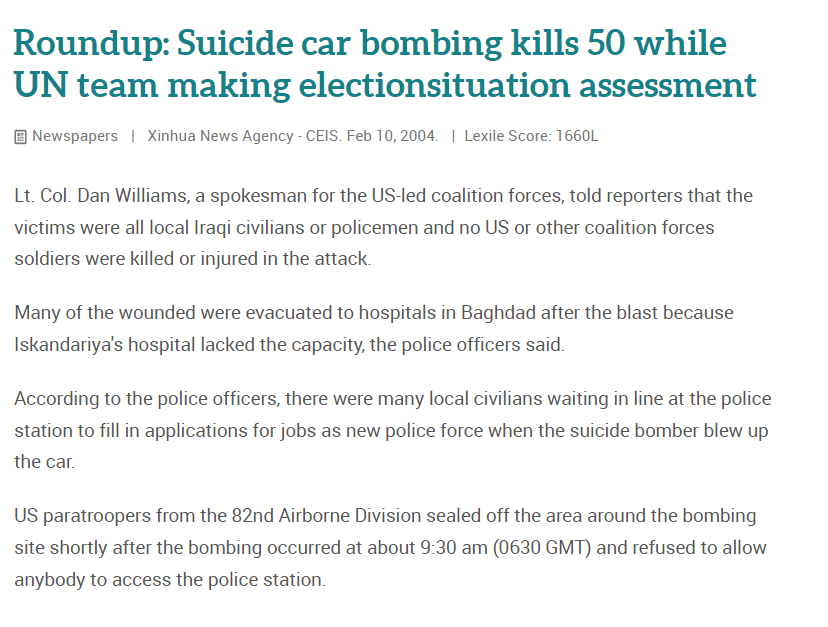
Without specifics we see in this article that the unit is from the 82nd Airborne Division. Why do we want to know this? Well, this is at minimum a group of category 2 or category 1 actors.
And while they are carrying out actions directly, the categorization refers to their knowledge of and interaction with AQ-related forces – but by carrying out this action, they are at minimum category 2 “clued in” actors aware of the relationship.
And this is how we should expect a large portion of the coalition to be. But I highlight it here so that we can remember that framework and apply it in cases like this.
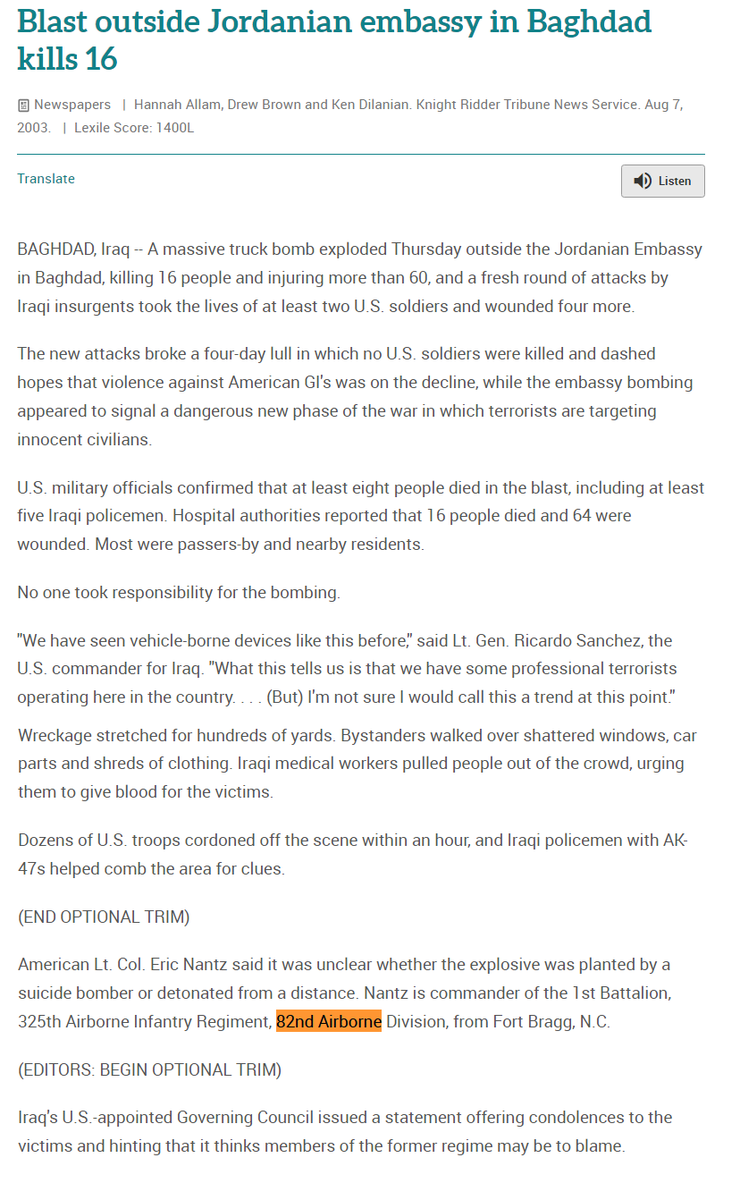
The 82nd were also on the scene after the August 2003 bombing of the embassy of Jordan. A division is a very large group, ~20k, so this doesn’t mean ‘much’ but notably this is a division that keeps coming up as ‘on the scene’ for similar events.
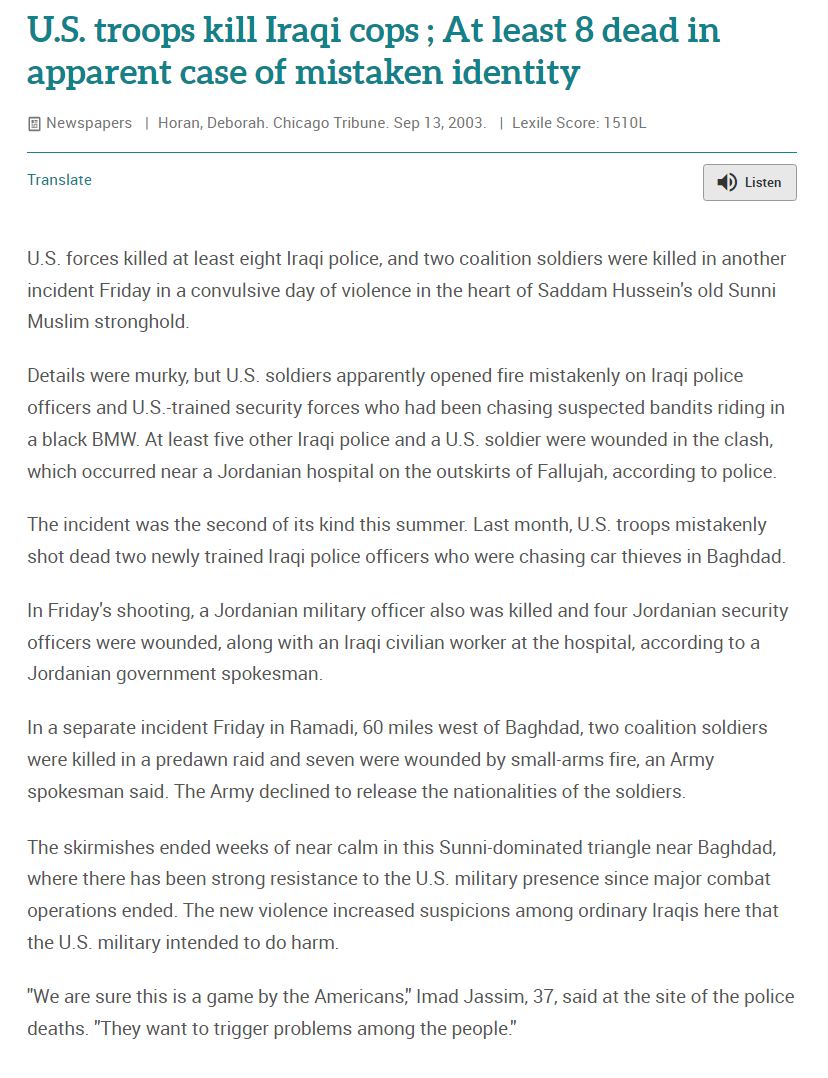
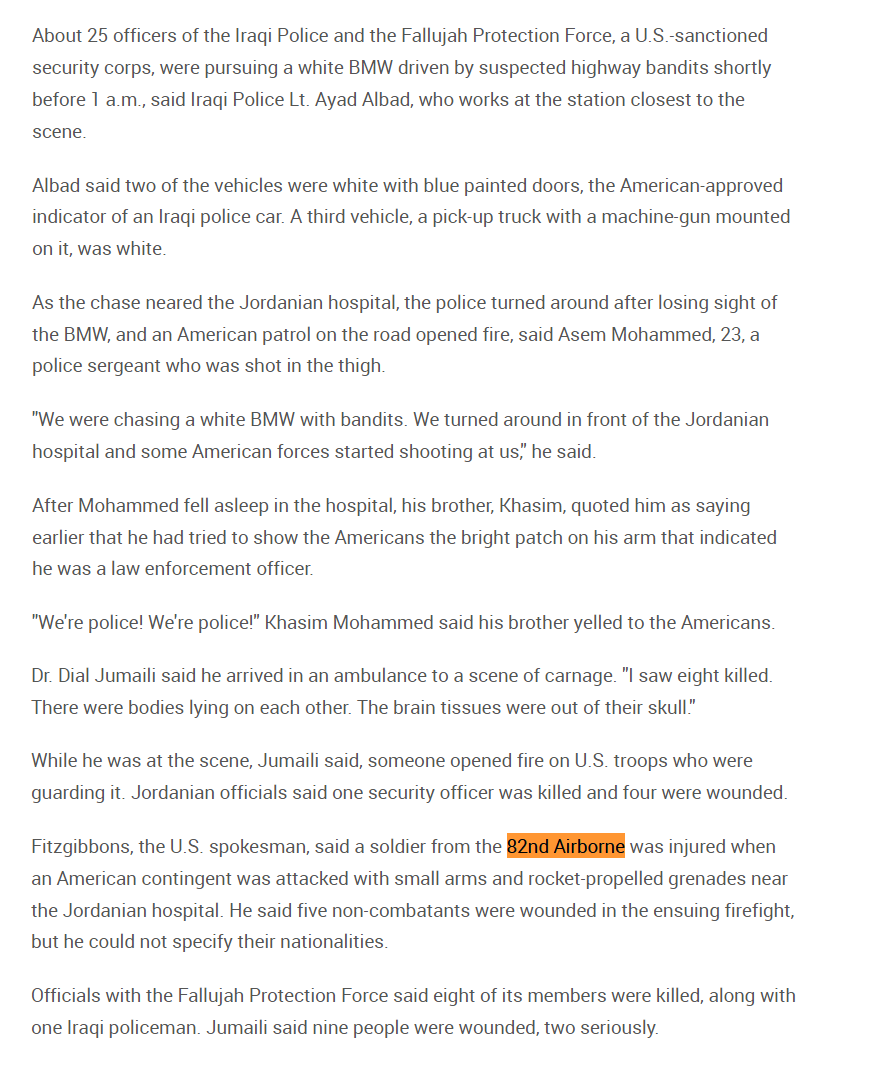
Here again ‘opening fire mistakenly’ on Iraqi police, and note that they go right ahead running the quote that says ‘we are sure this is a game from the Americans’.
I don’t add these quotes because I think it is necessary, and in the absence of them I think it is fine to simply rely on logic –
But this is the end of any conversation to rehabilitate the soft-pedaling of the war, of ‘isolated incidents’ and ‘random atrocities’ rather than a cohesive plan with civilians as a primary target.
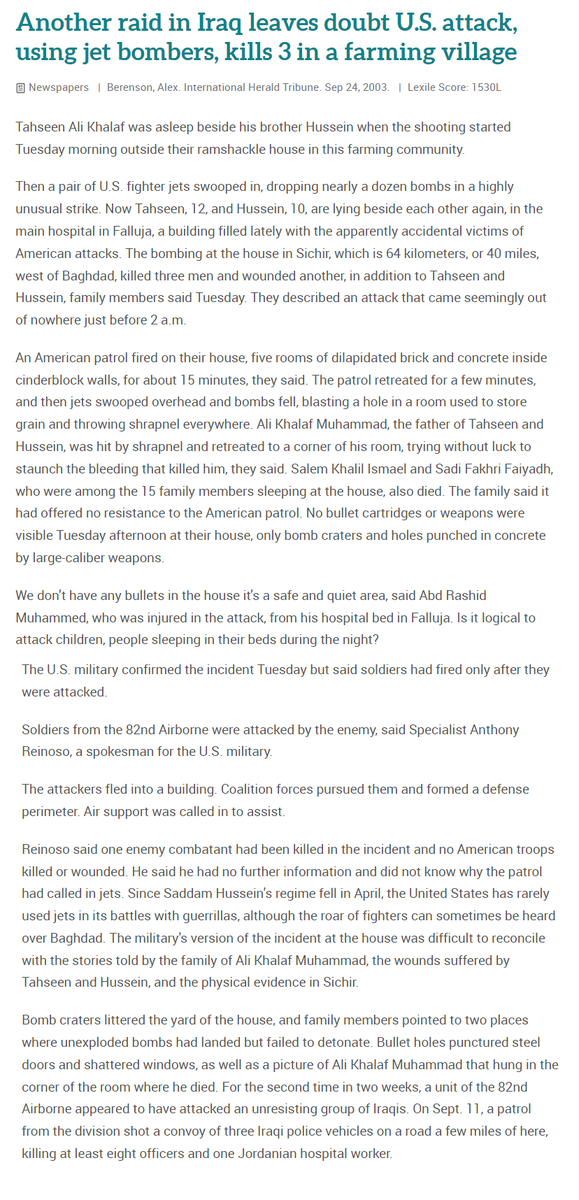
Here again the attackers are from the 82nd Airborne.
This does not necessarily mean that its true that the troops involved are from the 82nd – I don’t think that the true structure of the coalition military necessarily corresponds to the public-facing structure.
It could be that it is a convenient catch-all to label dark operations with the 82nd brush when this is in fact not true. But I point it out as something of mild interest, we don’t need to dig overly ‘deep’ into it.
By March of 2004, the AQ narrative had set in –
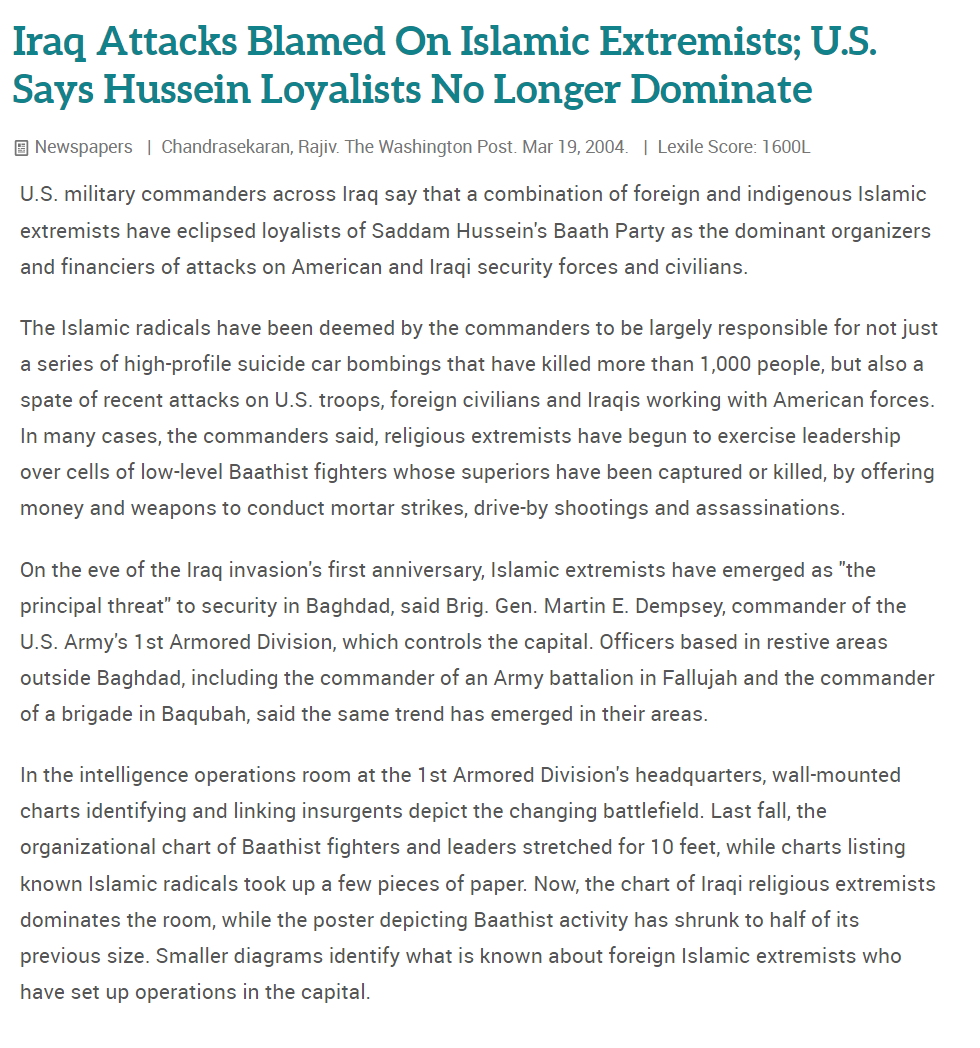
The abandonment of the ‘FRE’ narrative has become convenient, though we may note how brazenly they simply imply that AQ has “eclipsed” FREs as if the two groups would just happen to have identical goals and methodology! As if they were both conducting the same types of attacks but one has simply surpassed the other in terms of scale. This is the level of cognition expected of Washington Post readers.
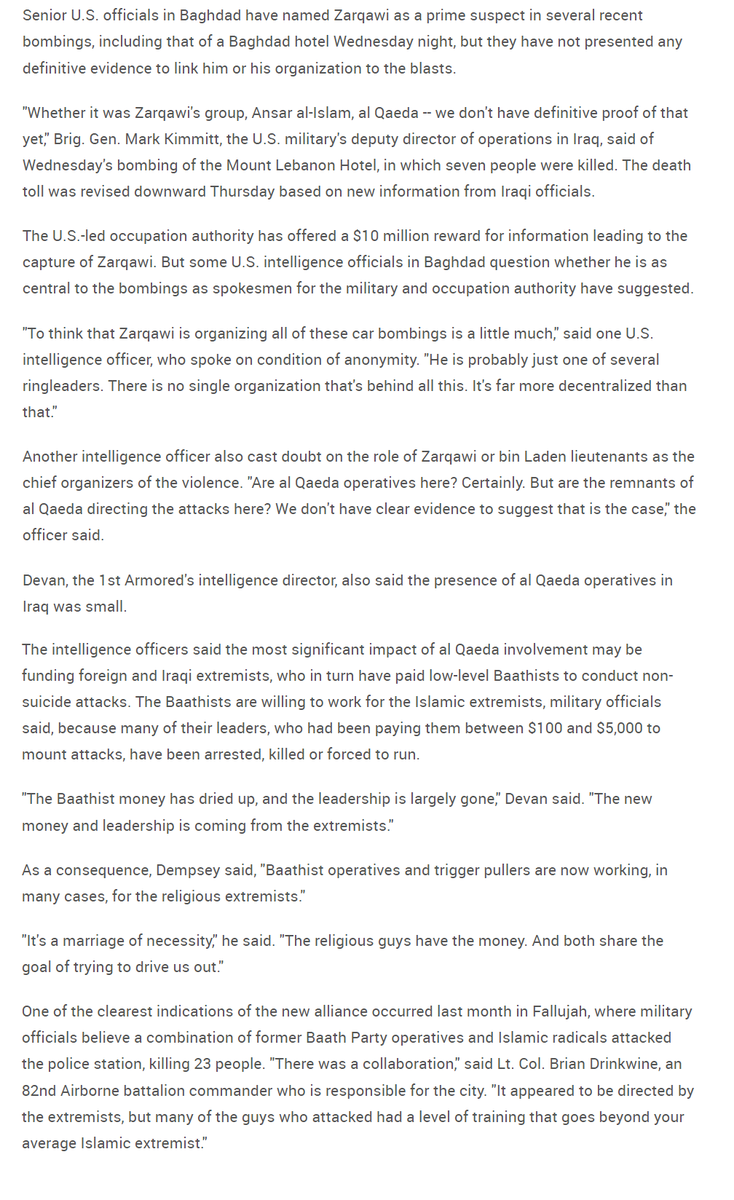
Zarqawi the fiction is becoming a more and more emphasized aspect of the narrative. There is some merging here where they justify the FRE/AQ aspect by saying AQ is paying FREs, as if AQ has more money than the FREs.
We don’t need to interrogate every such nonsense but just think about, the idea that these random non-state groups would have more money than former officials IN their own country.
‘The religious guys have the money’. How, were they collecting taxes and running a country? Where did they get more money than former state actors? This is all a fiction.
Here again we see “Colonel Brian Drinkwine of Fallujah” – may whoever is responsible for this absurd fiction be cursed – justifying the AQ FRE collab narrative because they had “experience”.
Reaching ahead, we will see the quote of a spokesperson for Muqtada Sadr address the matter of Zarqawi before we take a brief pause –
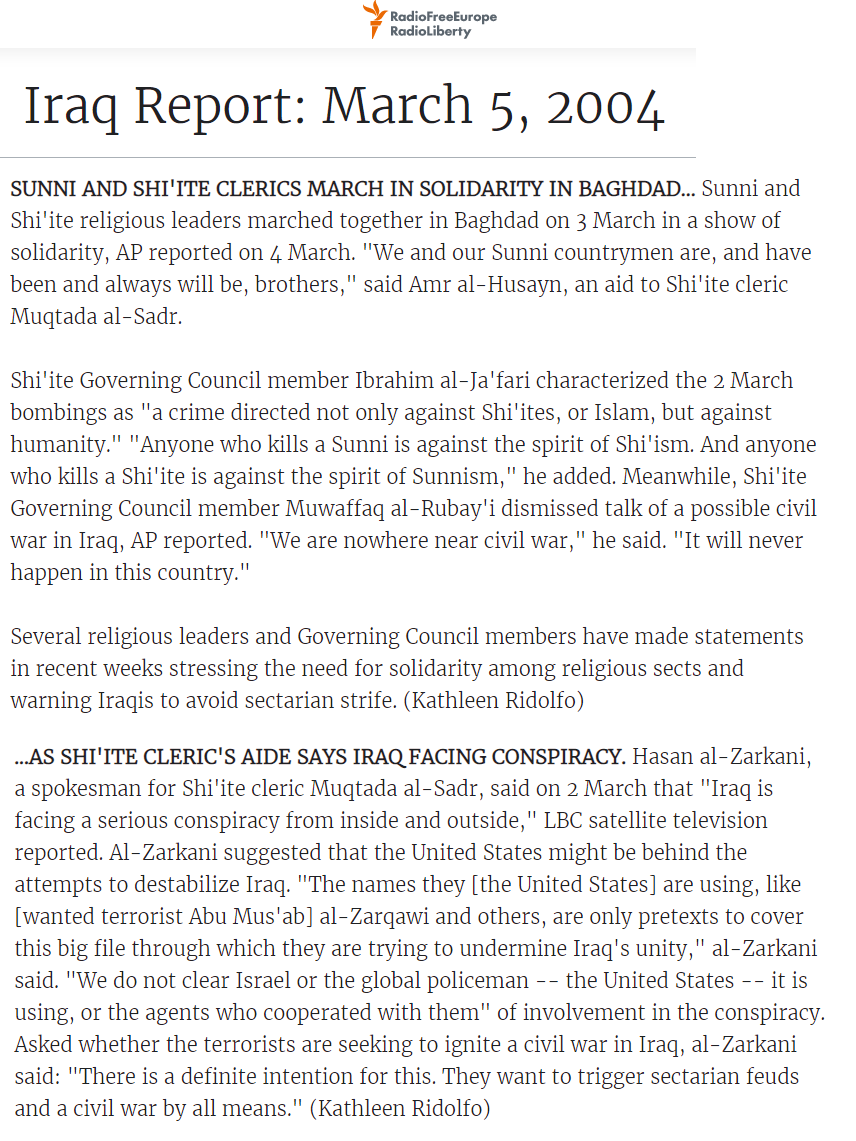
“The names they are using, like Zarqawi and others, are only pretexts to cover this big file through which they are trying to undermine Iraq’s unity”
Even the governing council denounces the idea of a civil war – “we are nowhere near civil war, it will *never happen in this country*”.
The context of this quote is the next significant event, and one of the most serious strikes made by the invaders, and one of the clearest aligned thus far with the true intent of the war – that it is a war against Islam itself. This will be our next focus, inshaAllah. But this serves as a productive stopping point having covered the period between the end of the “invasion” and the early aftermath as it gave way to the next phase of the war.