VI. March 2nd, 2004.
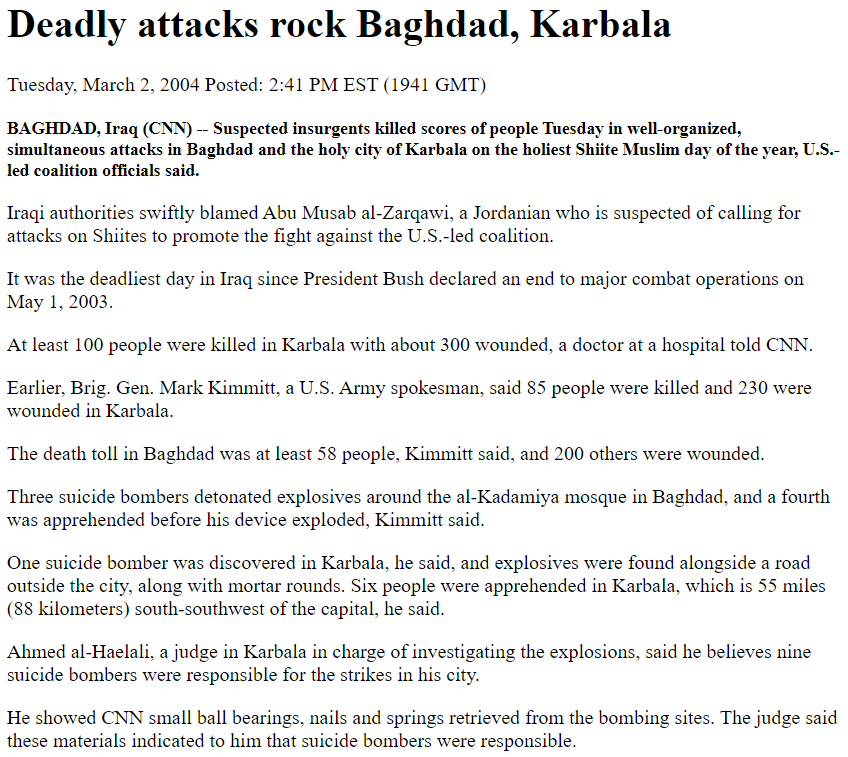
It’s been awhile since the last update, so lets recap where things were at heading into March of 2004. By February, Western coverage had shifted towards the idea of an Al Qaeda-dominated insurgency (as opposed to “former regime elements”), and had floated a document called the “Zarqawi memo” that outlined a plan for Al Qaeda to provoke a “civil war” between Iraqis – Sunni and Shia. As previously stated, Iraqis asserted this would “never happen” and it never did.
On March 2nd, the coalition made good on its threat to fabricate a civil war and launched a series of bombing attacks that killed over 100 people on the day of Ashura. This was immediately referred to as a series of “suicide” attacks in the Western press, such as the CNN article above. This is also a fabrication – we will see coverage of the immediate reaction of Iraqis after the attack and their reaction makes it very clear that there were no suicide attacks. Bombs were placed and detonated in both Karbala and Baghdad. Details such as, “there was a fourth suspect apprehended” I write off as pure fabrication. The judge quote here also makes no sense. Maybe another intentional “error”, but at any rate more padding for the suicide narrative.
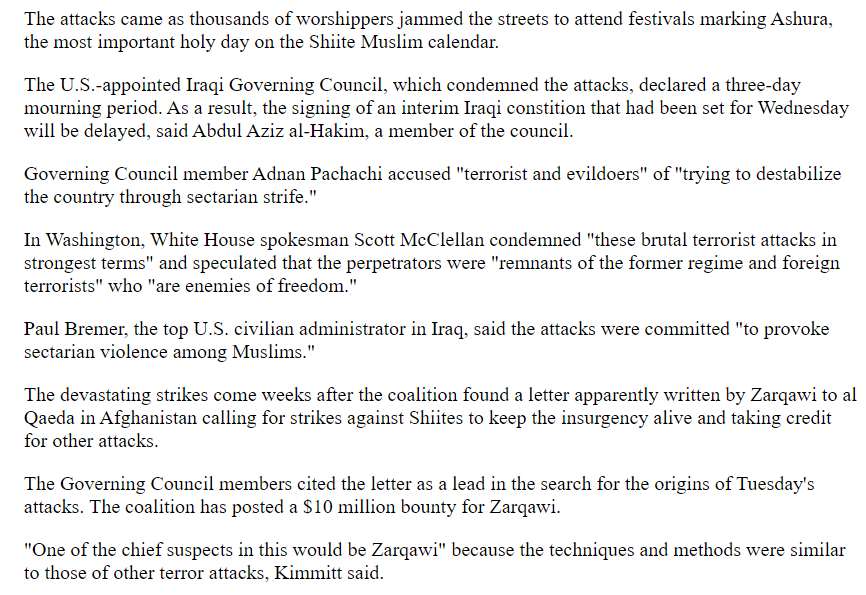
Of course, the Zarqawi memo is referenced as an explanation. Remember that this is a fiction that is still widely believed in the West
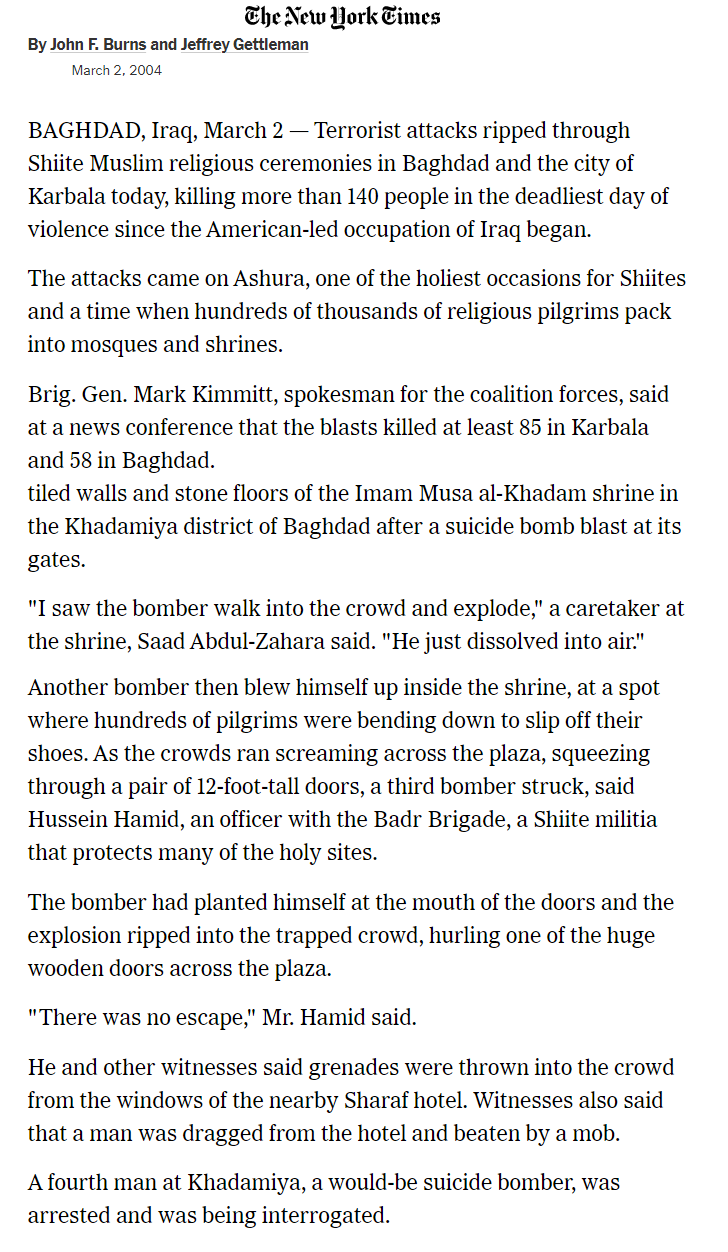
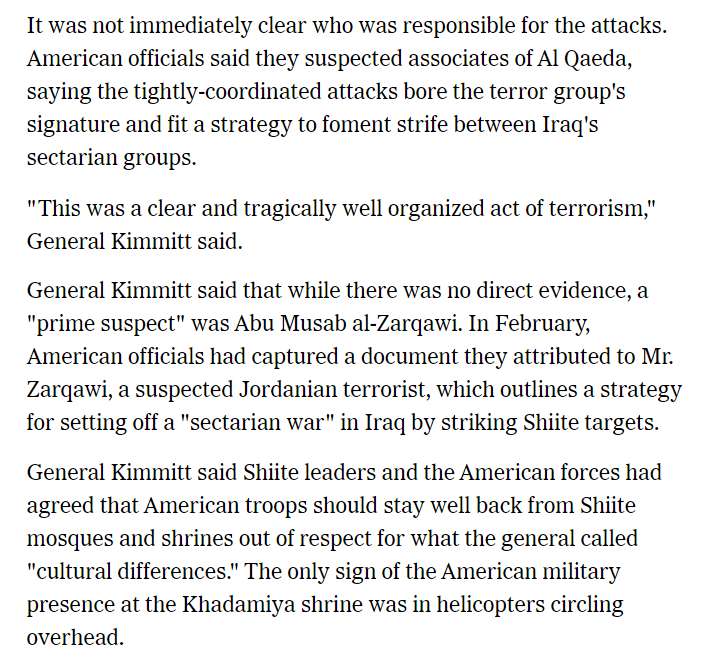
In the NYT coverage of the same event, more fabricated evidence is touted to push the suicide narrative, and the Zarqawi memo is referenced again.
There is some utility in covering how these events are covered in the Western press, and how these events are used to build narratives for Western audiences, insofar as a portion of the goal of this thread is to undo these false narratives and make it easy for a truer understanding of the Iraq war to spread and be transmitted. But these narratives, all told, are fairly inconsequential – they don’t drive the events. But it is easy to incorrectly get or impart the “sense” that they do. For example, from the timeline of the Zarqawi memo -
First we see the narrative seeded via the memo, then we see the “pay off” now in March which activates the AQ narrative. Simply by constructing this timeline, we have to be cautious of erroneously inflating the significance of the memo and the narrative. Lets stop then, before analyzing the event itself, and reiterate Iraqi viewpoints about the event and Western narrative:
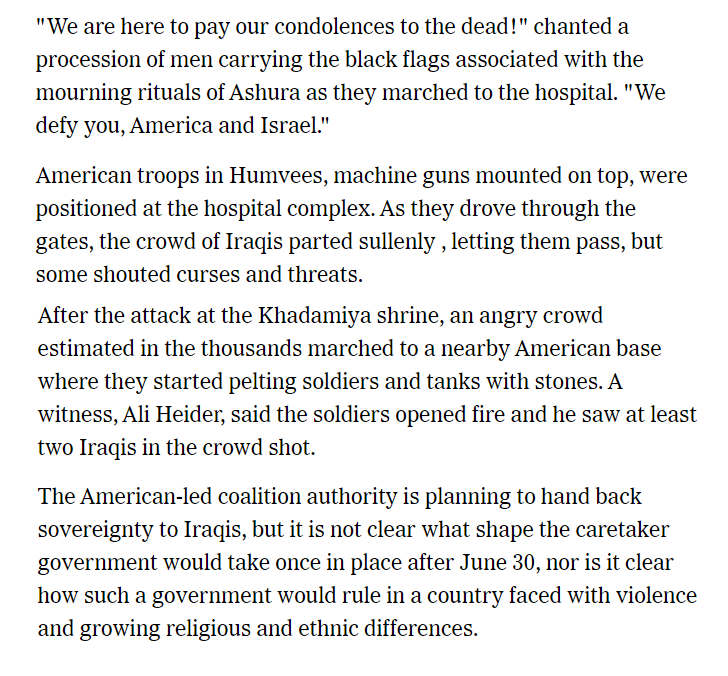
This is still the NYT article, and even here they admit that everyone knows who actually did the attack. Does there seem to be any doubt in where to assign the blame? No, and rather than outright contradiction this is mentioned for three paragraphs and then the fourth paragraph simply pretends the previous three didn’t exist.
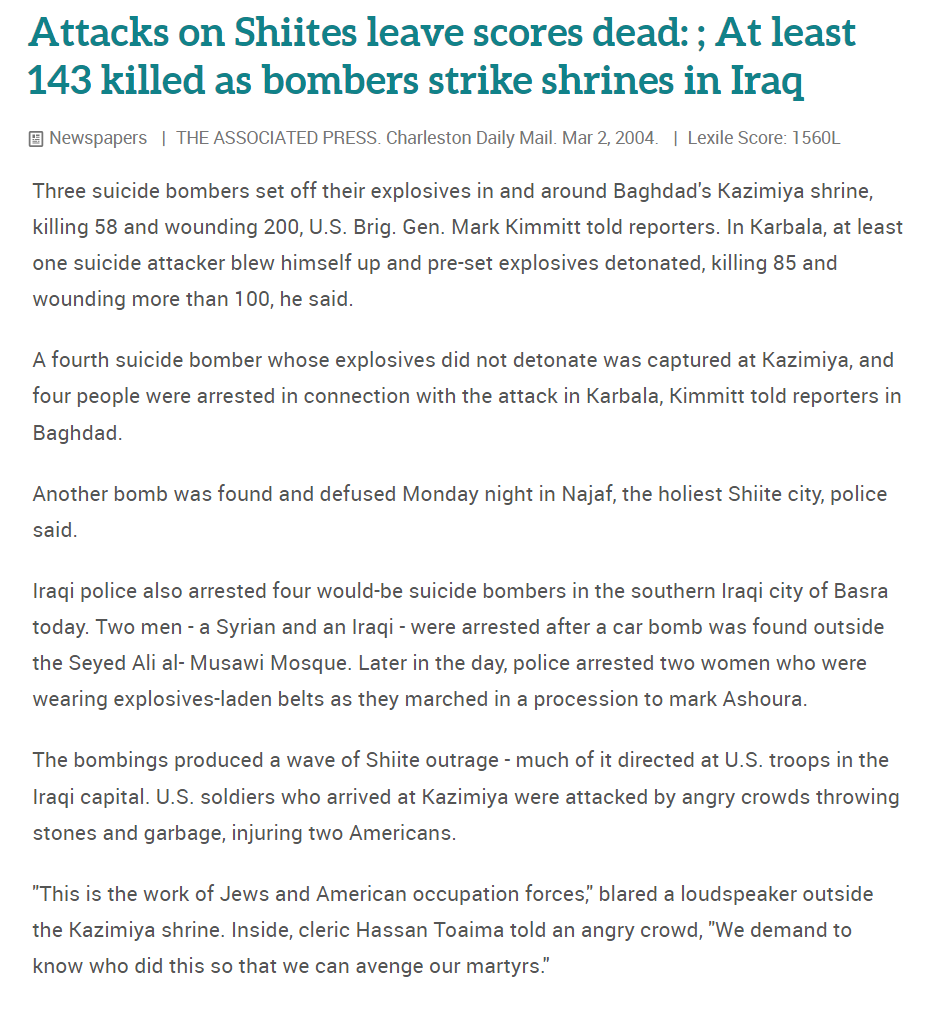
Here is an AP article with more fabrications towards the suicide bombing narrative, but also another admission that the people at the shrine which was attacked were correctly blaming the occupation over loudspeaker.
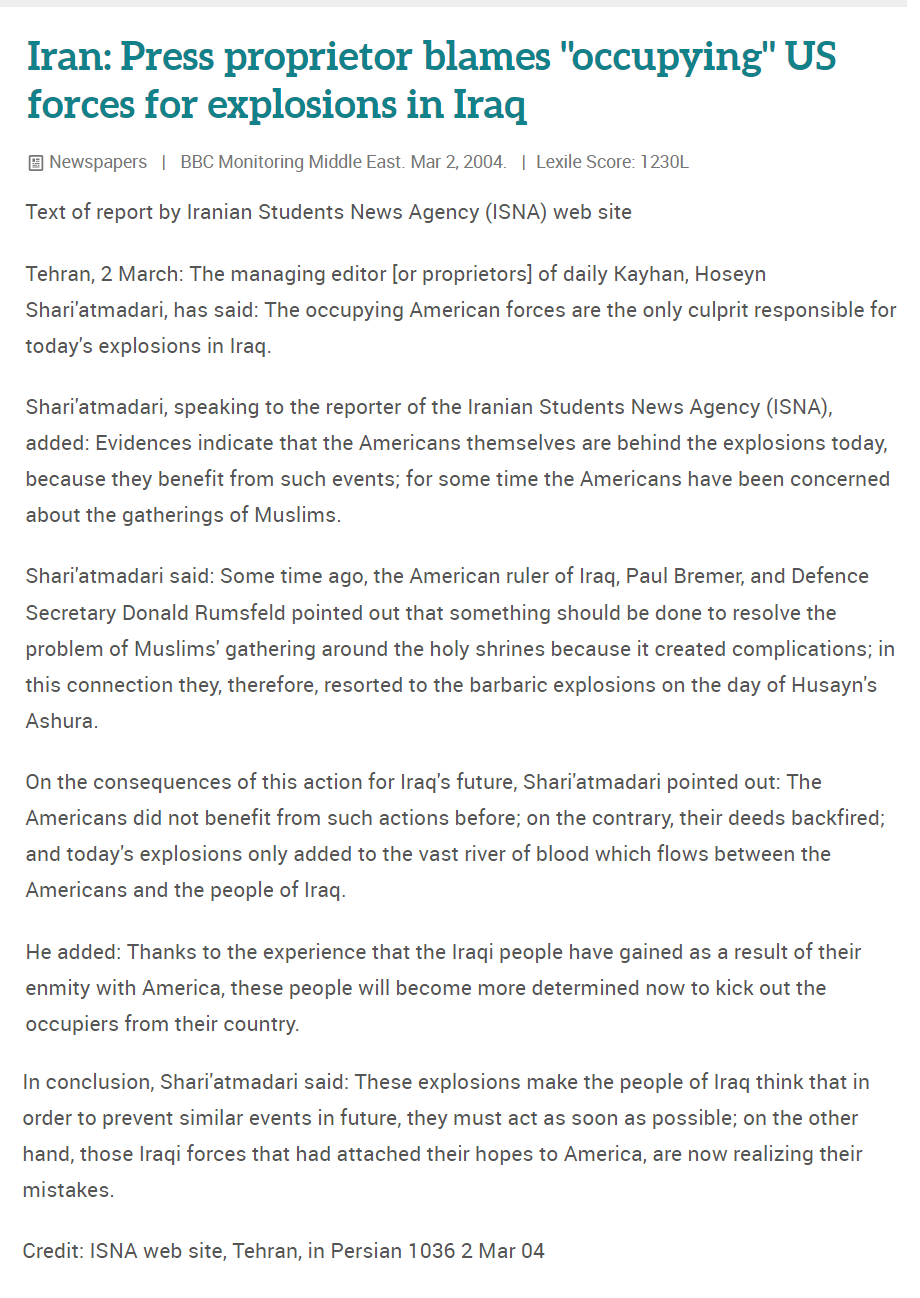
Iranian press was of course more direct, I personally disagree with the analysis that the motivation was to prevent large gatherings and we can explore that later.
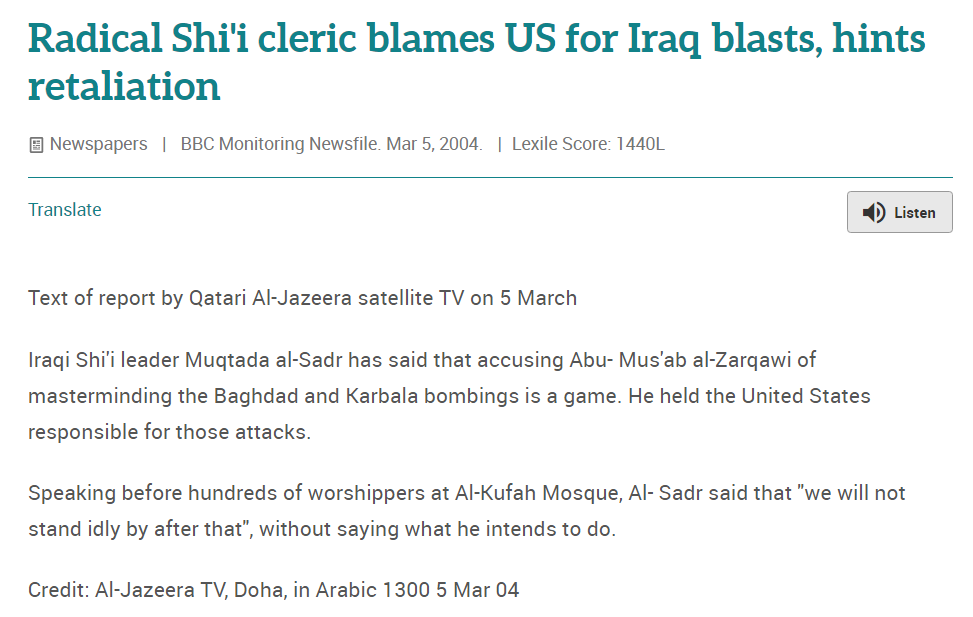
Here we see Muqtada Sadr say explicitly that accusing Zarqawi is a “game” and that the United States is responsible.
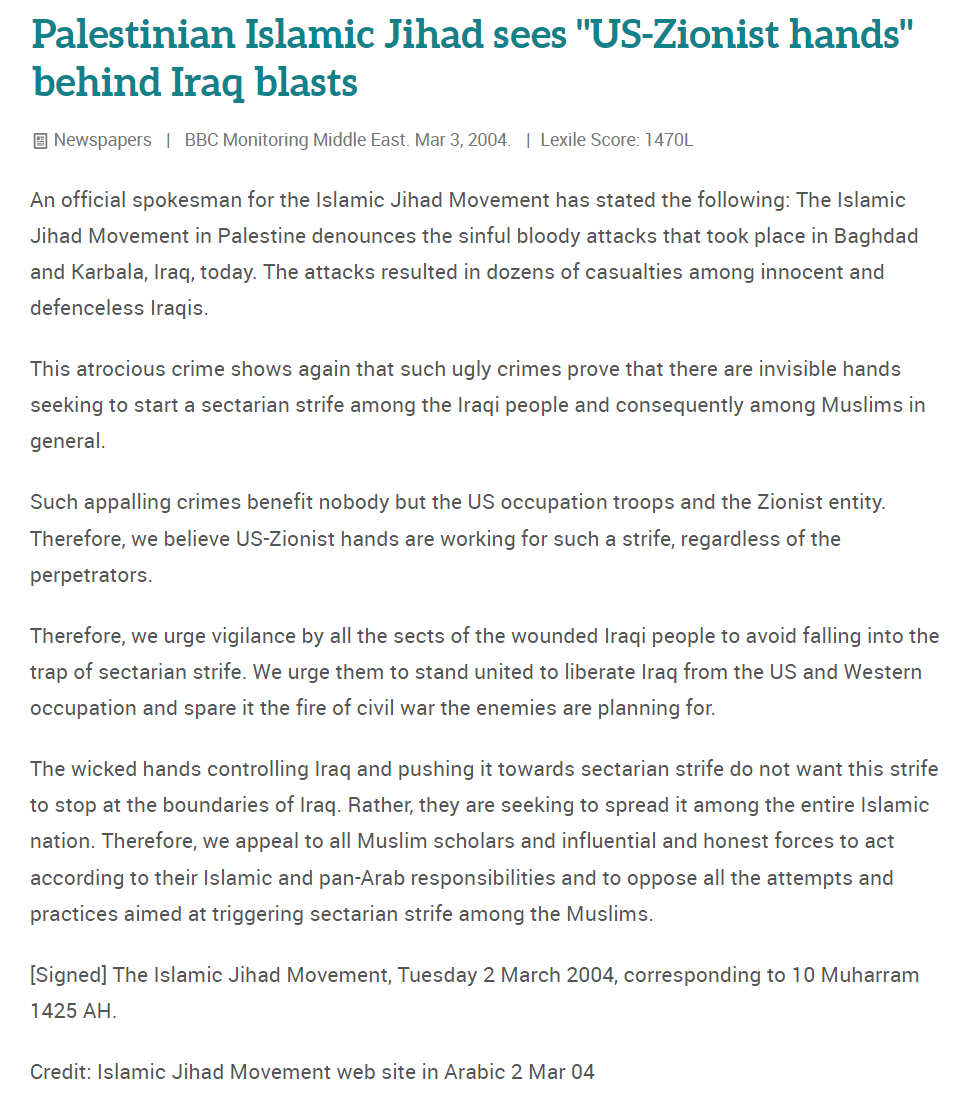
And on,
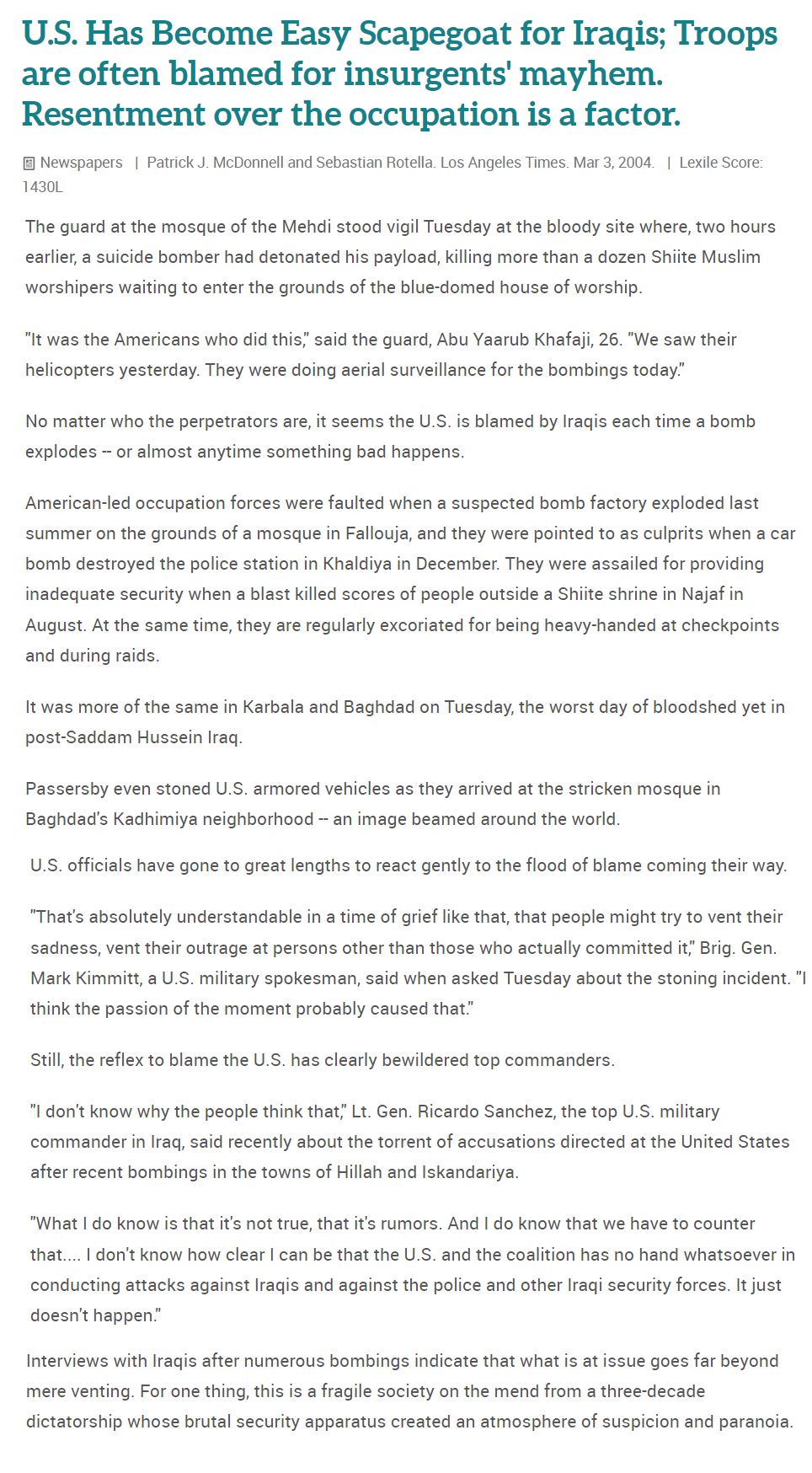
And on. What is my point in belaboring this? I just want to make it clear that the AQ narrative, the Zarqawi narrative, the civil war narrative, these things did not hold sway over Iraqis. So we can dismiss the idea that “the coalition wanted to ‘ignite’ a civil war” and we can dismiss the idea that Iraqis were behind so-called civil war violence.
Furthermore, at this point it should be clear to any and all readers who is really behind the attacks we have covered and the attacks to come. All suspicious violence from this point forward may be blamed on the coalition by default. This includes not just violence blamed on “AQ” but on “elements reacting to AQ”.
So while it is productive to examine the narrative and psychological manipulations directed at the West, because people do still believe wholesale in these narratives here, we can also consider this accomplished and now cease including this aspect into our examination of things. Addressing the fantasy built around the war does not explain the war, it distracts from an actual explanation.
But I will include one more side-by-side comparison here, and may do so going further from time to time:
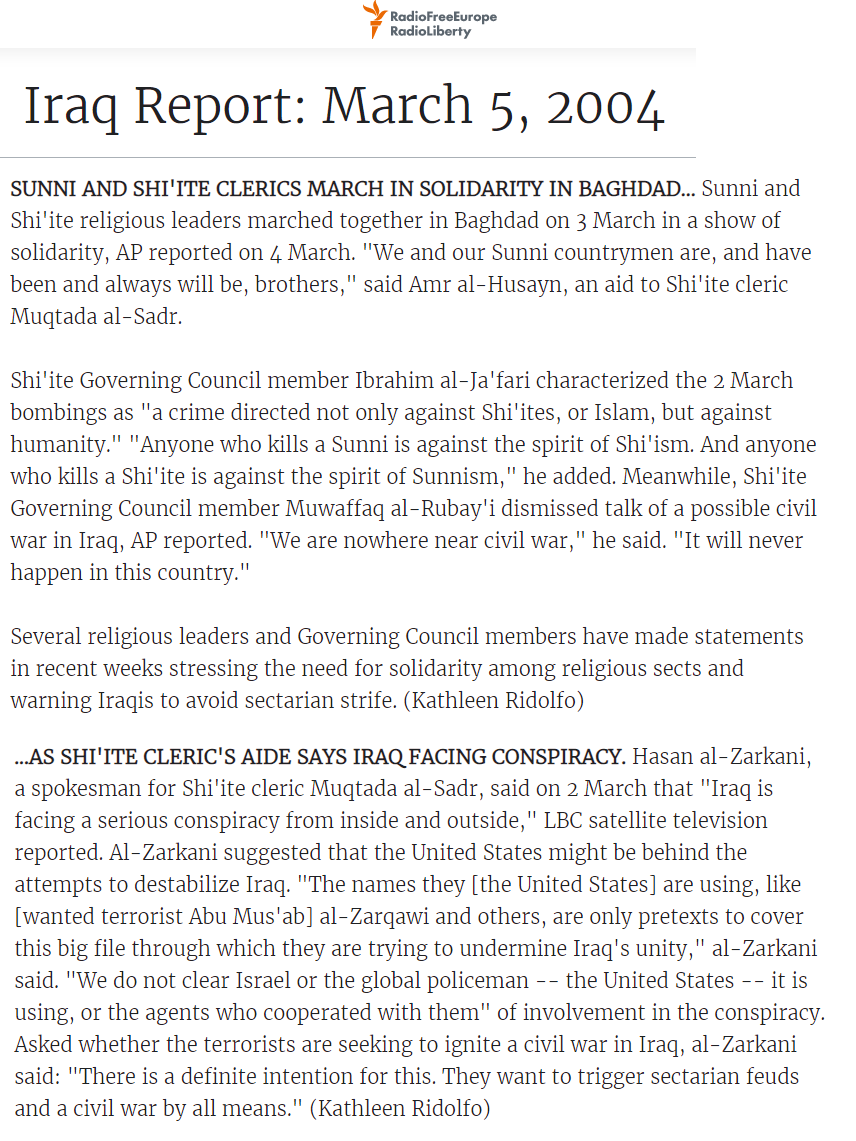
On one hand, “we are brothers and always will be”, “we are nowhere near civil war, it will never happen”. “Names like Zarqawi are only pretexts”.
On the other:
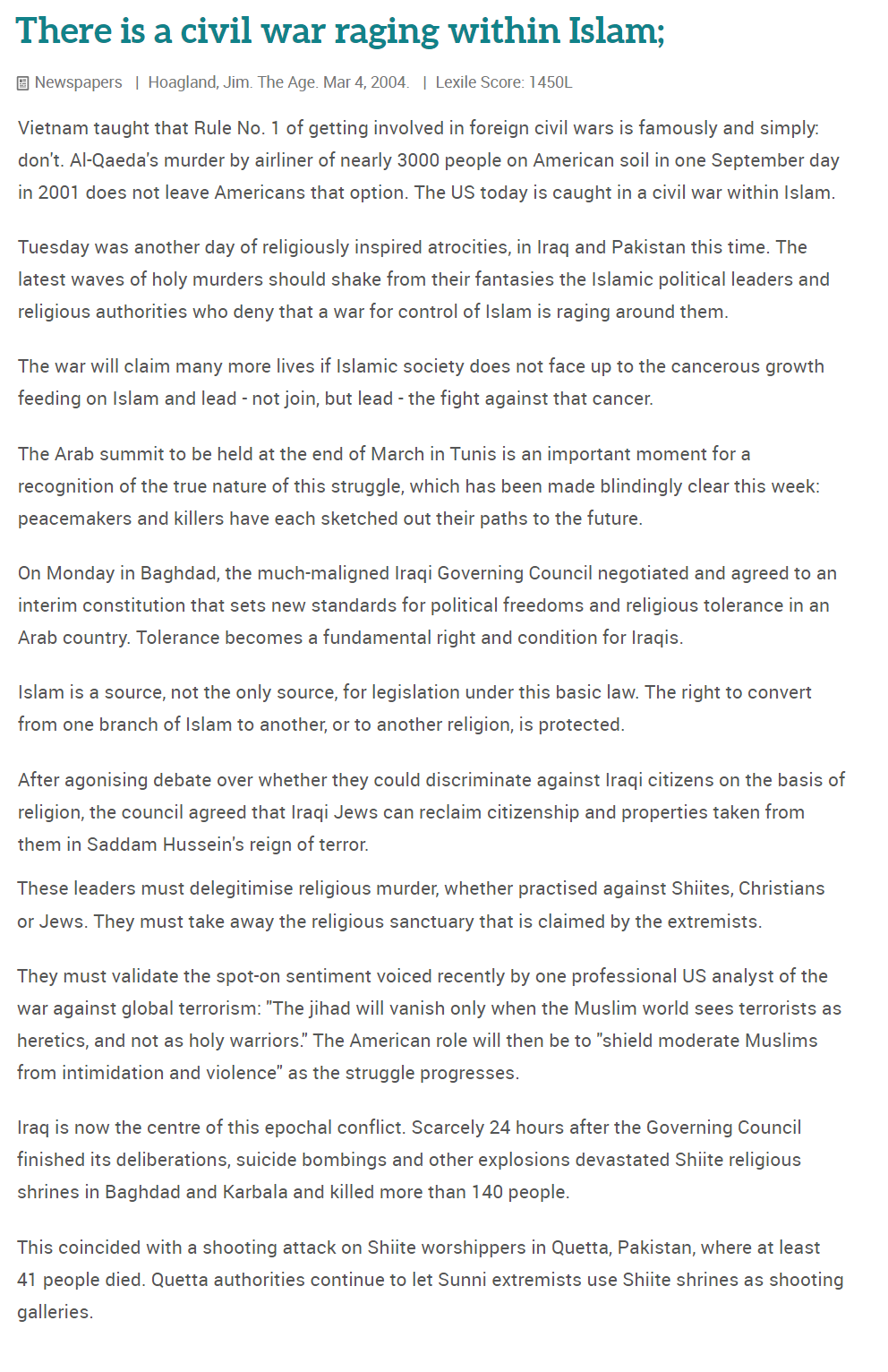
“There is a civil war”. “The USA is caught in the civil war”. “Until our arrival, tolerance did not exist”. “Islam must step up and cleanse itself”.
One final note before examining the attack in the absence of this narrative game -
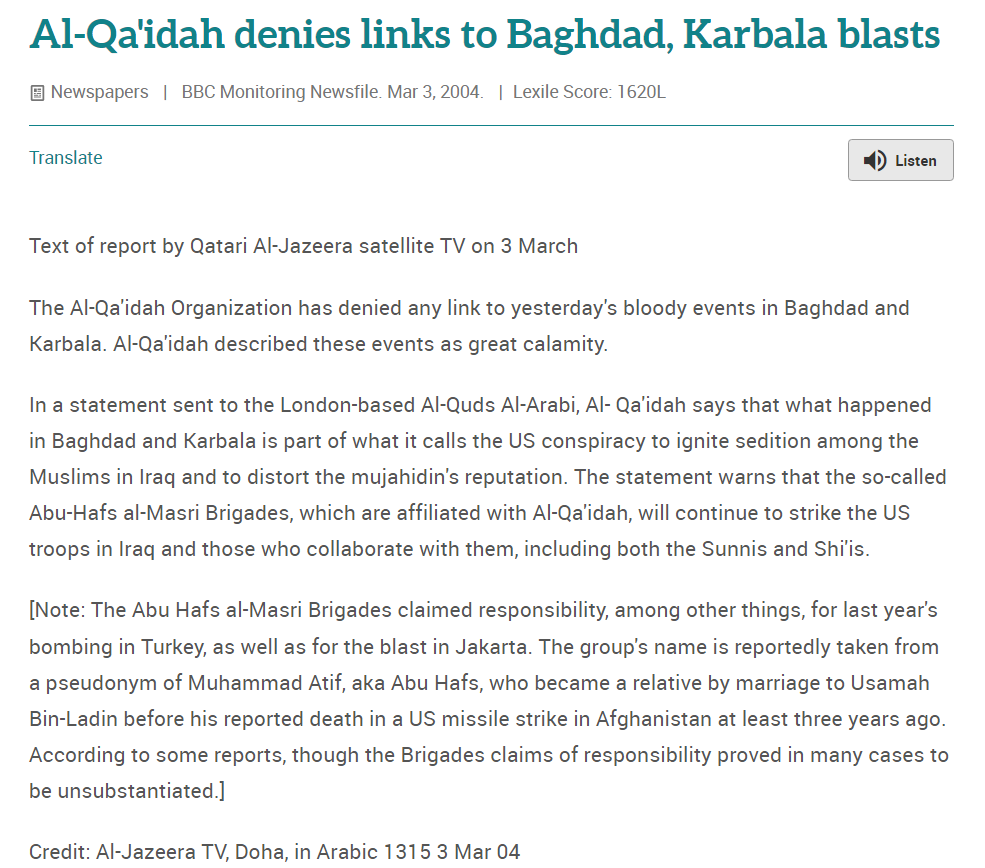
AQ itself denied this attack, and accused the United States. This perhaps was done as damage control so that they could continue to strike an “anti imperialist” posture – this particular statement was sent to London, so perhaps the utility here is to keep a useful degree of AQ support abroad in order to entrap or stoke fears etc.
It may be that in Iraq as well there was a campaign to distance AQ from these events, to confuse Iraqis about AQ so that they could enmesh AQ with genuine resistance factors in order to control/observe/eliminate them. This is the actual practical matter of the war which is very hard to observe from outside, so I am just speculating.
It is a little gross to spend so much time on narration around the attack, but I also do not want to dwell on or emotionalize the attack for the sake of the privacy of the victims. While the Zarqawi aspect was fictional, this attack is still a symbolic milestone in the war – it is an escalation. It is a target dearer to the religion. And it does I think serve as an indicator that this new phase is fully underway – a phase of continuous attack on civilian targets.
It is true what the article earlier asserted, that large gatherings are inconvenient for the coalition. Perhaps there is value from a resistance-prevention perspective, but evidently this did not stop very large crowds from forming after the event which were nonetheless unable to act against the coalition.
I don’t know if it is just lost in translation, because it is somewhat similar in concept, but attacking masajid or markets or schools targets the act of gathering period. So in a sense, it is about “crowd dispersal” but not on the scale of the crowds of Ashura but really any place of socializing. This more so than breaking up very large crowds erodes overall resistive capacity and creates a vacuum that eases the targeting of larger objectives such as the industry of Iraq, broader societal stores of wealth, etc. These attacks will become near-constant and this is why I keep stressing that the commonplace “accusations” of disparate and individual warcrimes by the coalition are counterproductive and in fact serve the coalition.
Its hard to feel like enough has been said about this, but I think it is in everyone's interest if I try to keep a more rigorous pace.
So, these attacks on civilian targets and police place society in a disarray enabling the attacking of larger objectives such as industry – lets observe this in practice during the same early 2004 period.
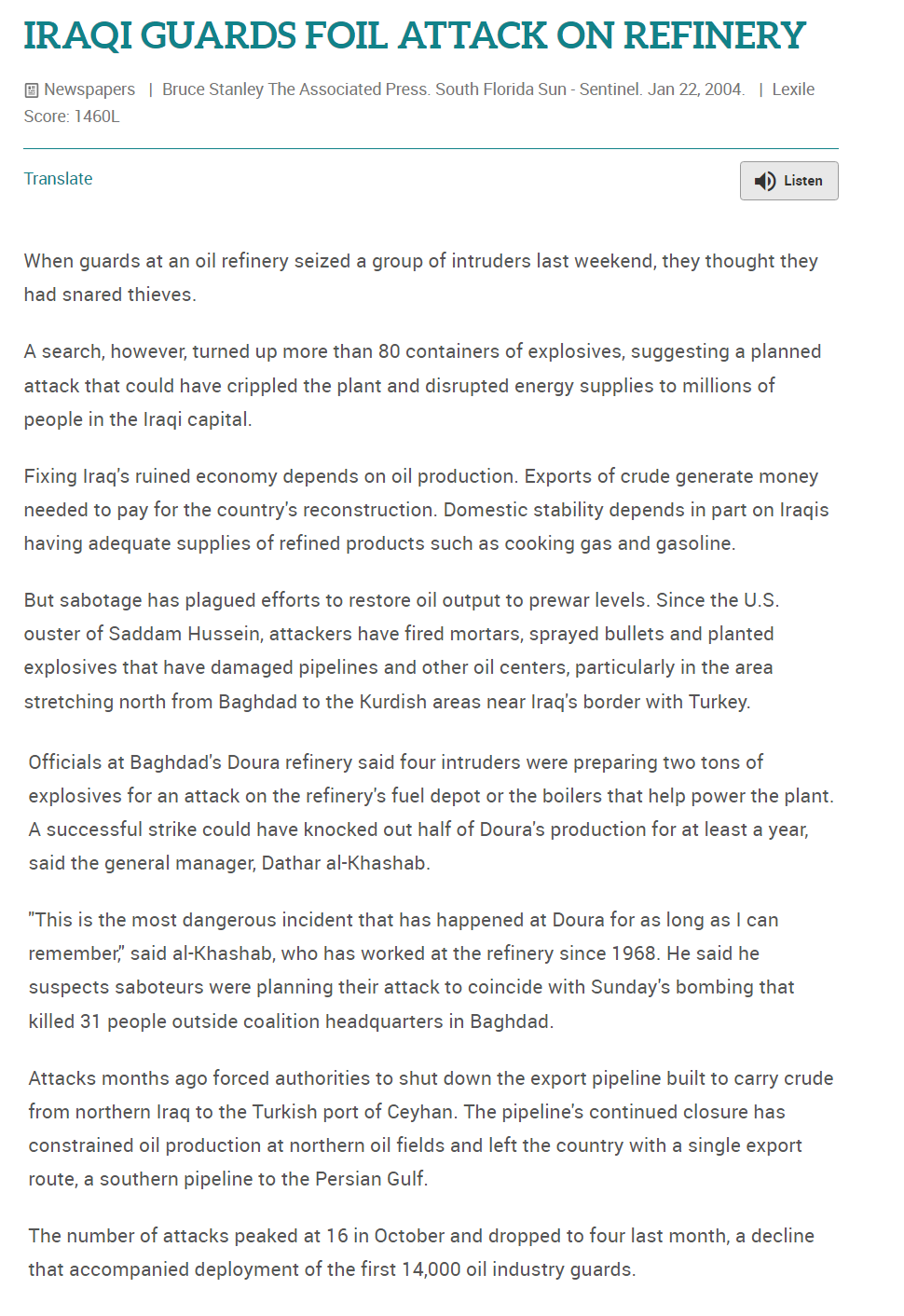
Here is an article covering a “foiled” attack – but before swallowing the story, recall that we have already observed beyond-the-pale fabrications including fabricated quotes. And so, once again, we have to parse through what is mostly narrative-building fabrication for Western audiences and try to understand what may have actually happened and the actual motivation. This challenge is one of the key skills that has to be developed in order to interface with the Iraq war through English-language documents specifically but also to interface with modern media generally. That’s why I keep stressing the importance of really paying attention to this coverage and the common themes and structures.
Reading between the lines, to me it feels like this whole incident never actually happened. I say this because it is a ‘large impact but small surface area’ attack, hard to verify but outsized “impact” as a story. But I do find the idea of the pipeline attacks, or other “successfully carried out attacks” to be credible. Because certainly there was a shift, an aggravated capture of infrastructure, related to the narrative built by this article. And this sort of attack had been ongoing since much earlier in the war -
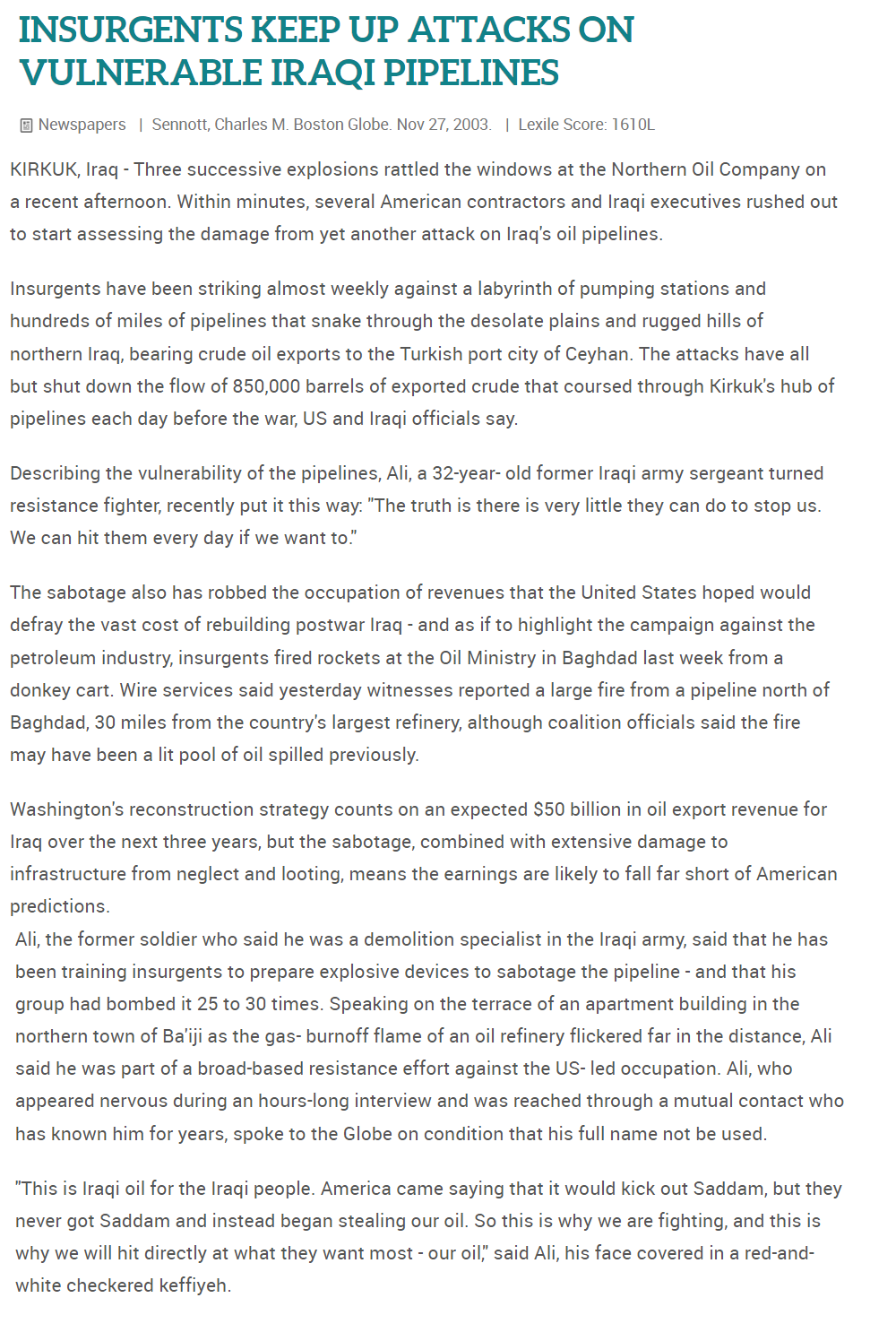
And there is a lot to note here – the framing of the sabotage as “robbing the occupation of revenues” is one of these misframings of coalition objectives that people use to create deniability that the coalition is actually the saboteur. This is crudely reiterated through their fabricated cartoon “Ali”. “they want to steal our oil, so we are going to destroy the oil” – this is a cartoon for an audience that cant conceive of sequences or even really objectives. The coalition at present wants to disrupt industry, engulf it with a security apparatus, and then allow it to be productive or force it to be unproductive strictly on its own terms. It is an extreme error to see America as an “oil glutton”, that they just want to “steal” the oil which in this framing is presumed to just “flow naturally at its own pace”. Much of the time, it is more desirable that the oil stops flowing!
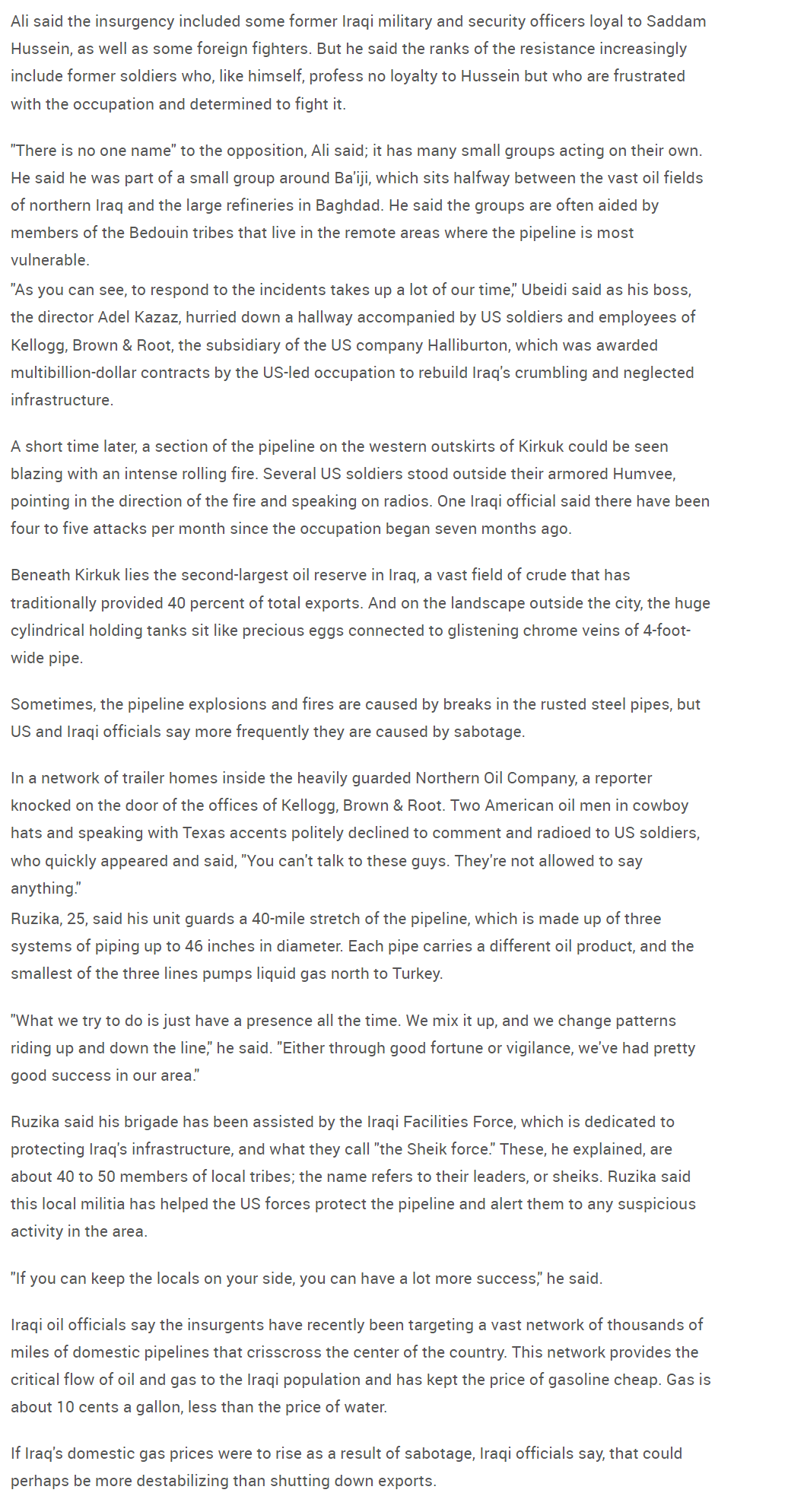
Again, hard to draw a line at what is or isn't fabrication but I think the portrayal of the pipeline as being patrolled and policed by coalition forces is accurate because I think they are the ones placing the bombs on their patrols.
So, to try to interpret - I think these articles usually try to encode a genuine picture of reality into the fabrications while simultaneously creating the cartoon for lesser audiences. We have seen this pattern almost completely dominate the coverage, I don’t believe its unintentional, and the deeper implication is how lockstep coordinated all media production must be in order to achieve this. And this I think is something someone should chase down and try to examine systematically, but it requires interpretive skills that I feel like most people seem fully content to be lacking in because they are afraid to 1) admit the complexity of modern media and 2) afraid to misinterpret, so they simply yield and focus on the superficial narrative.
But back to 2004, there is a difference here because the attack we first examined was at the refinery level. If pipeline disruption is an important but low-hanging fruit in terms of capturing the ability to process distribute and export oil, refineries are a much larger and more valuable objective. But lets examine the actual structural nature of this capture -
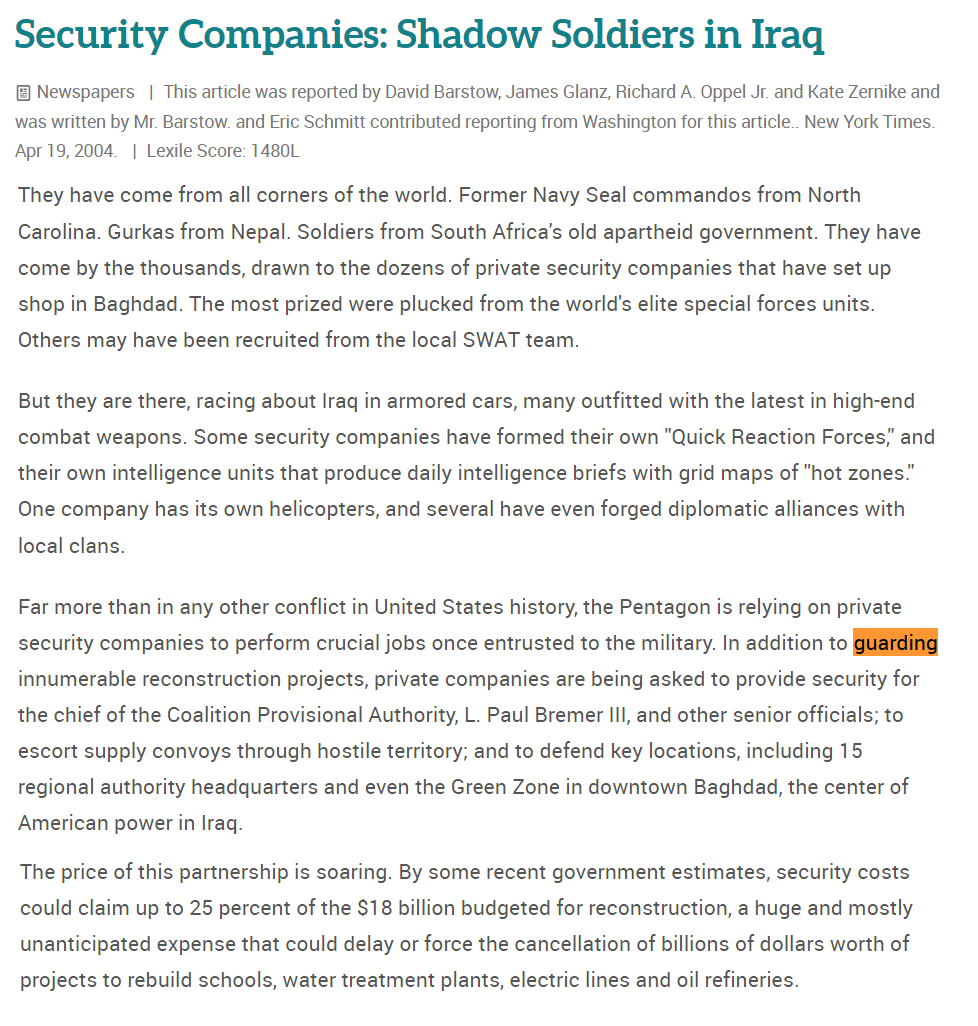
Hold your horses with regards to the “unexpected diversion” of 25% of the reconstruction budget into security. And it doesn’t matter, truly, that these are “private” security forces. Focus instead on the security aspect itself – the coalition first pins down production by attacking the pipeline, then controls production via the refineries themselves by placing all of them under guard. This “guard” could, if necessary, manufacture “attacks” that could be used as a pretext for a production shutdown but almost more importantly they have the entire refinery at gunpoint and can simply tell them to operate faster or slower or not at all. They are not there to keep the operators safe but rather to hold them hostage. Anyone who steps out of line could very easily find themselves the victim of an “insurgent attack”. No actual damage to the refineries need be done, and its important to realize too that this was never the intent. One can simply look at Iraq’s oil output to see that the goal was never to truly eliminate oil productivity nor was it simply to “steal” all of the oil productivity. Rather, the goal is to be able to control the productivity in a vacuum completely indifferent to the societal needs of the rightful owners of the oil. And indeed this includes stealing the benefit of the oil, but the manner in which stealing is achieved includes keeping the operators at the gunpoint of the coalition in this manner. This is all very simple, but I’ve never found any analysis actually put it down on paper and that is what my goal is here.
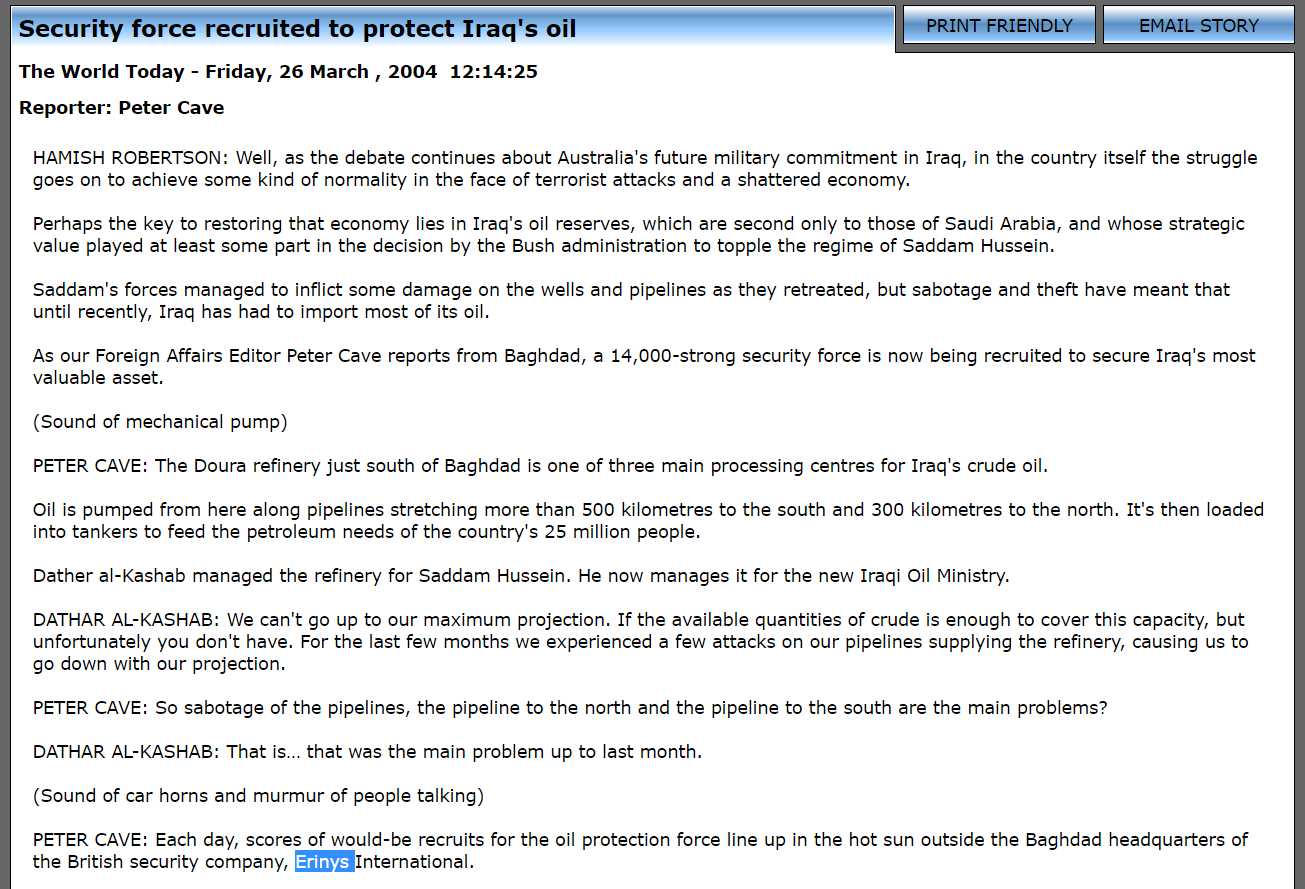
What else is achieved by this attack on Iraq’s infrastructure? Here we see that a company – we can note the name for later, Erinys – is “recruiting” a pool of 14,000 Iraqis for an “oil protection force” it is managing. The purpose of this force is not to genuinely defend pipelines or refineries – nor is it likely in my opinion that such recruits are all traitors helping the coalition to capture refineries. If anything this sounds like a liability to the coalition’s efforts to take industry hostage.
So, we are back to the same pillar of confusion again – if Iraqis don’t believe in the narrative being hocked here, what do they think about all of this? To answer the last question, ‘it pays a living at a difficult time’ is one possible answer. But its hard to say – we only have the version of events built to feed Western audiences with the desired narrative.
Back to the question of what purpose this serves to the coalition, I could see it as the following:
Iraqi society could presumably place pressure on the political apparatus to do something in the face of these brazen attacks. Allowing the security force to form, but under the control of the coalition, is perhaps a way to fight off this political pressure from society at large. And by controlling the force, the coalition can simply move them around when they need to conduct an attack or outright eliminate or attack them by leading them into an ambush etc. This “oil protection force” is also held hostage at gunpoint. But – furthermore, this is 14,000 people who are sucked away from a genuine resistance context and put under gunpoint and moved around to remote locations where they cannot be usefully resistive to the occupation. I could see this being a motivation as well – diversion of possible resistive units into a more controllable situation, while superficially reducing pressure from society at large re: gas availability, and yielding no meaningful control over the infrastructural resources being “guarded”. There is always a risk when it comes to arming people – what if they turned the gun at the coalition? Perhaps the arms were damaged, faulty, etc. This is a level of mechanical detail we can only speculate about.
Back to Erinys specifically -
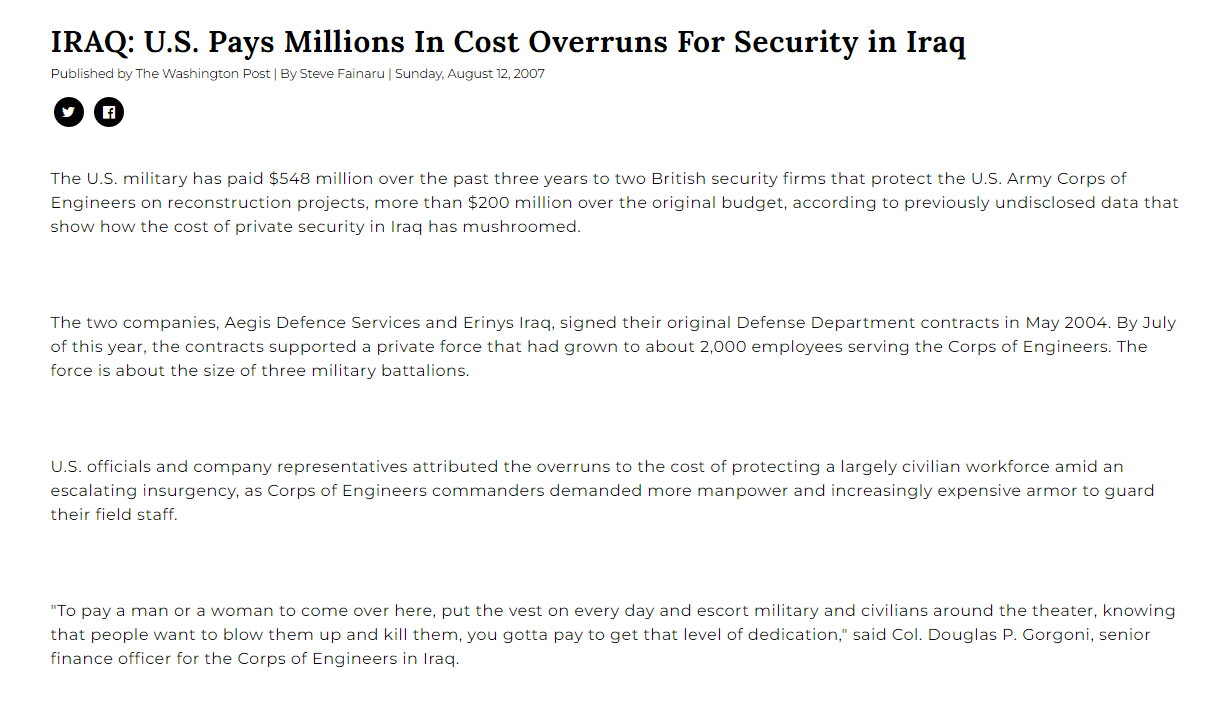
This is just a small but concrete example of how fabricated threats are used to simply pocket the money. There is no threat, so there is no need for Erinys, and so that 25% of the reconstruction budget is just completely vanished minus the actual fee paid to whoever was holding the refineries at gunpoint. Caveats being it is easy to disappear the rest as well by starting projects and canceling them due to threats, claiming never-purchased materials to be “destroyed by insurgents”, or funding “planning” efforts that never occur because its already known the project will never exist.
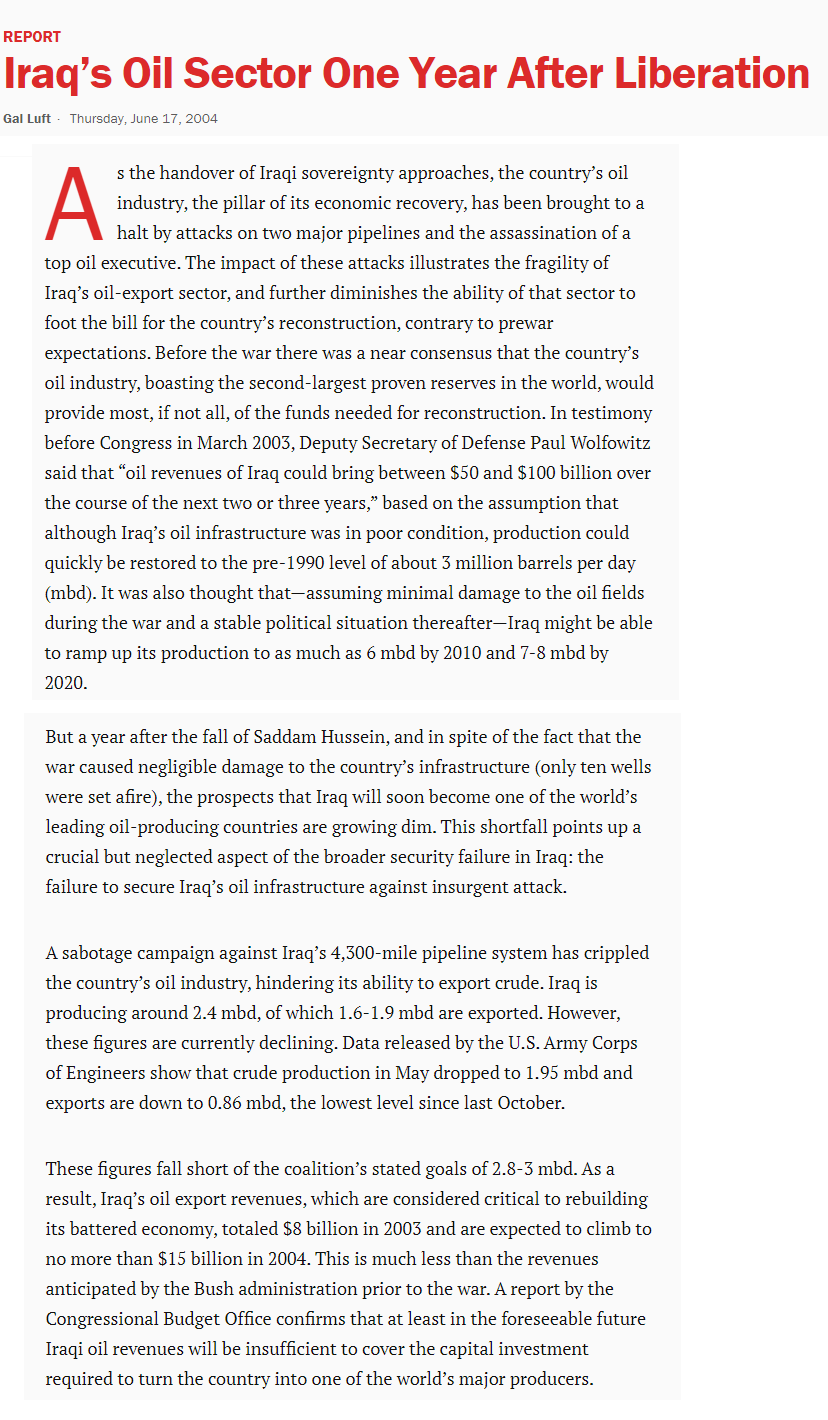
Here we see a nice summary of the coalition’s activity, including assassination, and has the gall to assert that Iraqi oil revenue should fund “reconstruction”. One can see that over time Iraq’s oil productivity is quite high but that the society itself fails to benefit from this. The oil is “stolen”, but not by some goofy irrational mechanics that newsbrainers think such as on-paper ownership by “foreign oil companies”. Its stolen because its held at gunpoint, the gunmen are the ones who extract the fee and dictate the terms of production. We will see how this model applies to the political apparatus as well, in time.
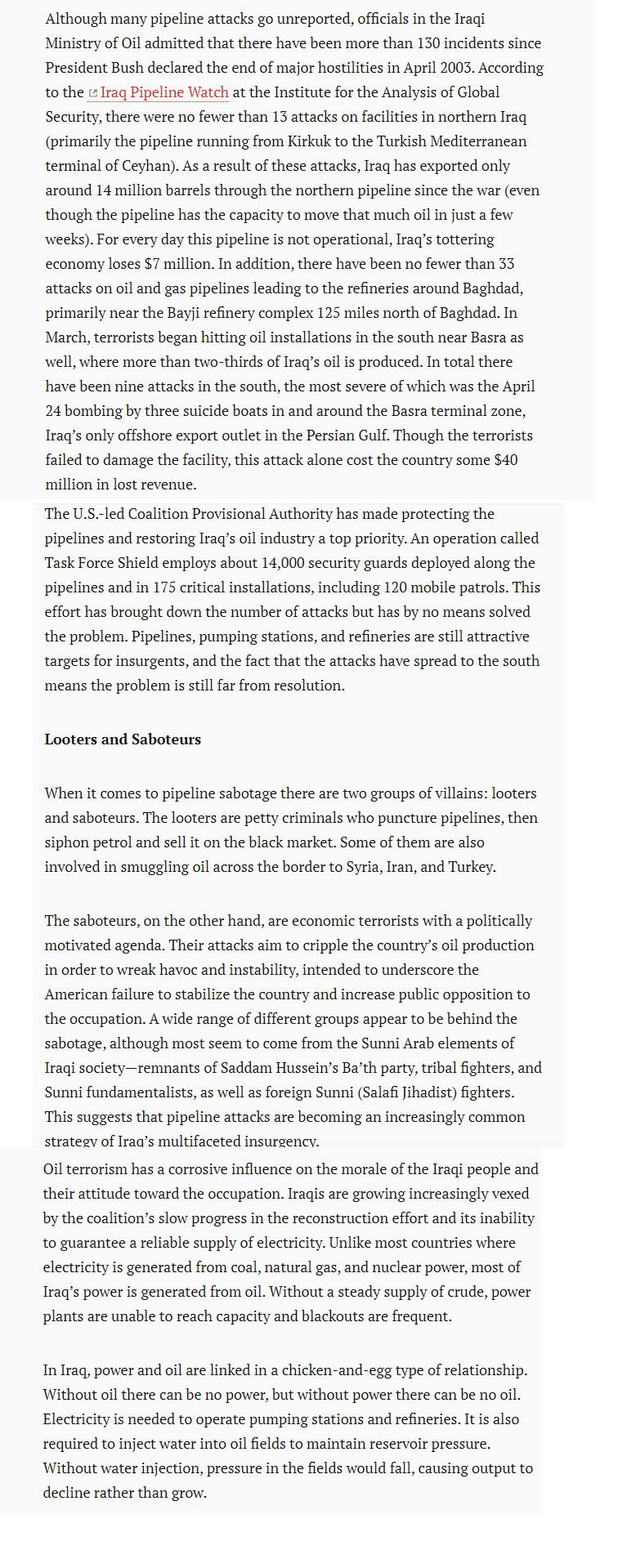
This here is just more convenient summary for those looking to have a nice and neat picture of events.
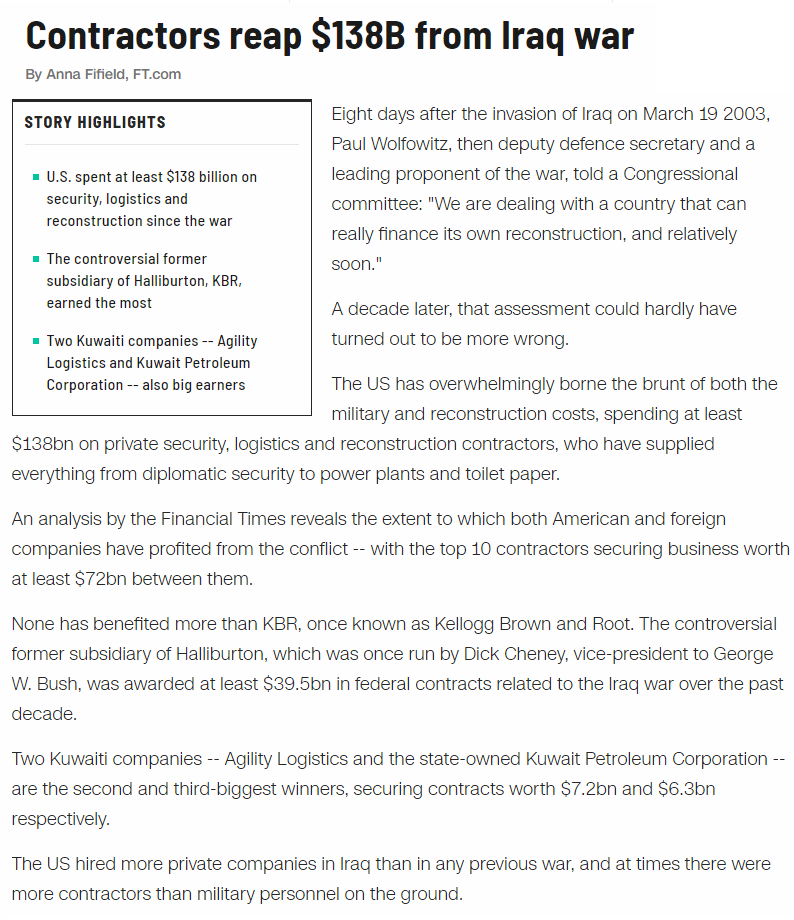
And this as well is simply a summary of the disappeared funds allegedly spent on securing industry and infrastructure. Its important to separate the money and the con of reconstruction funds from the very-real military capture of the industrial resources.
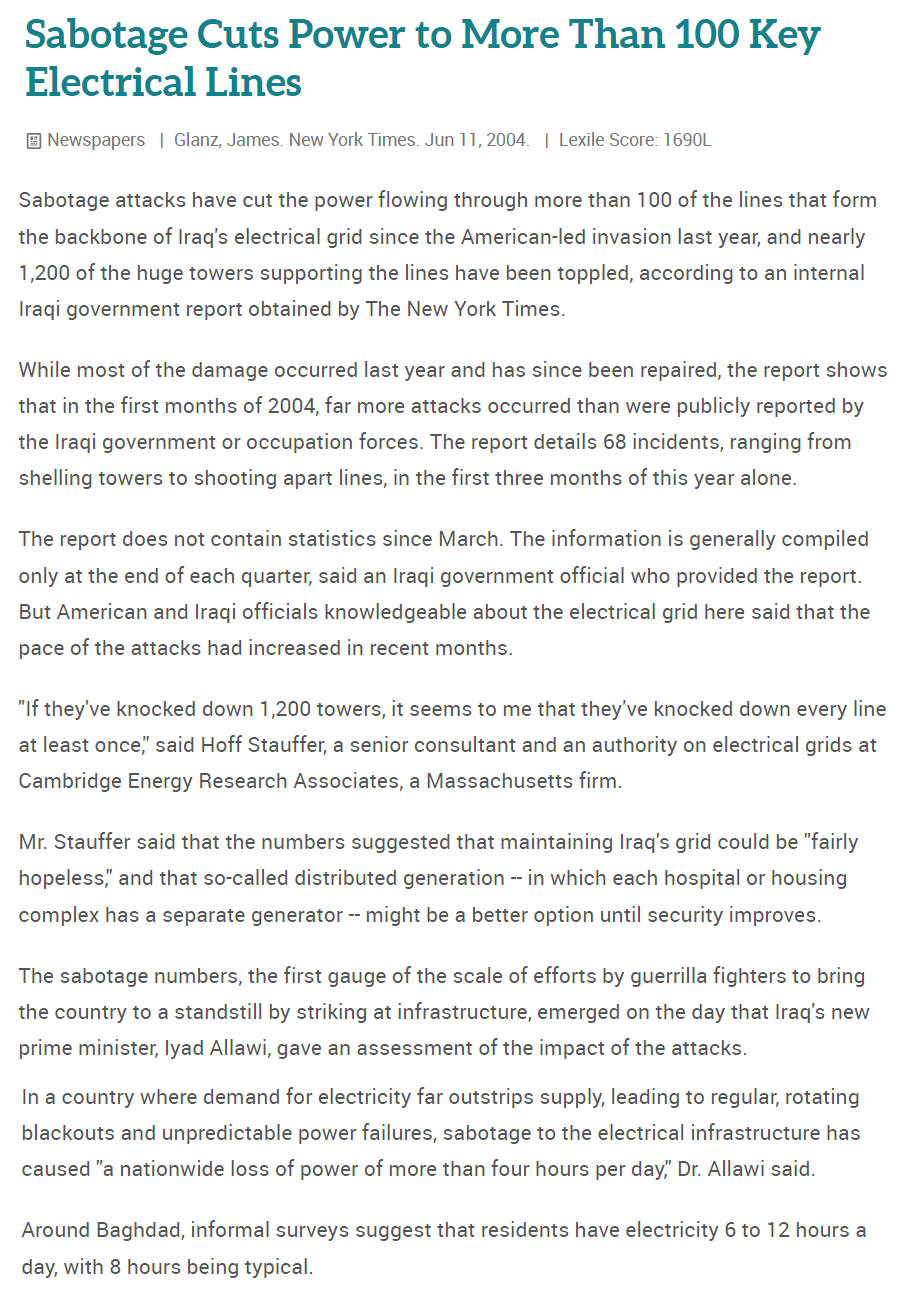
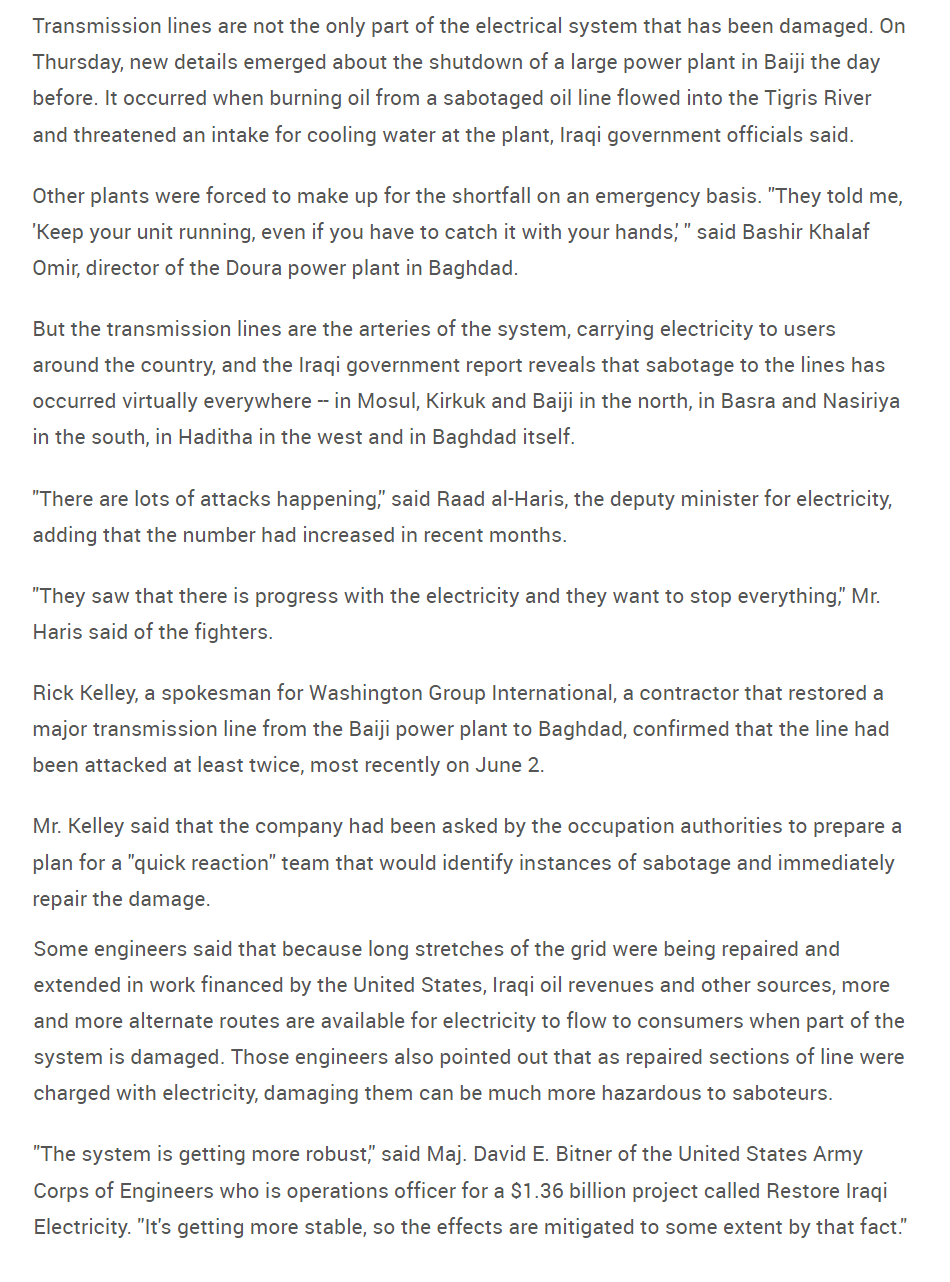
This is a summary, written in June 2004, of this strategy as applied to electrical infrastructure.
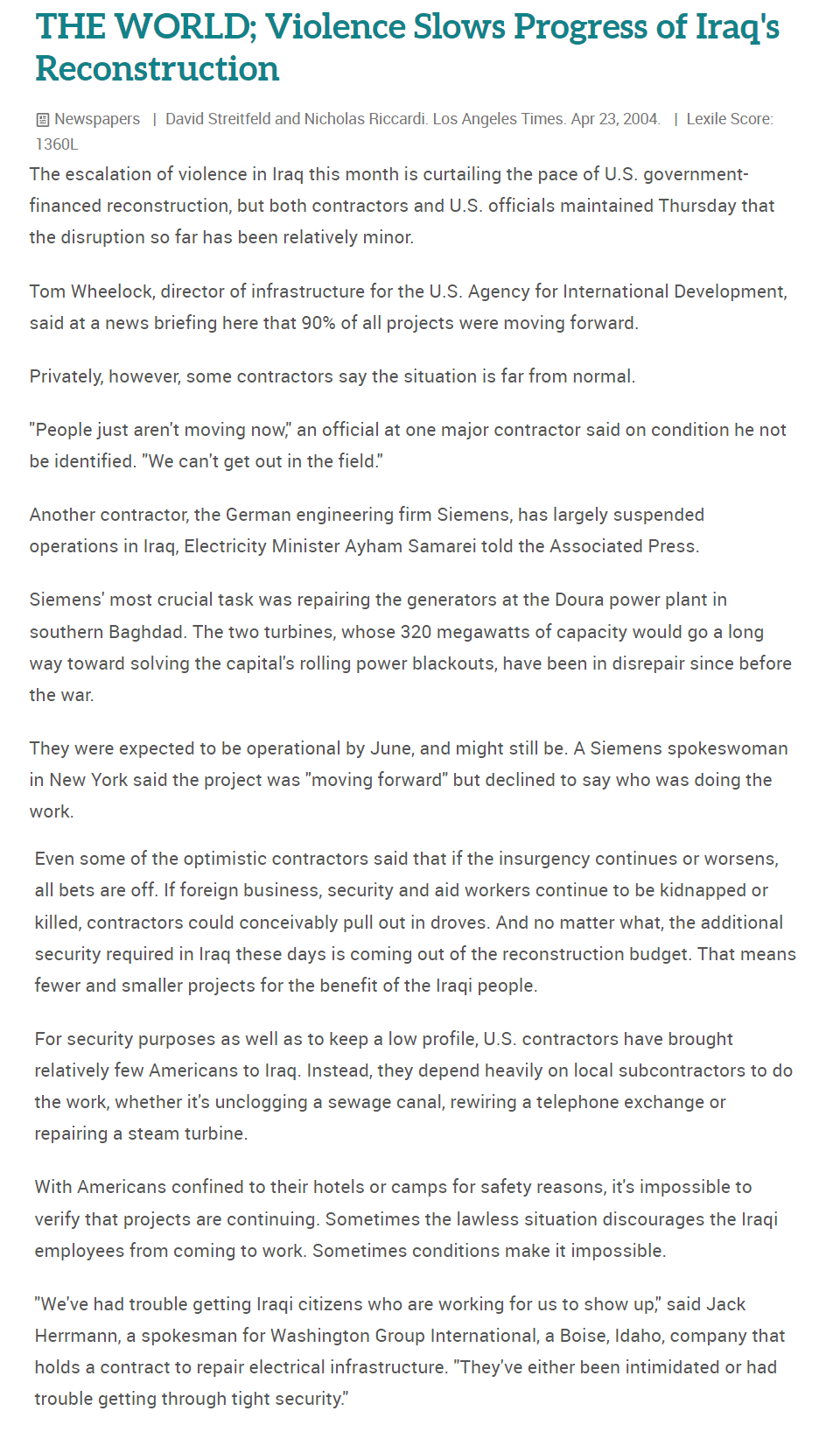
Here as well we can see how this fabricated “threat” is used simply to prevent Iraq’s basic societal infrastructure from functioning. Earlier we focused on the aspect of the real meaning of “stealing the oil” and controlling export productivity, and on the financial con of reconstruction, but even with regards to oil (see one of the earlier clippings re: gas prices) this is one of the broad and persistent objectives of the coalition.
Some of the sabotage I presume to be real, some of it I presume to be wholesale fabricated. But this aspect of the war I think is one of the most important to understand, as it is especially erased by the common narratives. The bombing attacks against civilians and the “sabotage” or seizure of societal infrastructure form a very difficult pincer for the people of Iraq to outmaneuver, and of course there is no “Al Qaeda” behind any of it. When describing the criminal nature of the coalition, the blame must be attributed directly – they attacked the pipeline, they planted the bombs in marketplaces, they held the country at gunpoint.
One final clipping,
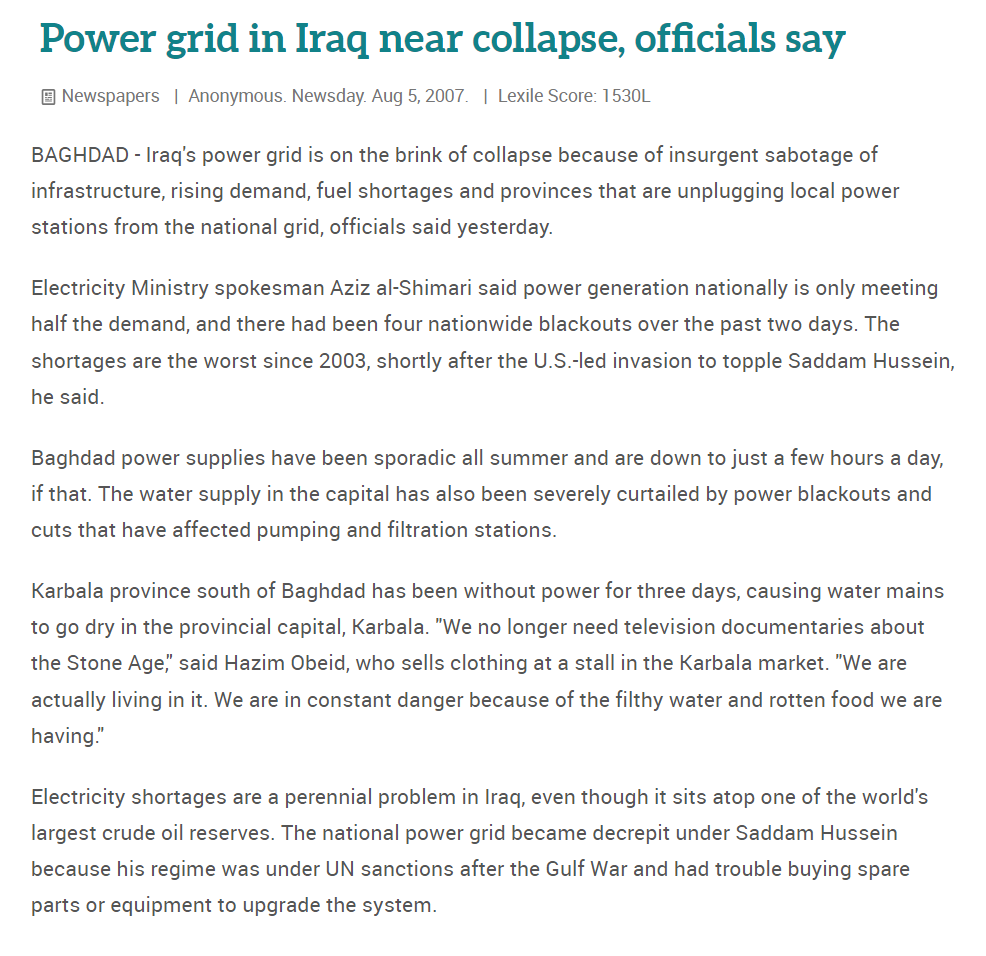
I include this just to give a sense of the persistence of these attacks. This is an article from august of 2007, anyone who wishes to research can likewise confirm that this was not simply an opening move in the occupation but a pillar of the coalition’s presence in the country.
Although more could always be said, these events I think give a solid picture of what is to come and now the early war period and patterns are well-established. Going forward we will not always see novel action but I will try to document as best as I can the character of the war even when it stays the same, even if we are mostly viewing clippings with little analysis. Thanks for reading.