IV. Spring and Summer of 2003.
Alright, lets resume. As we move into the war proper I will reiterate that this is not a “history of the war” – rather I think a safer goal is to try to characterize it, observe the patterns with which it was executed, identify recurring themes and in the process eradicate some of the common mischaracterizations and misunderstandings. By the end of this work I think readers will be able to stand on firm ground in their understanding of the nature of the conflict and be able to take and apply that understanding elsewhere.
Sometimes I will be able to focus on and dig into a particular episode and a lot of times I think we will just be reviewing news coverage with minimal analysis. I think that there is a lot to learn from this approach and I think for average people accurate ‘characterization’ is mostly what we do in conversation and in our own learning.
The first event we will cover will illustrate a number of recurring themes. And this ‘event’ is really two events, a pair of assassinations conducted in spring/summer of 2003.
I’ll repeat an important caveat – any individual who is not a member of the coalition, by and large, I am not passing any judgment on. I’m covering the war as prosecuted by the coalition, not Iraqi matters which are none of my business.
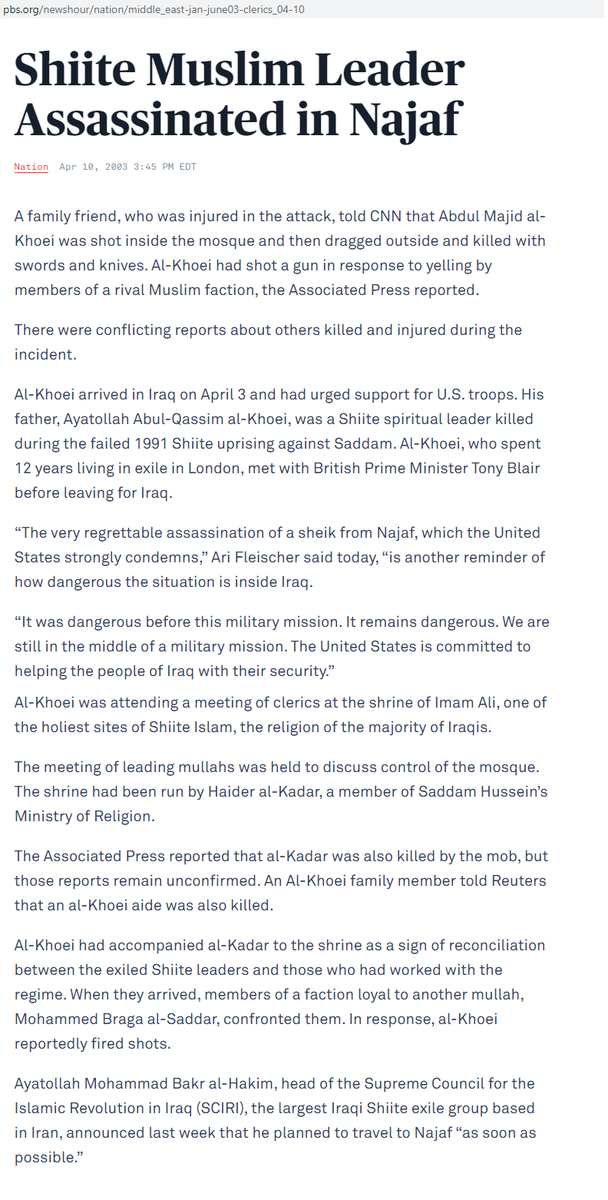
The first of these assassinations was the assassination of Abdul Majid al Khoei on April 10th in 2003.
Khoei was an exiled figure who had familial ties to people opposing Saddam Hussein, this much is probably accurate. This man was murdered inside of the shrine of Ali radiAllahu anhu. According to the Western press he was killed by a “mob” of people, with some kind of “factionalism” narrative. I don’t believe this to be the case, rather I think it is probable he was killed by the coalition forces.
My guess may or may not be true – if its wrong it doesn’t matter. Whatever happened that was done by the coalition is indictable, whatever was done by organic groups of people is out of scope.
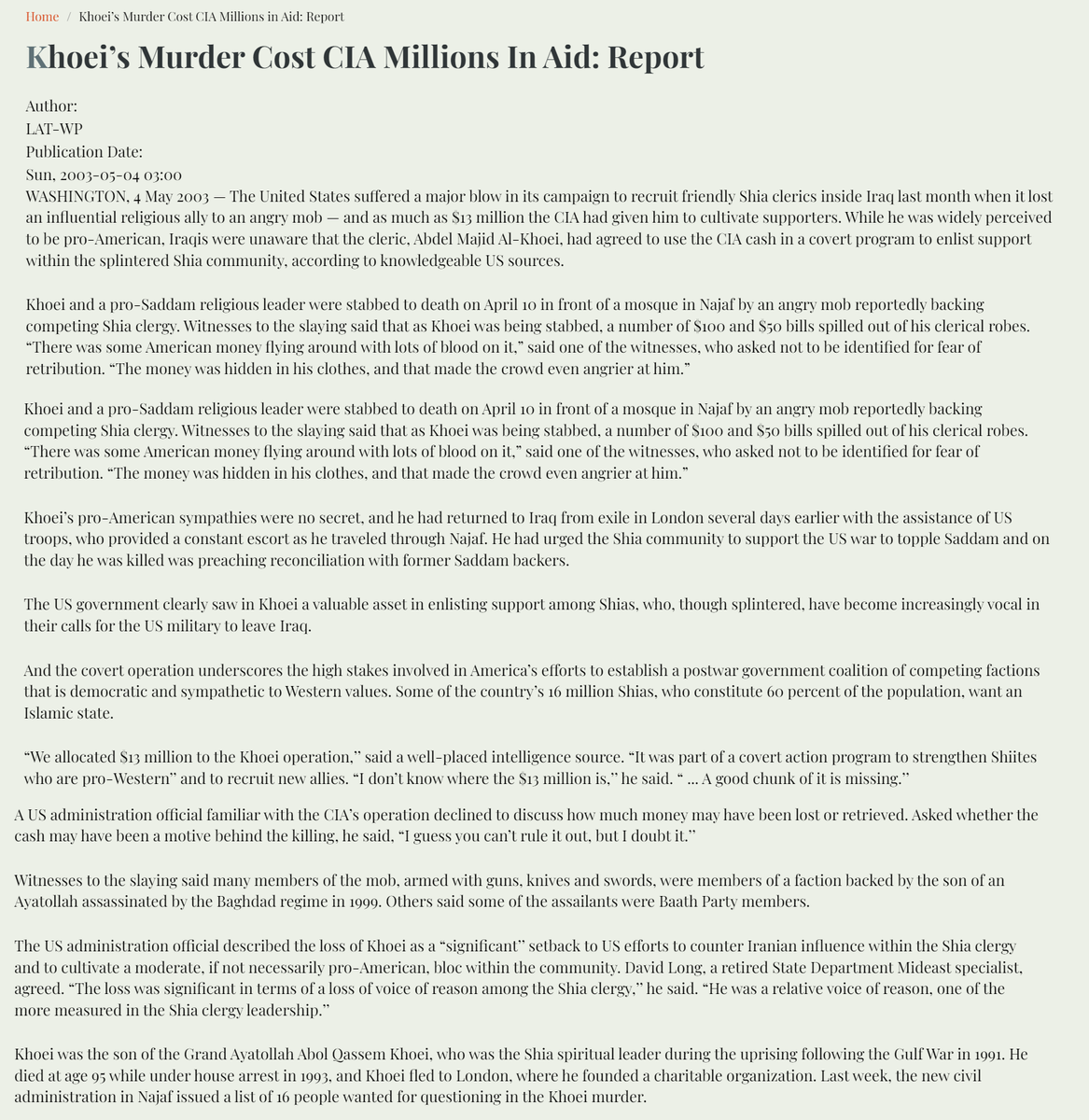
Allegedly, according to the Western press, Khoei was a CIA asset. The details of the story here are beyond absurd, that American currency was “flying around” during the murder – this makes zero sense. However, is this detail simply absurd fiction attached to the story? I would argue here is a deliberate use of symbolism, almost cartoonish, where the storytelling in the fictional sense was deliberately constructed as some form of embedding symbolic content. Keep this kind of construct in mind throughout all of the coverage, this is one of the more on-the-nose examples of it.
Allegedly Khoei was vocally sympathetic to the coalition, I cannot verify this. It may be that he was vocally allied with the coalition, with the invasion, and for reasons that if are they not clear already will certainly become clear over the course of this thread I find this overall unindictable and I make no indictment on anyone taking such a public posture or taking such funds.
Let’s assume that it is true, that he is vocally an ally, that he would be willing to work with the coalition. Why would the coalition attack him? Why would they destroy an “asset”?
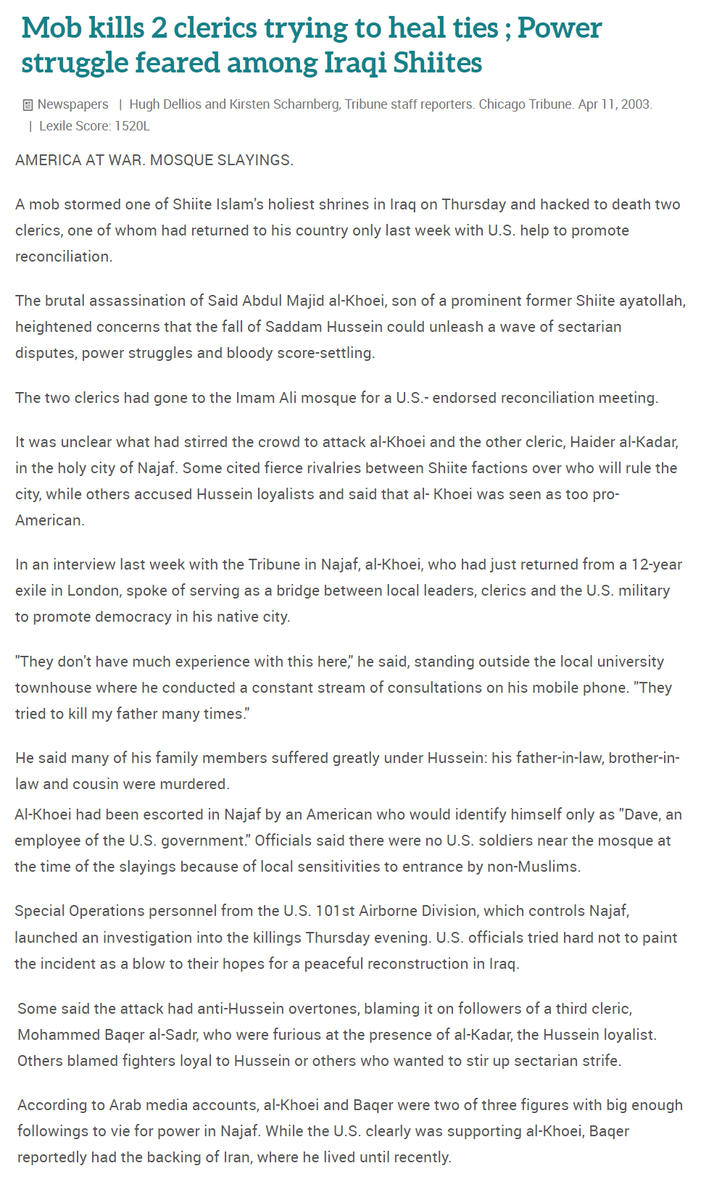
Here we see one very obvious reason – the Western goal of “unleashing a wave of sectarian disputes”. This is certainly a core theme of the Iraq war, and the quotation marks here are not simply quoting the article but are also meant to imply that the entire notion of “sectarian conflict” was a fabrication of the West:
Layer one of the media operation is to inculcate the idea that there was a “natural” sectarian conflict in Iraq. Layer two is to give the impression that there was a sectarian conflict *curated by* the coalition,
this is a variant of the “Al Qaeda was an unwitting or semi-witting asset used by the coalition to create genuine sectarian violence and chaos that allowed them to stay”. Rather I think here and throughout the case is that the goal was simply to create a *notion* of sectarian conflict as a cover to directly conduct violence against the Iraqi society by the coalition, that there was no sectarian violence.
If you’ll go back to the first image –
“A faction loyal to Mohammad Braga al Saddar”
Who is this person? If you search this name the only results that come up are articles related to this assassination.
Back to the third image –
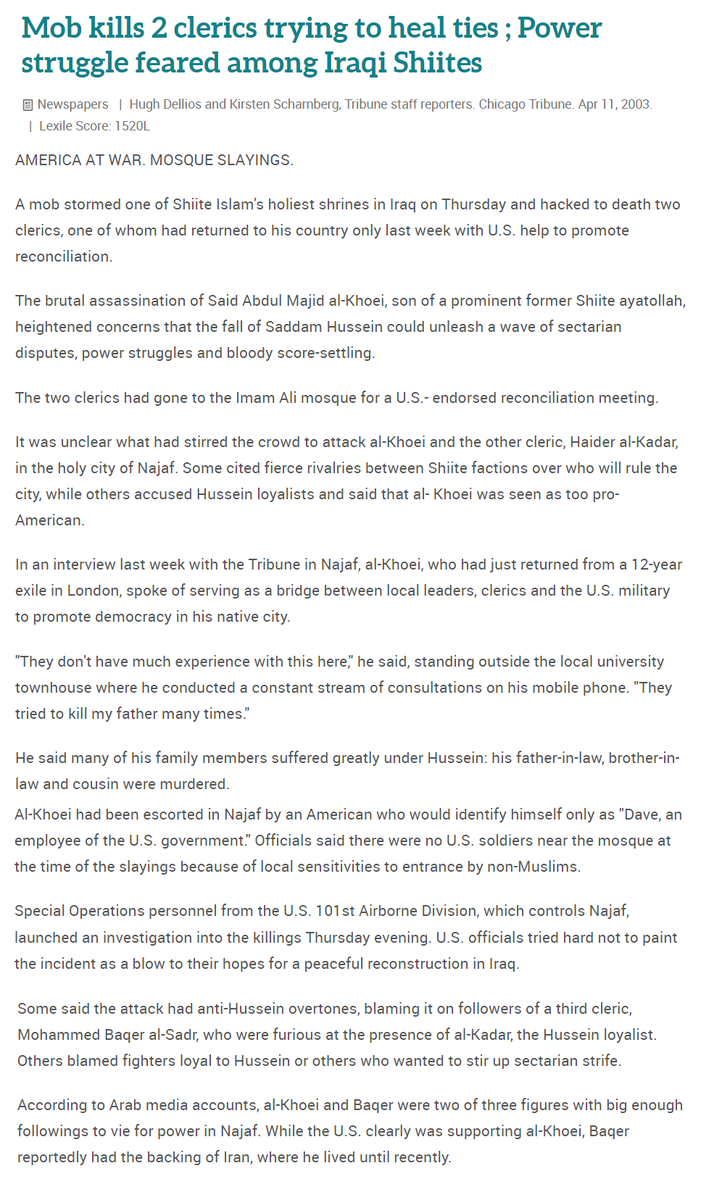
“Mohammad Baqer al Sadr”. This person died in 1980. What are they getting at with this, what are they trying to say with this? This is a little bit on the “symbolism” side, meaning simply an “error” or unbelievable content that is deliberately false in order to embed some kind of message.
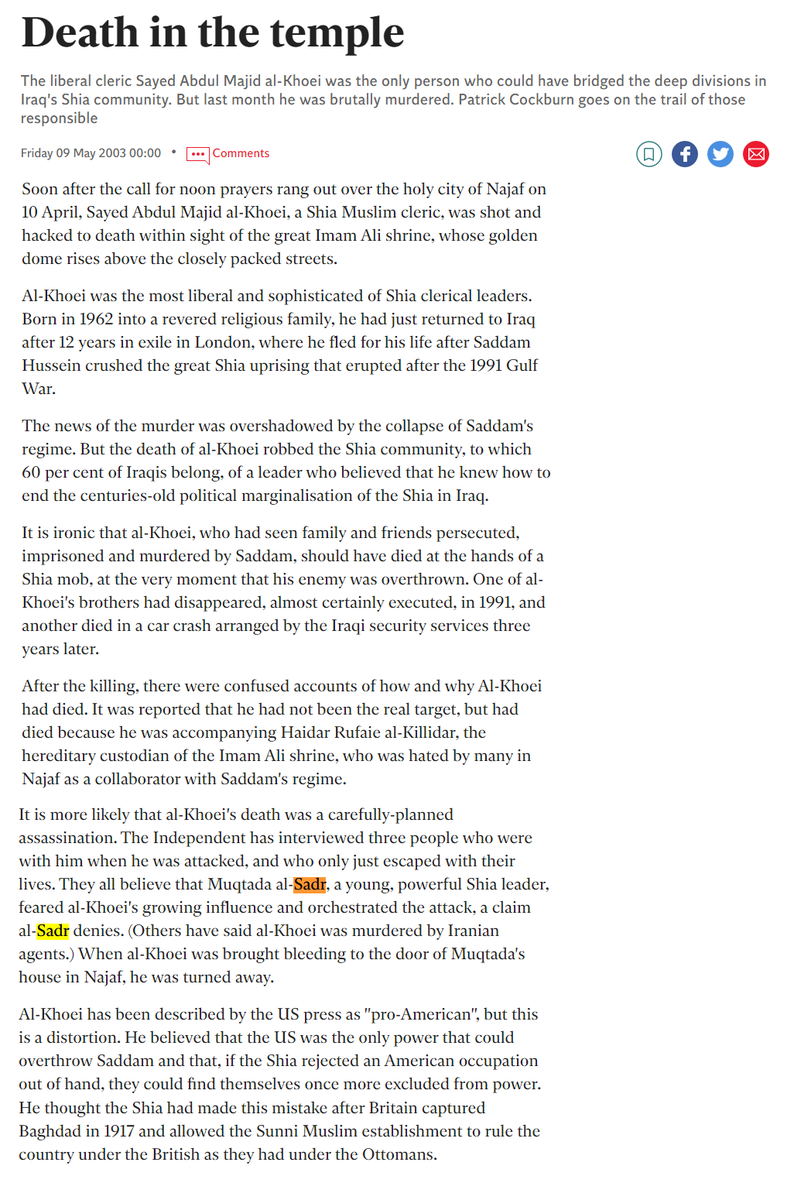
Finally, here, we see the genuine narrative emerge. The one they are trying to blame is in fact Muqtada al Sadr, it is his “faction” that the Western press is asserting is responsible. Why the earlier naming “confusion”? Personally I don’t believe this was in error but rather again some kind of messaging for some kind of reason. Could be disrespect, could be a number of things.
Also note that in the final paragraph we see the premise, albeit in yet another Western propaganda article, belied that Khoei was even truly “pro American”. So this is why I remind that the reality of this kind of situation or accusation of support for the invasion is truly indiscernible to those of us that are just bystanders. And note too that Muqtada Sadr denies the charges, and though it should not be necessary to even state this.
Just try to use your brain and evaluate the premise of whether or not murder and factionalism would be wise for any Iraqi opposing the occupation – why would the first target be mere “collaborators” rather than the coalition itself? Hold onto this question though of why would the coalition attack its own “assets” – this idea will not only be explored more right here but also throughout the coverage.
Going back to the third image –
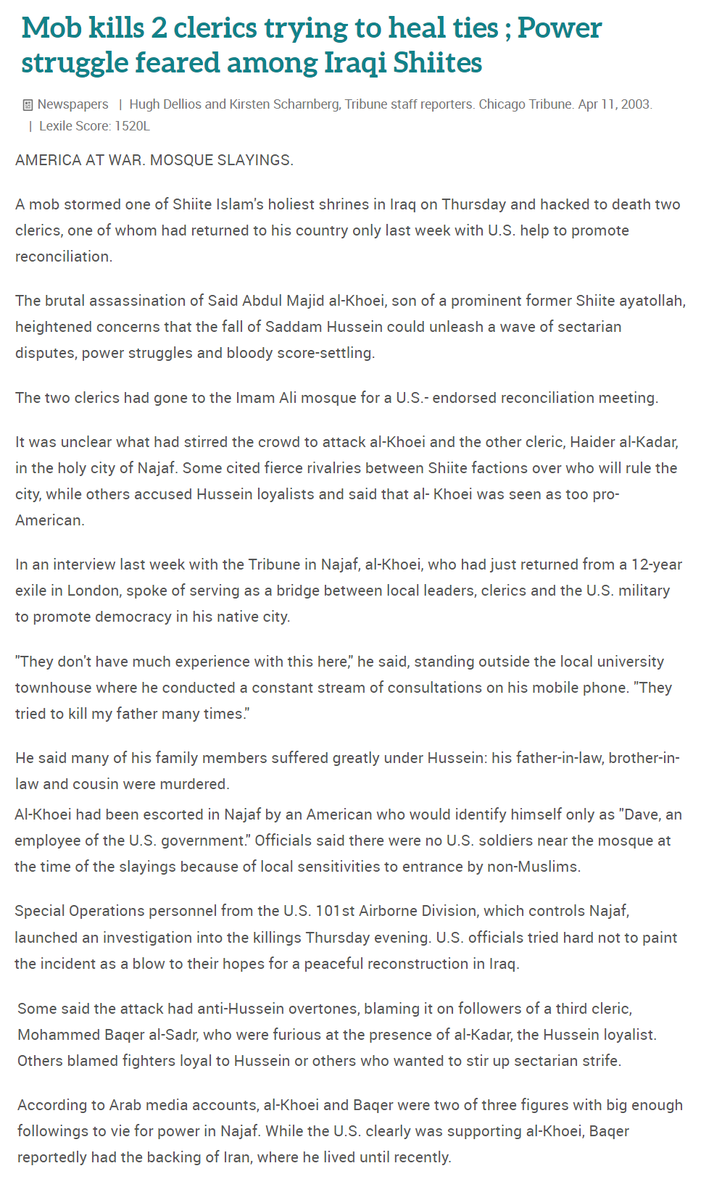
Note that this image claims “there were no soldiers near the mosque” and that the investigation – what a concept – was conducted by the special forces from the US 101st Airborne Division which “controlled Najaf”. So 101st spec ops were already set up in this area.
The religious context of Najaf can be investigated by readers on their own time, the significance of this location can be investigated by readers on their own time, for most Muslims it is quite readily apparent what these things mean and why they are dear to us.
Iraq is a place where the companions of rasulAllah sallalahu alayhi wasalam lived and died, the real and true companions of our prophet, true historical figures who are known to us, who are the pillars of our entire ummah.
The Romans were unable to extinguish Islam as they attempted to extinguish Christianity and the true followers of Isa, alayhis salaam. So of course Iraq and its history are unspeakably valuable targets in this modern war, by the inheritors of the Romans, against the true religion of Allah. I am not grasping at straws, this is not an ‘obscure conspiratorial idea’, I have outlined the explicit and intentional connectivity between these two campaigns in extensive detail so that we do not need to constantly retread this point from here on out. This war is part of a broader war against the religion and civilization of Islam.
The second assassination we are examining in tandem is the assassination – an incorrect term for this attack, really, it was a bombing attack that killed over 90 people – of Muhammad Bakr al Hakim in August of 2003 and also at the shrine of Ali, radiAllahu anhu.
This was not just as an attack on Hakim or those at the shrine but on the shrine of Ali itself, radiAllahu anhu, on Muslims as a whole. An escalation from the assassination of Khoei to a mass casualty bombing – assuming, as I do, that these attacks involved the same perpetrator which was the coalition.
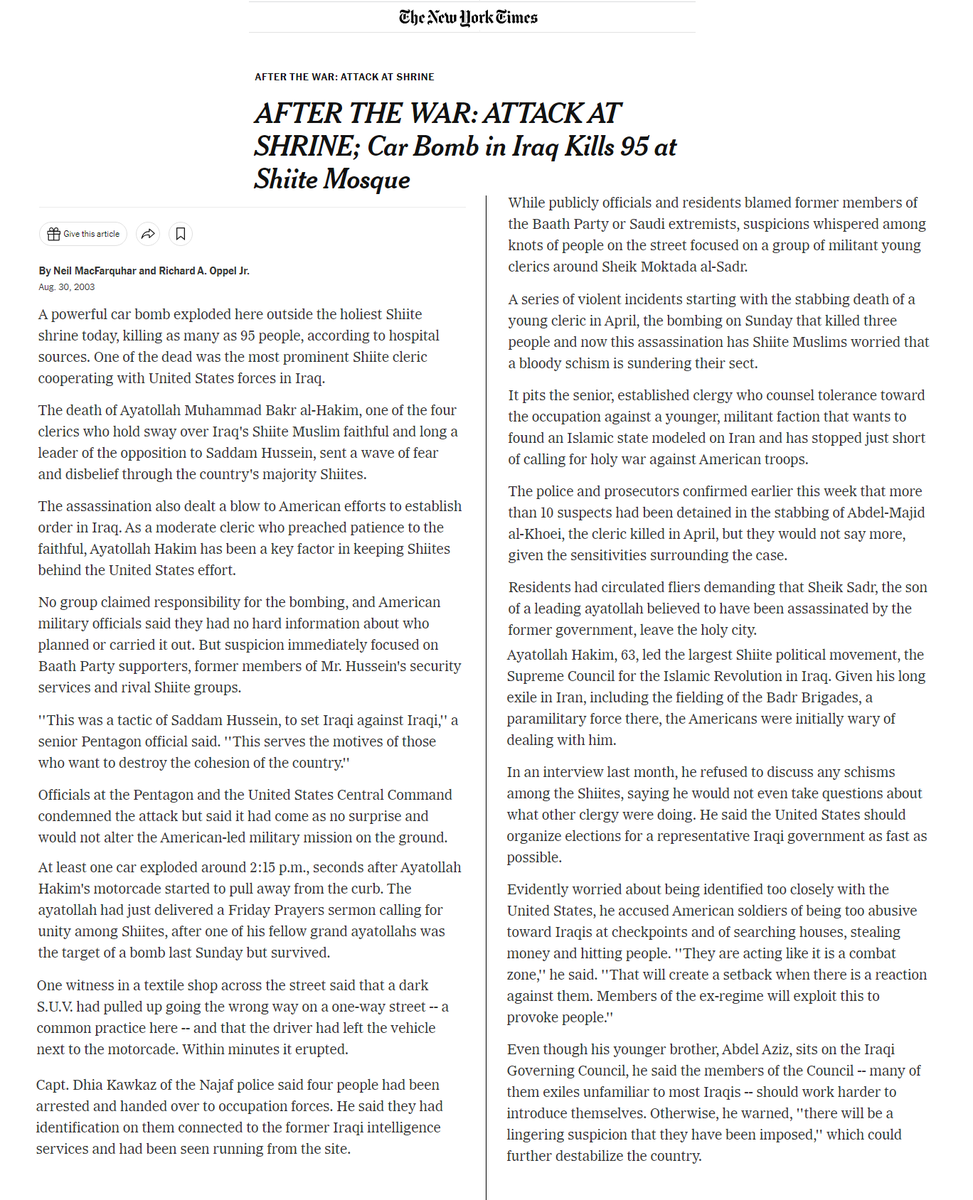
There is a lot to examine here. Starting with the first paragraph, the New York Times frames Hakim as “the most prominent cleric cooperating with the United States forces in Iraq”. One, this is not an accurate characterization. Two, this does however set up a conceptual parallel with Khoei even though *neither* necessarily was willing to cooperate or endorse the coalition forces. But the narrative we are examining, produced by the Western press, fictional as it may be, is drawing the parallel and this is thematically relevant to the rest of the analysis of the war. He is portrayed as an “ally”, his death a “setback”.
This much is character assassination, feebly executed, for the sake of the desired narrative of a ‘schism’ where the ‘ally’ was attacked by a faction in the ‘schism’.
As for paragraph two, this is an example of a linguistic attack on the recipients of the attack. The New York Times in this second paragraph tries to reinflict damage and linguistically attack them by calling them afraid and also I am certain quite deliberately using the phrase ‘disbelief’ to describe these faithful people.
This is a pun on the part of the NYT, explicitly connecting the attack on Hakim and on the shrine and on the faithful to the broader assault on their belief, their religious belief, their religion. Arrogantly claiming that this attack caused them ‘disbelief’: this is a miniaturized metaphorical encapsulation of the broader Western goal of trying to attack the religion of Islam with violence, to try to inflict disbelief via violence as did their Roman predecessors against the Jews. And similarly, it is only in their own words and media that they are able to pretend to have succeeded.
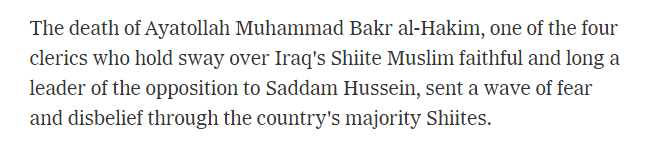
The degree to which Hakim may or may not have been considered an “ally” or “useful” or anything like this to the coalition – with zero implication of fault – this will be examined after the coverage, along with Khoei, and this is where we will at length introduce a new core theme of the coalition “attacking its allies”.
Paragraph four introduces the idea that this was carried out by “former regime elements” (FREs). As the blame is shifted away from the coalition, ask yourself why would “former regime elements” do this? What do they gain from this? And look at the elaboration afterwards in paragraph five, “to set Iraqi against Iraqi” – how does this attack actually do that? This is another “slip”, another “error”, that I think is meant to receive similar “symbolic” treatment.
Because this attack does not in any obvious way “set Iraqi against Iraqi” – refer back to the article. This premise relies on a subsequent premise that is not yet introduced in this article, that the attack was done by a “rival Shiite group”. The ideas here are twisted around so that the structure and presentation of them does not make sense. Unless one treats this article as a logic puzzle in the Roman style introduced by Atwill:
1. The premise of the NYT is that people believe the former regime is responsible. The Pentagon is “”sympathetic”” to this viewpoint.
2. The former regime would do this to “set Iraqi against Iraqi” – How? This would in fact unite all Iraqis against the attacker.
3. Unless, and again this idea isnot yet introduced, the attack was framed as being done by a “rival group”. Pay attention to this point. The motive given for FREs is to sow division. To sow division would require the perpetrator to introduce another group and cast suspicion on them.
4. Then, the article itself actually embraces the idea that this was conducted by a “rival group” and that there is a splinter. The article introduces the other group and casts suspicion on them.
The solution to the seemingly-confused construction of the article is revealed, inducing the reader to “swap” the FRE with the coalition, the Pentagon, the NYT.
[Refer back to https://2yb.neocities.org/iraq/ch02/ch2 for commentary on the Romans and Atwill’s analysis of their media]
This swap “solves” the confusion. To reiterate the steps:
1. After describing an implausible motive of “setting Iraqi against Iraqi”, one wonders “why would this attack, if done by the FRE, do that?”
2. NYT answers “it would do that if people believed that an internal party, a rival group of Iraqis, was responsible”.
3. So now we have a motive for the attacker, to make it seem as if another party was responsible.
4. Then the NYT actually *does the work of accusing the rival party*. THE NYT ITSELF makes it seem as if another party was responsible.
Thus one concludes that the NYT, the Pentagon, the West, were the actual attackers and one can substitute them in place of the FRE.
I hope this is useful for people, not every part of this thread will involve such in depth analysis of the propaganda text itself but this kind of deeper analysis is a rarity and I think it deserves some time. I will repeat the image since we have digressed:
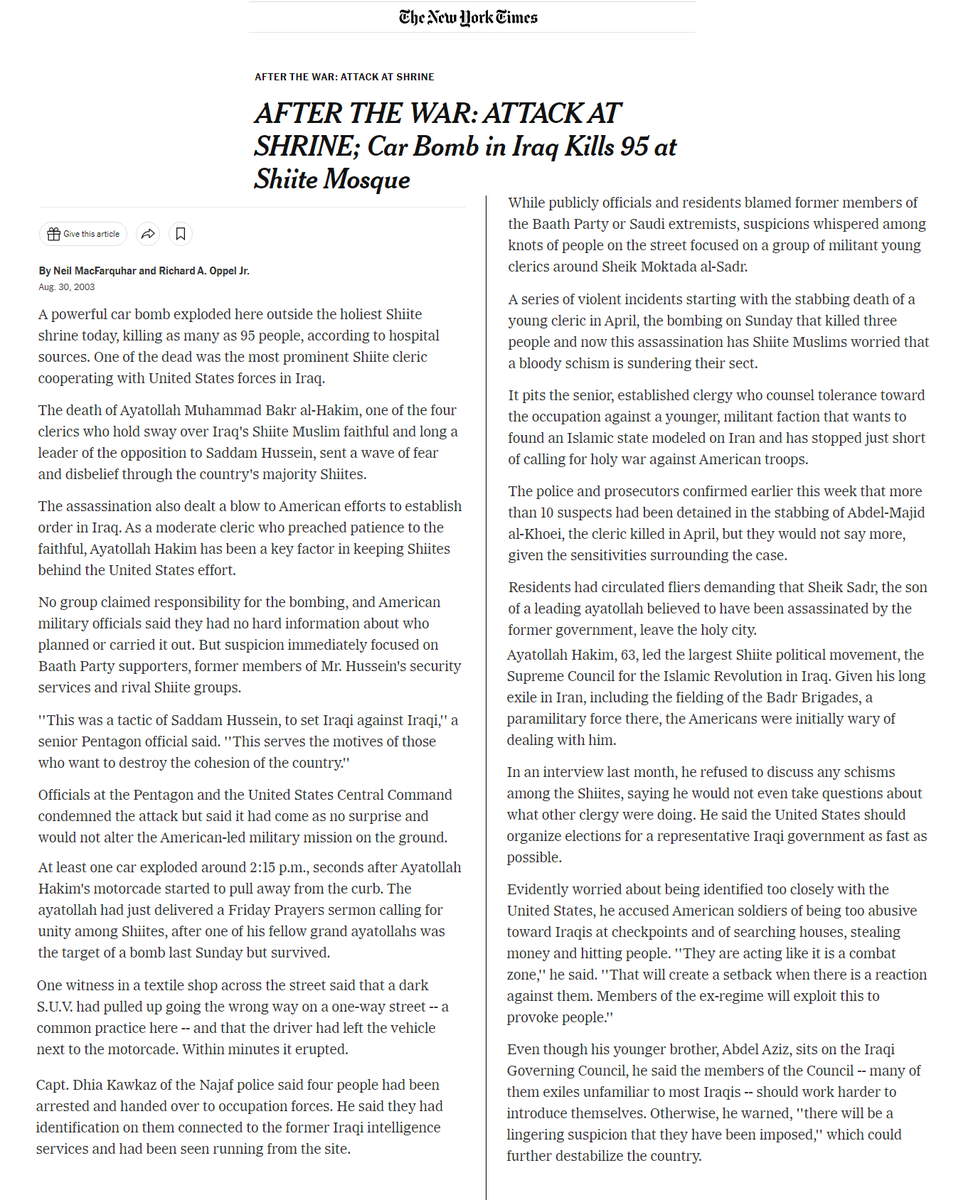
Continuing, we receive alleged details about the attack and I want to highlight something here. While it is possible that a single-car source could be visibly observed by a bystander – although we should also assume witness quotations in the Western press are fabricated by default –
I do not think it is possible that it could be identified 1) in an attack of this scale and 2) if it was *next to* other possible sources, car or otherwise.
Which is to say that, this witness statement is not even a believable fabrication if one genuinely thinks while reading.
We will see many such dubious witness statements as we progress through the course of the war, usually attributing an attack to a specific car or person. Sometimes in the case of a car this may be possible if the scale is small and there is no other vehicle around. I don’t have an objection to this concept outright, being that a car is a convenient way to place things and is inherently somewhat protected. Without counter-surveillance by the Iraqi people, it’s possible the coalition could get away with subtly moving cars around to achieve this objective.
A point against it is that this method would somewhat mute the blast. But it is possible that in some cases, even this case, the coalition did use cars as a delivery mechanism. As for the case of a person, it is probably impossible a witness could identify a single human source and the narrative around this concept to be completely unbelievable.
And so as we examine attacks that occur in places a car cannot reach, I believe we have to assume that materials were placed in advance of the attack by agents of the coalition. I personally do not have answers about how this might be done given that I cannot honestly estimate the size of the finished device.
If it was baseball sized, one group of possibilities emerges. Golfball sized, another. Shoebox sized, another. I just don’t know. But I assume pre-placement in all cases of coalition bombing attacks and I do not think any materials were detonated by individuals who would stand to be destroyed in the attack.
At this point I will briefly remind of the previous examination of the now-captured explosives in the hands of the coalition –
https://2yb.neocities.org/iraq/ch03/ch3
So keep in mind the scale of effect (”1 lb per plane”), amount seized, etc, now being put to use and we will see that this is a primary mode of attack throughout the entire war.
Moving on we see that allegedly four arrests were made, we have a statement from an alleged captain of the Najaf police force. Here we are forced to make another judgment – is the quotation fabricated, is the scenario fabricated, is the entire person fabricated?
It is more than safe to assume ‘yes’ to all of the above, however we shouldn’t dismiss collaborators at the police level out of hand. Even though we will see that the police are one of the primary targets of the coalition, this does not mean there are no agents working within them. Here this deeper question is not really relevant.
Note as well the alleged arrests of FRE (former regime elements, to use their language) seen “running from the site”. The scale of casualties of this single-detonation attack implies a very large crowd and probably dozens if not hundreds of people were running from the site. How, in such a crowd, could FRE be identified and how could they be singled out from everyone else running away? Remember that they arrested four people. So four people out of a crowd of unknown size but presumably in the multiple hundreds based on the scale of casualty.
So – four FRE arrested and under suspicion. We will get to this, this attack was actually later explicitly claimed by AQ and this claim was endorsed by the Iraqi government and Western press altogether. So, either these FRE were innocent or working with AQ or this entire line was a bizarre fiction. Once again we now have a bizarre detail that makes zero sense and actively contradicts what will become the main narrative thrust of the article: that, despite a complete lack of evidence, “maybe” Muqtada Sadr is responsible for this attack as well. Almost as many paragraphs are spent on this effort as on describing the actual event. “A bloody schism”, “senior established clergy vs younger militant faction”, etc.
A detail I will highlight that will be part of one of the main patterns we explore throughout the war is that the brother of the martyred Hakim sits on the Iraqi governing council. This pattern will be addressed later, please simply hold onto it for now.
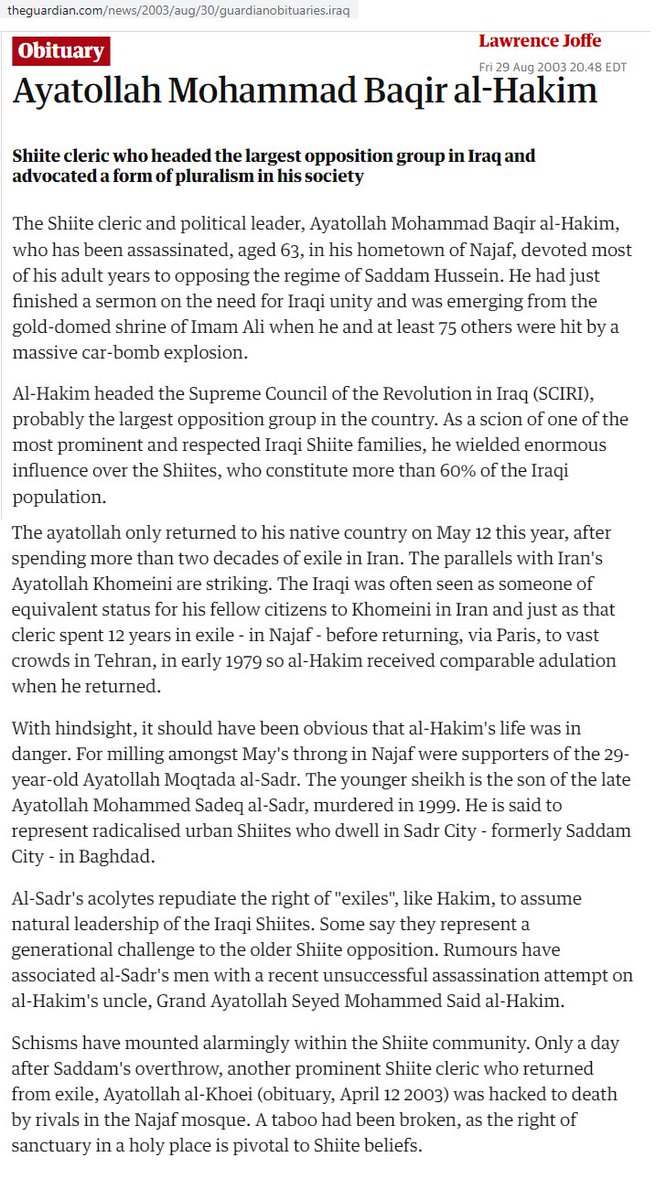
Here, we see the Sadr-blaming agenda has taken a primary role in this Guardian hit piece that they unashamedly call an ‘obituary’. If this is an obituary, why is almost no time spent on the life and times of this person but rather on “investigating” and accusing?
Another note actually, we have to also remain thoughtful at least about any casualty statistics and I don’t mean to imply that I uncritically believe what is being reported in terms of the scale. But this is not the time, yet, to delve more deeply into this aspect.
Regarding Sadr this author goes farther than the previous article and ‘knowingly’ implies that it should be ‘obvious’ that Hakim was at risk of an attack from ‘Sadr supporters’. We don’t need to spend as much time on this article, I’m just trying to emphasize this genre of Western propaganda. Going along with our theme of “contradiction”, of hyper-fictionalizing the propaganda narrative, here we are to believe a major religious/political figure who is against the occupation and very popular would actually conduct a mass-casualty attack in such a religiously significant location. It is deliberately unbelievable.
This much is even acknowledged in the final paragraph of this dreck – just how unbelievable this premise is.
Sadr will remain one of the key figures we will see throughout the thread and the efforts of the occupiers against him or groups that hold him in regard will continue to be examined. We see now that as early as spring/summer of 2003 his existence is being signaled to Western audiences. And we will give him his say in this attack as well, shortly.
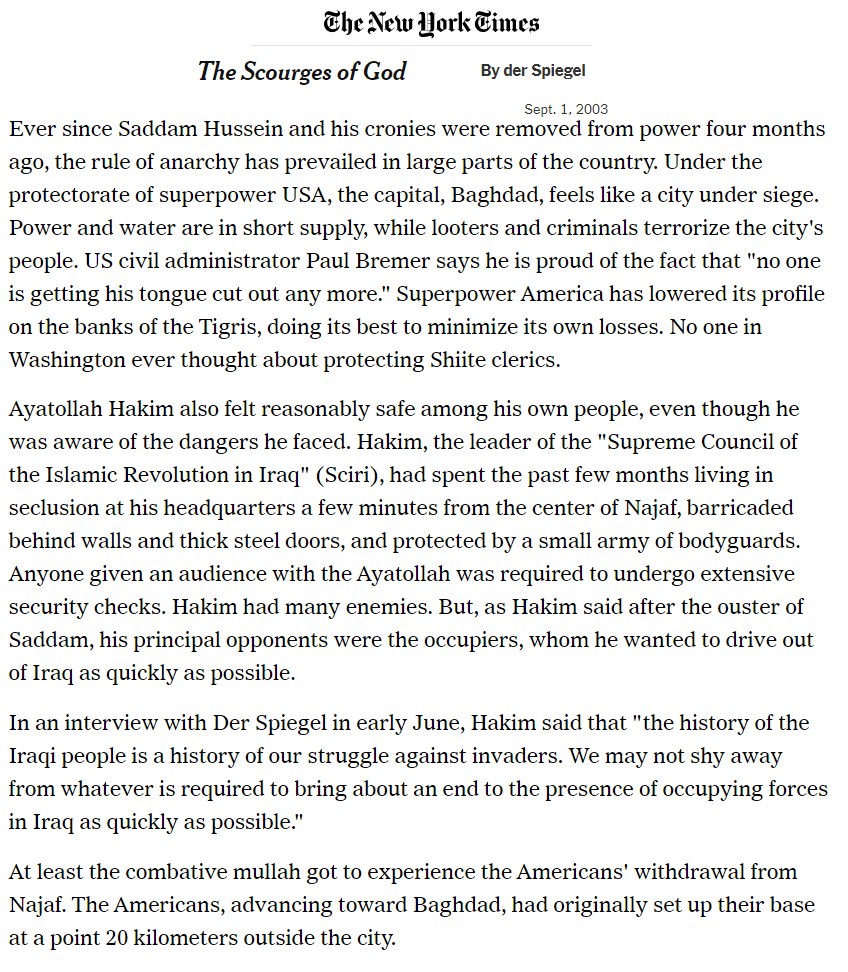
Here we unravel a little bit of the ‘ally’ narrative – Hakim himself stated and this article admits that his principal opponents were the occupiers. The gall with which the Western press reinvents and unreinvents people for its stories is something truly astonishing.
This article is for lack of a better word almost mortally cringe, with the doubled use of “superpower America” – phrased as if its a proper name like “Doctor Mario” – sounding so bizarre that it comes off as a hypnotic cue.
I’m assuming this was a translation from German and subsequent repost but I don’t think sloppiness is a sufficient explanation because the final paragraph is most definitely a deliberate sarcasm constructed to mock the martyr Hakim. As if to say, “Hakim wanted the withdrawal of us forces from Najaf? Well, look what happened”. Such is the ire of the West, and this no doubt resonates with the kind of readers that would enjoy the rest of this article.
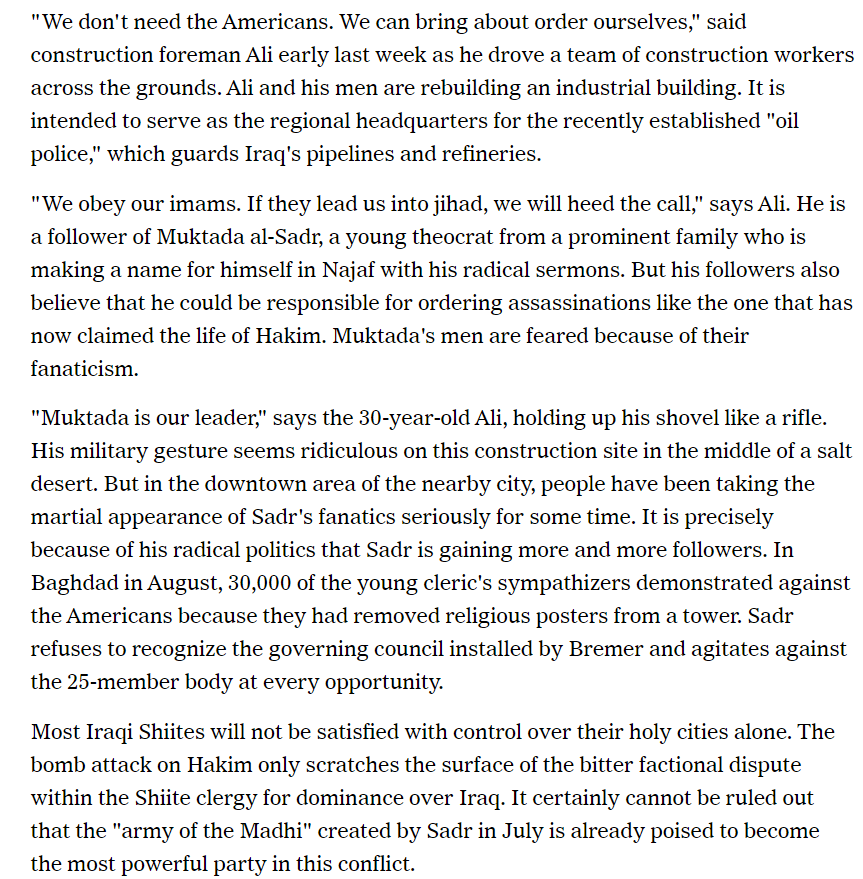
Here we are given more context about Sadr – keeping in mind that by default these details can be considered completely fabricated, we do see what reads to me as a very sympathetic profile of one of his followers. The writing quality here is very very low, “his followers” believe? Etc. but despite the mocking tone I felt like the article comes off as a little desperate and this is interesting insofar as the article could have been written/translated otherwise.
In the last paragraph here, and maybe this is the reason for the deliberately sloppy and confusing writing, out of nowhere comes the reassertion that this is a “bitter factional dispute”. In fact this is probably the reason for the slop, you need to introduce a lot of weird sentiment in the reader in order to just out of nowhere make this kind of accusation as if it is an established fact.
I can safely say that any mention of schism or faction or internal strife that we have examined is obviously and totally fabricated. The coalition executed this attack in order to fabricate this narrative. That’s the only logical conclusion to come to after reading the Western sources.
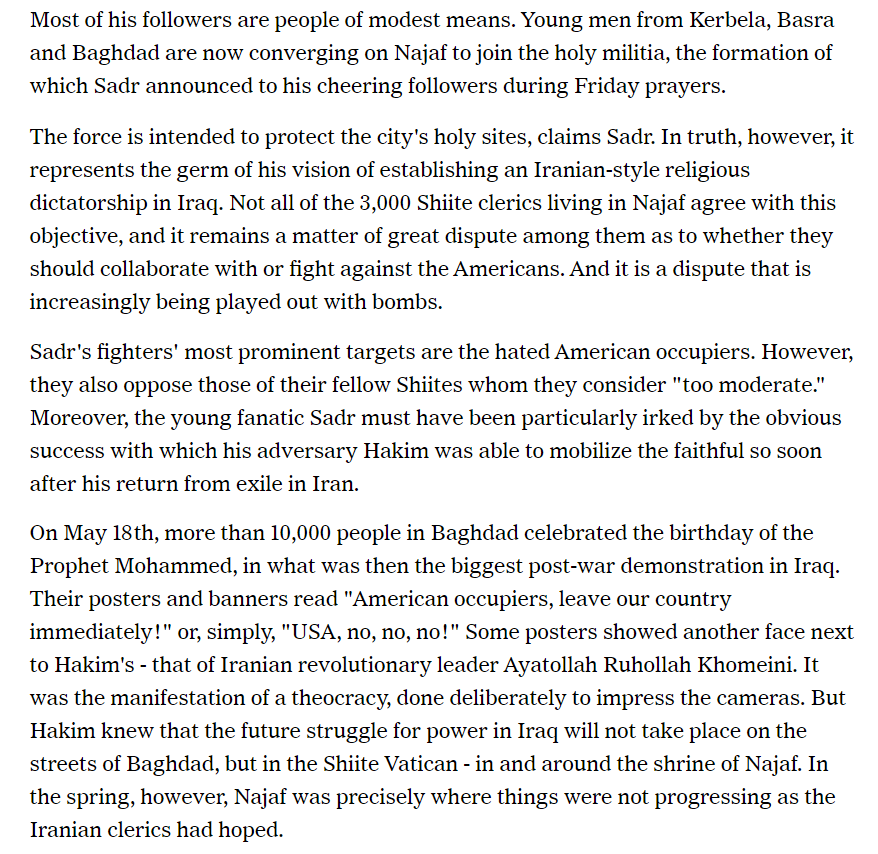
More profile of Sadr and his followers that reads very sympathetically to me. No doubt this would be understood by the publisher, so one has to ask “why”. The schism seeding feels absolutely forced and the brain should be rejecting the resolution of, “this person is very popular, a devout religious figure” with “this person conducted a mass casualty event at a place of religious significance”.
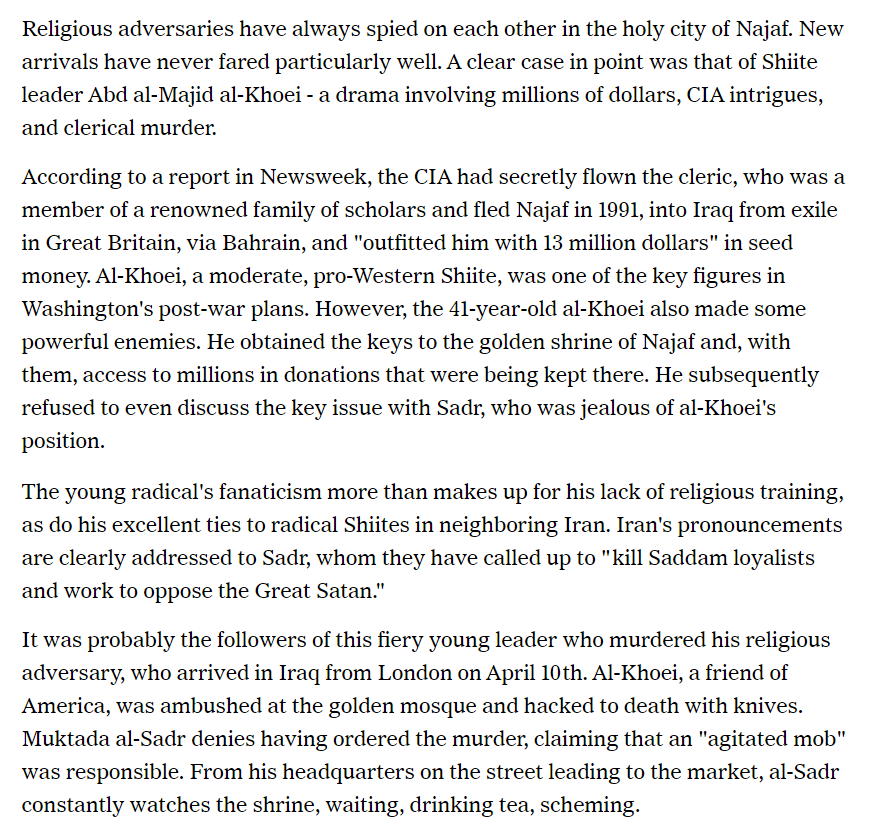
Once again they try to tie this event to Khoei, and we ourselves can remember that in this previous case as well presumably the coalition was responsible. Why attack an alleged ally? Again we will get to this point and it will come up repeatedly.

🙃
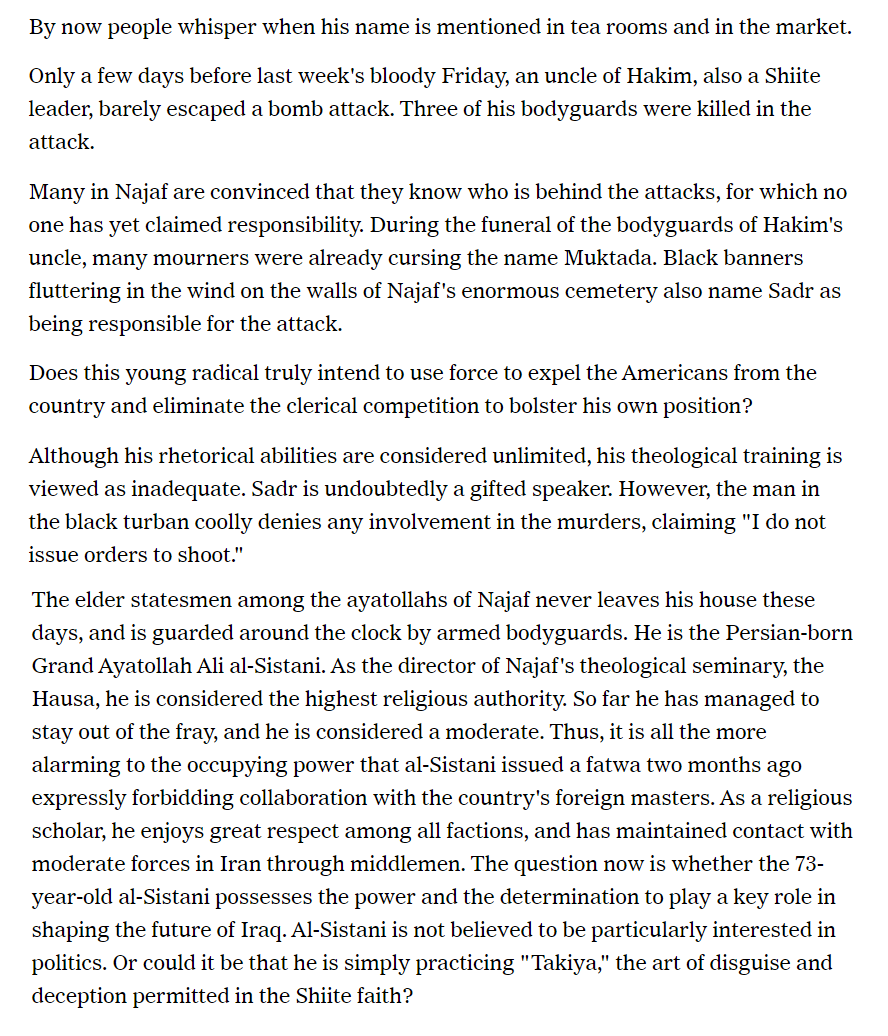
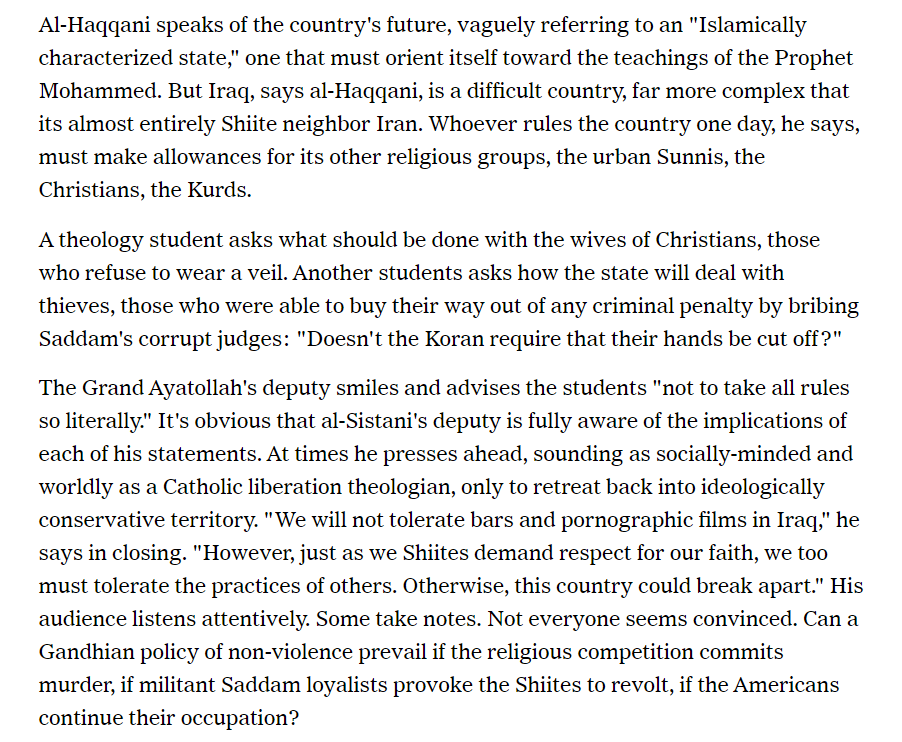
Enough is more than enough of this toxic dreck but I have to include it to give a sense of what went along with the invasion. The “takiya” passage, the outrage that any society would not tolerate bars and pornography, and on and on. Enough, but this is the West letting it all out and we can examine it at least this once, in this thread.
Let’s not get lulled to sleep however – note the accusation of FRE trying to “instigate” a Shiite revolt. This narrative exists as a stopgap until it can be transformed into AQ is trying to “instigate” a “civil war”, and we will track this transformation explicitly and in detail. By recognizing it as a fabrication that occurred and was produced by the invaders as early as as Spring/Summer/Fall of 2003 it will be forensically obvious that the coalition is the guilty party, as we observe this transformation into the “civil war” narrative. This pre-examination will allow us to very easily write off the accusations made by the West later and try to come up with our own understanding of events.
Moving on, we will now examine various contrasting views on this event.
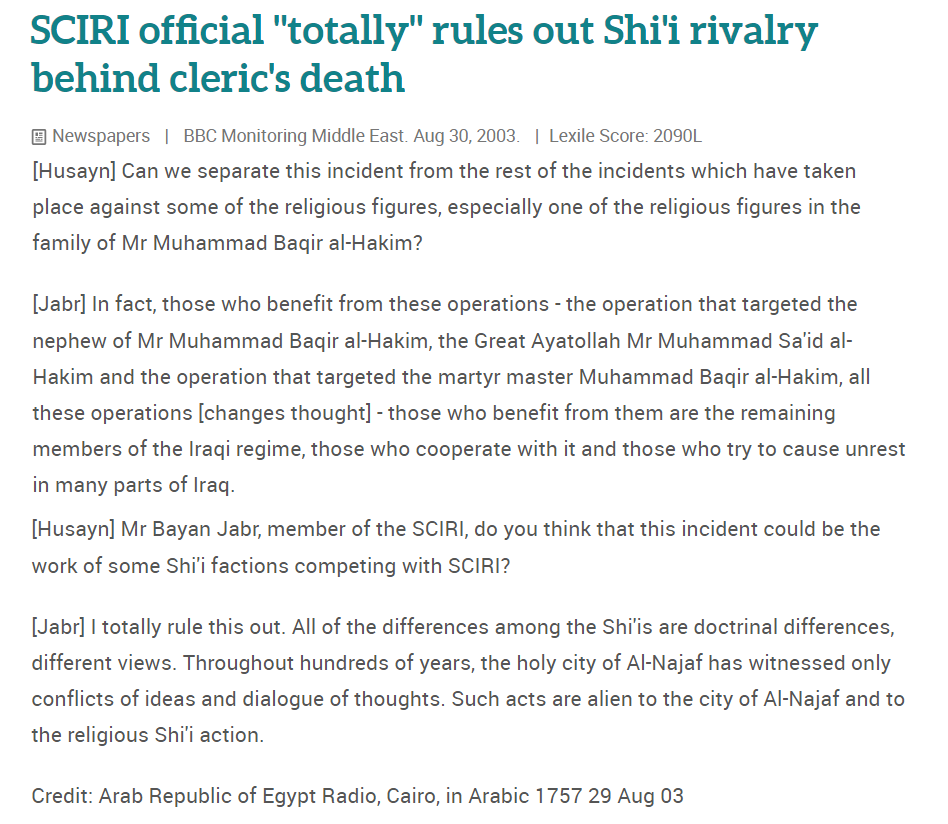
SCIRI itself unequivocally denies the “schism” narrative. Interestingly it does accuse FRE, and yet if you examine the final paragraph – that for “hundreds of years” there is no precedent of this violence in Najaf – this I think undermines this accusation.
So this sort of attack is brand new, is it not obvious then that it was perpetrated by the “brand new” element in this equation, the occupiers?
A possible explanation here is that SCIRI, Hakim, certainly oppose the occupation but may be placed in a situation where it is difficult for them to accuse the occupiers of this kind of attack openly. But unequivocally they deny a “schism”, “factionalism”.
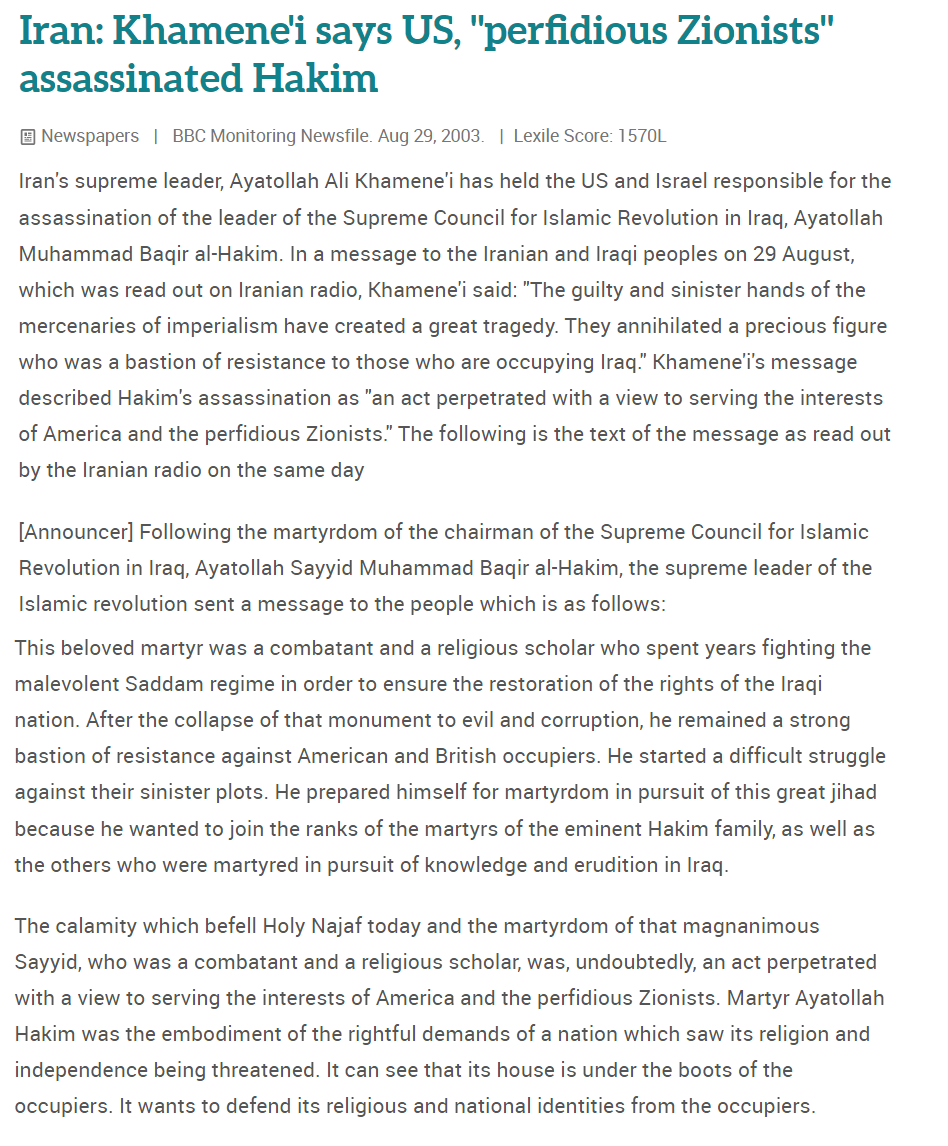
Here though we finally have the correct and coherent attribution made outright – and it is beyond obvious, but I present this to illustrate how stark the contrast is between coherency and incoherency.
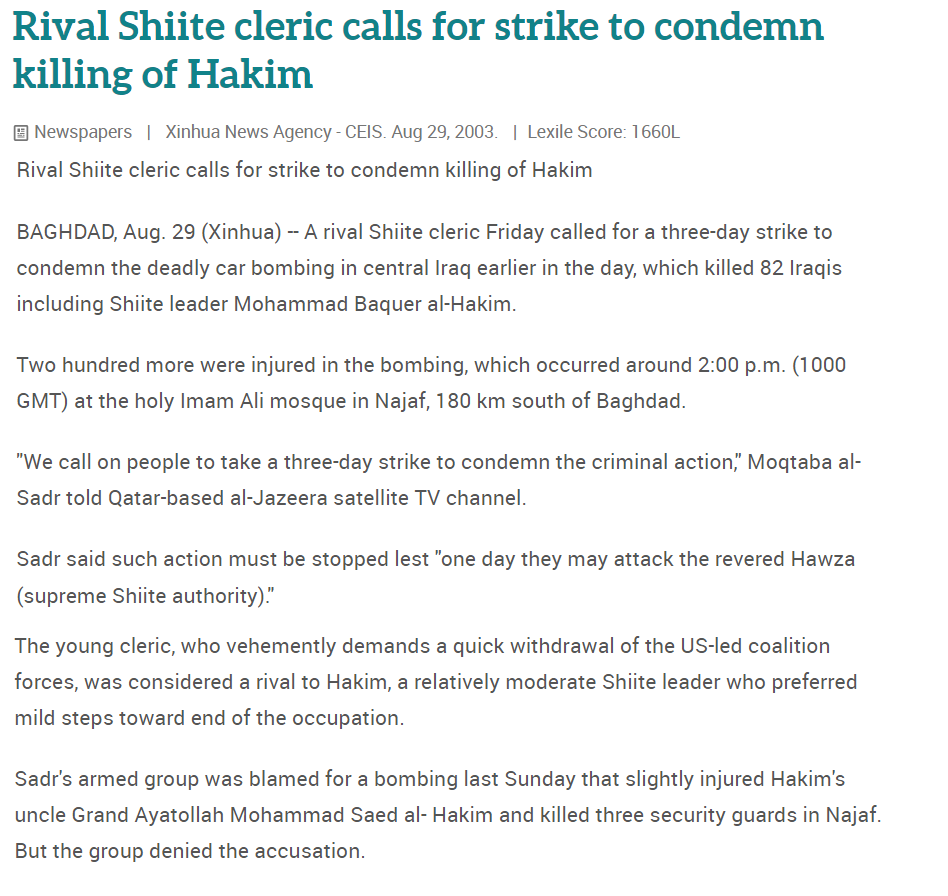
The accused Sadr himself organized a strike to condemn the action,
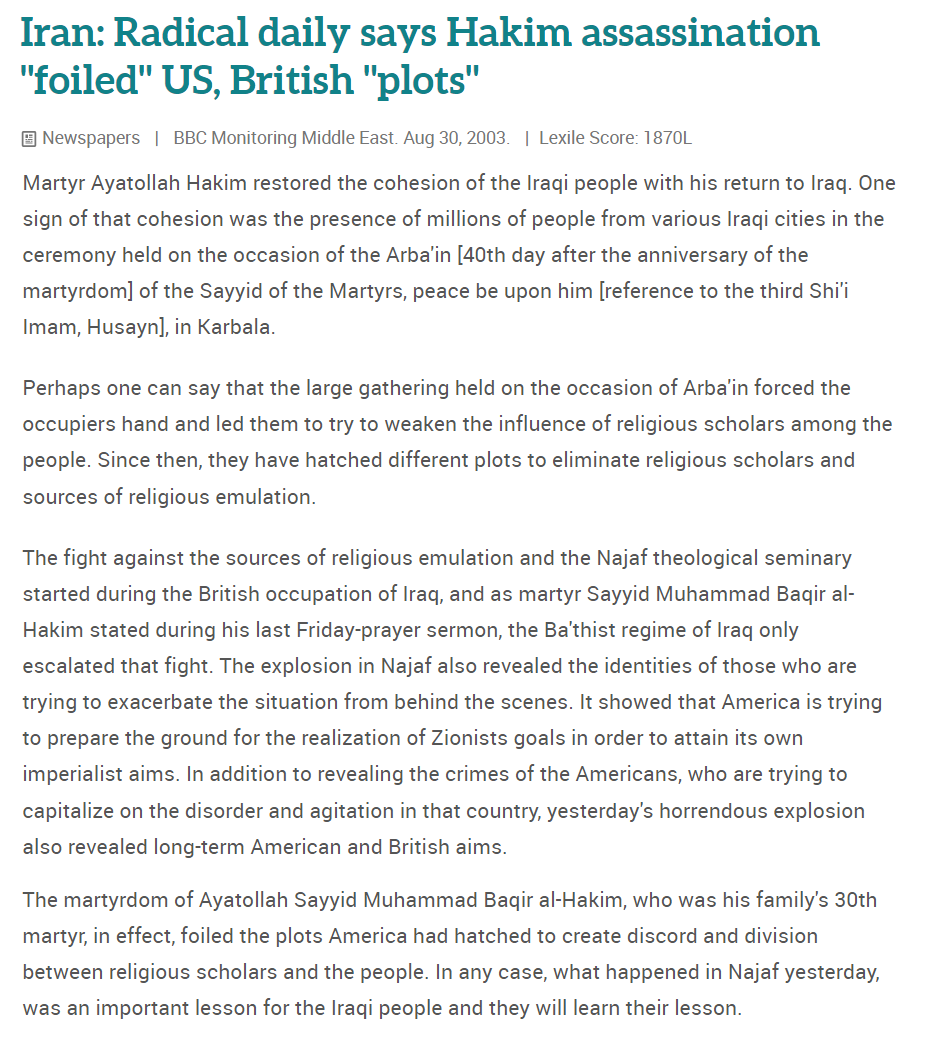
And this is perhaps the most clear and detailed statement and accusation of the invaders. I have nothing to add to it. If you deny this and affirm the invaders, either out loud or in your heart, you are a fraud or worse.
We will see how the false narrative around this single attack will be transformed to cover a much wider attack on Iraqi society.
The final point of interest I will add is that by 2007, AQ took responsibility and the Iraqi government was content in blaming them for this attack. As if none of the previous discourse, the alleged arrest of FRE, the accusations against Sadr, had even happened.
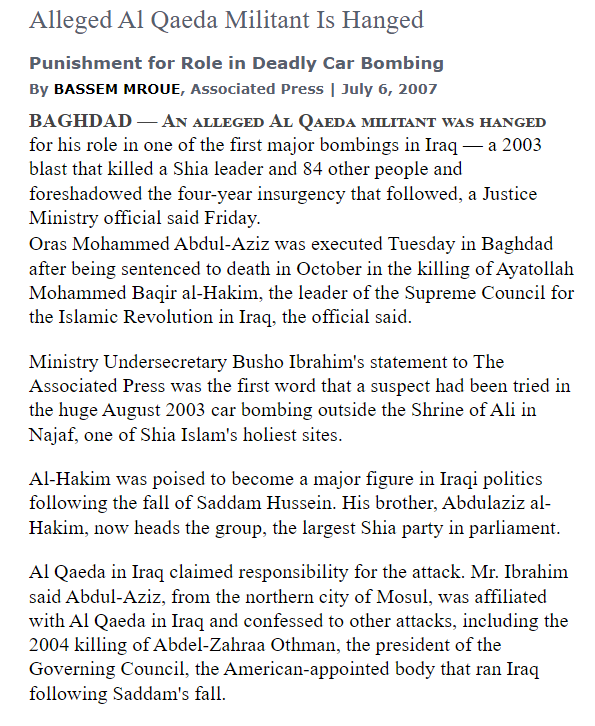
By then there was a pivot to framing AQ as “deliberately provoking sectarian conflict”.
NOTE AS WELL: AQ is also taking responsibility for the assassination of the president of the governing council appointed by America – I told you, there will be a consistent theme of attacks against people who at the very least on paper “collaborators” of the invasion. But we have already illustrated that anything conducted by AQ is actually conducted by the coalition – why would they attack their own propped-up governmental bodies? This produces a fork for us, where either we assume the attacks are conducted by genuine resistance and falsely attributed or conducted by genuine coalition and “correctly” attributed. I lean towards the latter, and will explain why when we get there.
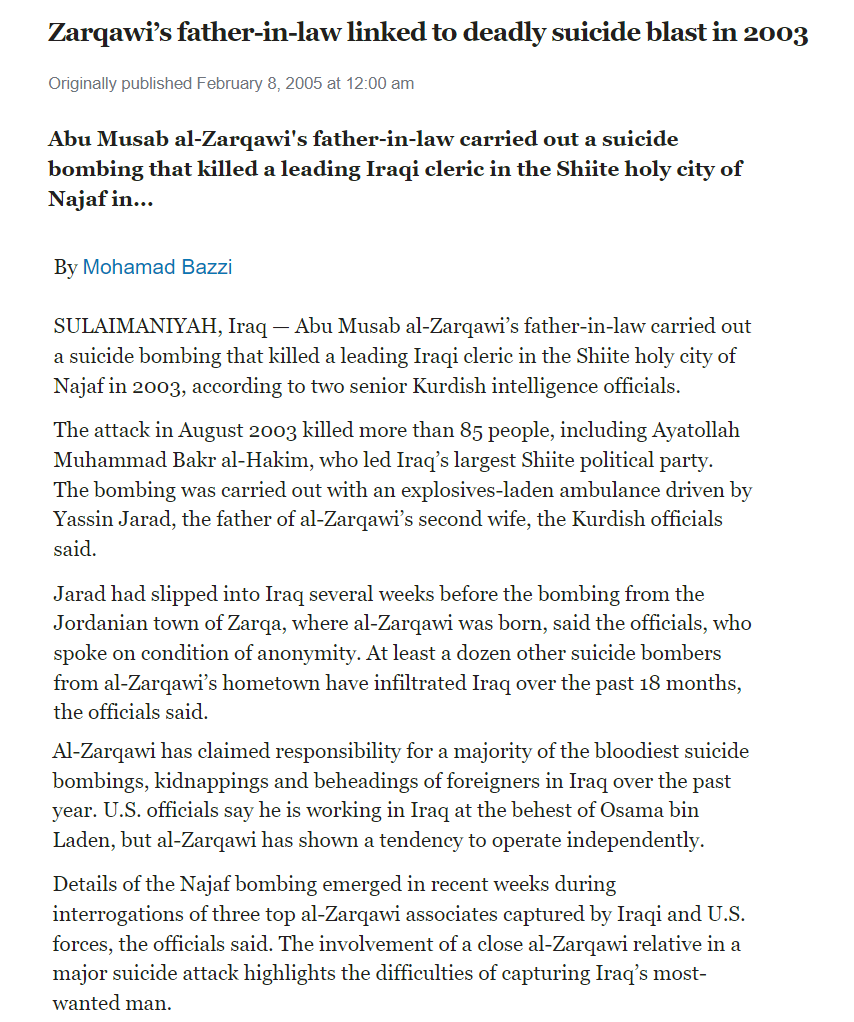
Even more shockingly, the narrative given for this bombing – which having just covered the initial press in detail, we should all be able to immediately react to this new characterization – is that it was a suicide attack.
What happened to the SUV, where the driver left? What happened to the FRE running away from the scene? Where is the apology to Sadr? Forgotten. Now this was an attack conducted by an ambulance. Reinvention, unreinvention.
As for the theme of “attacking allies”, I will start by saying it is unknown whether or not Khoei himself was ever genuinely working with the coalition and it is deniable outright in the case of Hakim. Hakim may have been more willing to conduct dialogue with the invaders, but he was never an “ally”. That being said we will see examples where the recipients of the coalition attack are much more explictly collaborating with the coalition and this first example provides context before we see this behavior expand.
Ostensible allies will continue to be attacked, their families attacked, throughout the entire course of the war – by the coalition. This will occur again and again. So we can begin by analyzing this slightly more complicated instance of the double assassination from the invader perspective.
First of all, in the case of Hakim and Khoei it is obvious that there was a motive to produce a narrative that Sadr was responsible. That is *one* reason to conduct the double assassination and also to characterize the two as allies. It is easier to deflect the blame from yourself if the recipient is your ally. But I don’t think this was the main reason, least of all because it is so obvious that Iraqis do not believe the accusation against Sadr. This was not an operation to convince Iraqis of Sadr’s guilt. Therefore, I see the Western Sadr narrative as capitalizing on the actions which were taken for other primary reasons.
What reasons?
In the case of Khoei, lets assume for the sake of intellectual exercise that he was a full and committed ally of the occupation, not acting under duress – and we do so with no disrespect to this individual.
I think anyone can understand that the societal stability and lack of bloodshed of collaboration could easily have been thought to be worth the price. If you cannot understand this, I think you should reflect on the sanctity of human life and the position of anyone trying to save it, protect it. We are simply exploring the concept and not actually accusing. Why prefer to kill him? Simply put, the invaders have an interest in destroying any measure of stability in Iraqi society. The following years represent not so much an occupation but an outright war against every facet of the fabric of Iraqi society.
Khoei was a very influential figure, son of a very influential figure, and as such a person of significance to Iraqi society. Even someone who may have been hated – think of a corrupt but well known politician, a greedy businessman – may represent some measure of stability. Their outright chaotic elimination would lead to instability, lack of social cohesion, if there was not an appropriate level of mass organization to replace the social stability these hypothetical hated figures offered.
I cannot speak to the degree to which Iraqi society loved Khoei. But no doubt he was of significance, a stabilizer, and this is why his elimination is preferable no matter what degree of cooperation to the invaders.
The greater degree of love held by Iraqi society for him, the greater the motivation. Remember this sentence: the coalition was not looking for allies. Its goal was to destroy Iraq, and not just with one strike but by engaging in years which have become decades of continuous attack against social cohesion. Therefore, the attack even of true allies and collaborators – people who would genuinely betray their society for the sake of material gain – would be desirable to the invaders. Their lives, the lives of such ‘true collaborators’, would be meaningless to the invaders provided they could find a convenient enough replacement. We will see this take place in reality throughout the war, again and again.
And typical of human societies, it is not individuals alone who are influential but entire families. In the case of Hakim, his brother was on the interim governing council. What do you think would be the response of someone in such a position, after witnessing their family member eliminated?
Moving on, we will examine a few more events of 2003 and then continue to slightly denser coverage of events as we progress through 2004.